Monthly Standards Update
2026 ELA Standard Course of Study Installation Under Way
On January 8, 2026, the NC State Board of Education (SBE) adopted Draft 4 as the 2026 ELA Standard Course of Study for implementation in the 2027-2028 school year. The current 2017 ELA Standard Course of Study will remain in place for classroom instruction through the 2026-2027 school year. The newly approved K-12 ELA SCOS aims to serve as the framework that guides each Public School Unit (PSU) in the development of the curriculum and instruction for English Language Arts.
In an effort to keep stakeholders informed, the NCDPI ELA Team will provide monthly standards updates that contain the latest announcements and current news regarding the adopted 2026 ELA SCOS. These updates are sent the first Friday of every month.
To receive these updates straight to your inbox, please subscribe to our listserv. To view past listserv messages, visit the NCDPI ELA Webpage.
Mark Your Calendars for Remaining 26-27 SY Webinar Series Sessions
CD.F Webinar is Next Week!
To maximize attendance to the remaining webinars in the series, educators are encouraged to join each broadcast using the meetings links on the series promo, whether or not they’ve previously registered. Topics, dates, and times for the remaining sessions are listed below:
-
Foundational Skills Substrand | November 12, 2026 | 3:30 - 5:00 PM
-
Comprehension Development Strand | January 20, 2027 | 3:30 - 5:00 PM
-
Communication & Writing Strand | April 22, 2027 | 3:30 - 5:00 PM
Please note: Recordings of each webinar will be shared via the ELA Team listserv and linked on the promo following each session.
Complex Texts Strand Recording Available
The NCDPI ELA Teams extends its thanks to educators who participated in the September 24 Complex Texts (CT) Strand webinar broadcast! The recording and slides for this broadcast are now available in the ELA VIK and on the webinar series promo.
Please note: This webinar included both K-12 and grade-band-specific explorations of the CT Strand. Grade-band-specific content is viewable at the following timestamps:
- Grades K-2 at 40:00
- Grades 3-5 at 1:29:08
- Grades 6-8 at 2:24:37
- Grades 9-12 at 2:52:41
Asynchronous Option for Earning a Certificate of Completion Available
Educators who were not able to participate in the Complex Texts Strand webinar can complete the activities in the asynchronous option Google form and submit it to earn a Certificate of Completion for 1.5 contact hours.
Please note the following:
-
The asynchronous option will be available through the end of the 2026-2027 school year, but it's best to submit as soon as possible to keep current with the information being shared about our state standards in local professional learning, regional workshops, and/or conference sessions.
-
All questions on this Google form must be answered to earn a Certificate of Completion. The asynchronous option has been designed to take approximately one and a half hours or 90 minutes to finish in a single sitting, and there will be no partial contact hours or certificates issued.
-
Submissions of the Asynchronous Option for "A Close Look at the Complex Text Strand" will be reviewed periodically (ex. monthly), and it may take some time after that review for the request for certificates to be processed and then sent out. Feel free to keep a copy of your submission for your records until you receive your certificate, which will come as an attachment via email.
Contact Dr. Stacy Daniel, Section Chief for ELA & Languages, at stacy.daniel@dpi.nc.gov with questions.
2026 ELA SCOS Installation Resource Spotlight
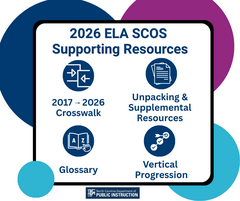
2026 English Language Arts Standard Course of Study Glossary
The North Carolina 2026 ELA Standard Course of Study Glossary provides definitions of key terms used throughout the standards and objectives. While these terms also appear within the grade-level unpacking documents, this resource is also offered as a standalone reference to support quick access across grade-levels. The glossary supports a shared understanding of the ELA standards by helping educators interpret their intent, clarify key terminology, and implement expectations consistently across grade levels and instructional contexts. Because student learning develops across grades, some terms may reflect developmental nuances, and their application may vary slightly by grade-level.
Note: The glossary document includes an interactive/hyperlinked format and a printer-friendly format.
|
|