In Other News
The Carolina Journal - David N. Bass | October 16, 2026
North Carolina teachers licensed for kindergarten through sixth grade could soon be assigned to seventh- and eighth-grade classrooms under a draft rule the Professional Educator Preparation and Standards Commission (PEPSC) reviewed Oct. 15. The rule carries out a directive in the state budget enacted in July.
The change widens the pool of teachers districts can place in middle school classrooms. The license itself does not change, so a teacher prepared to teach elementary school would keep a K-6 credential while teaching eighth-grade math or science.
Lawmakers did not say why they ordered the change, and the Department of Public Instruction (DPI) told the News & Observer in July that it was still reviewing the impact.
The budget provision says the State Board of Education “shall adopt rules expanding elementary licenses to include teachers of grades seven and eight.” DPI’s draft treats the change as a staffing matter rather than a new license.
The General Assembly created the EPP accountability system in 2017. It has never been used to sanction a program, and the state board is preparing to ask lawmakers to replace it.
PEPSC is scheduled to vote on the rule package Nov. 12. The state board would take it up in December, with a public comment period beginning in February and a final vote in May. The rules would take effect July 1, 2027.
EdNC - Molly Steur | October 15, 2026
The newly announced North Carolina Teacher Apprenticeship and Workforce Advancement Initiative will allow teacher assistants, substitutes, and other school employees in N.C. school districts to “become licensed teachers while keeping their jobs and paychecks” through a five-year, $5.5 million federal grant, according to a recent press release. The initiative is designed to meet teacher shortages across the state.
The grant was awarded to Western Governors University (WGU) — an accredited, nonprofit online university — and its apprenticeship organization Craft Education, in partnership with The Innovation Project (TIP). Nearly half of the project is funded through the federal grant, the release says, while the other half “will be provided through nonfederal sources, including WGU, The Innovation Project and participating school districts.”
Across the 16 districts, TIP will lead its operation, running the program as a U.S. Department of Labor registered apprenticeship sponsor through ApprenticeshipNC. The new initiative is an extension of the work TIP has already started in developing teacher apprenticeships. Over the summer, TIP launched its first cohort of eight districts partnering with ApprenticeshipNC to bring K-12 teacher apprenticeships to their communities.
The Carolina Journal - David N. Bass | October 14, 2026
North Carolina taxpayers could give about $810 million a year to scholarship groups under the new federal Education Freedom Tax Credit if one in 10 eligible donors takes part, according to updated estimates from the American Federation for Children (AFC) Growth Fund.
The credit was created in the 2025 federal tax law. A taxpayer who donates to a scholarship granting organization (SGO) can subtract up to $1,700 from federal income tax owed. The credit is nonrefundable, meaning only taxpayers who owe federal tax can claim it. Taxpayers can begin making donations Jan. 1, 2027.
Under state law, the State Education Assistance Authority must adopt rules for the program within 120 days of the publication of the federal regulations. That deadline falls at the end of January. The authority updated its SGO page Oct. 7 to say it “will begin developing its guidance on the program in the upcoming weeks.” It has not posted an application process for scholarship groups. States must submit their SGO lists to the IRS by Feb. 15, 2027.
Educational Programs and Opportunities
NCSEAA Blog
With the FAFSA easier than ever and NC experiencing record FAFSA completion growth, it’s never been a better time to apply to college.
College Application Week (CAW) starts October 19th, offering students interested in college an opportunity to apply to select colleges and universities without costly application fees. CAW is being held this year only weeks after the early opening of the Free Application for Federal Student Aid (FAFSA), which most students can now complete in less than 15 minutes — granting access to financial aid that can make paying for college more manageable.
During College Application Week last year, more than 25,000 applicants submitted over 66,000 college applications through CFNC. Almost 51,000 additional applications were submitted via Common App.
A full list of colleges waiving application fees for most students can be found at www.CFNC.org/apply. In addition, this year, CFNC also has a list of colleges waiving application fees for adult learners at www.CFNC.org/adults.
EdNC - Molly Steur | September 23, 2026
The FAFSA form provides real-time results, allowing students to view their federal Pell Grant and other federal financial aid eligibility immediately after completing the form. The form also includes earning indicators for colleges students are applying to.
- How to apply
- Eligibility, citizenship, and parents’ information
- Why does the FAFSA matter?
- FAFSA completion rates
- Resources for the FAFSA application
Applications are now open for the 2026-27 Purple Star Award, which recognizes North Carolina schools that demonstrate military-friendly practices and a strong commitment to military-connected students and families.
Application
- November 17 at 4 p.m.
- December 10 at 9 a.m.
- January 7 at noon
- January 26 at 4 p.m.
For questions on the application, please email Howard Lattimore.
Applications close February 1, 2027
|
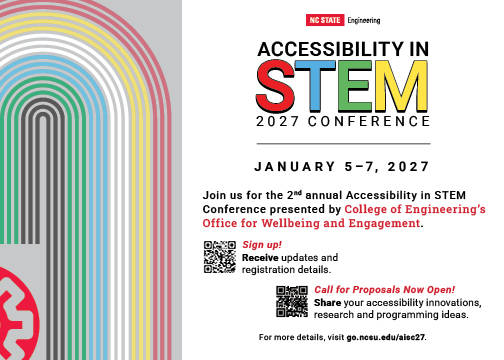
Accessibility in STEM 2027 Conference
Free! Come Anytime! Network! Free CEU's!
Presenters Needed!
- Registration is $25 and is refundable upon attendance. Educators, families, students, and anyone interested are welcome to participate!
- Complimentary meals will be provided.
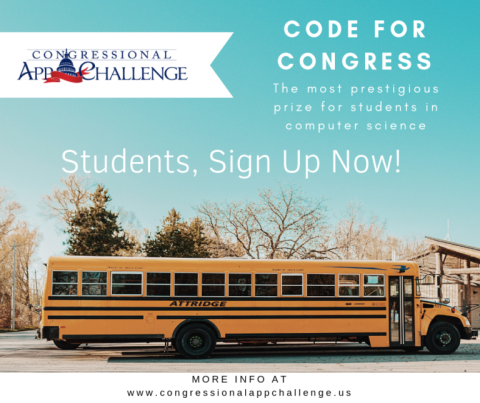
The 2026 Congressional App Challenge, the most prestigious competition in computer science.
Established by the U.S. House of Representatives in 2013, the Congressional App Challenge encourages middle and high school students from across the country to develop an innovative app for a mobile device or computer. The competition is designed to expose students to the world of app development without requiring prior coding experience.
PRIZES AND REGISTRATION
The winners of the competition will have their app featured on the U.S. House of Representatives’ website and displayed in the U.S. Capitol. Winners are also invited to the #HouseofCode Capitol Hill Reception.
GENERAL RULES
- Students must either be in middle or high school
- Students can participate as individuals or in up to teams of four
- For teams, 50% of the students must either live or go to school in the district
- For solo students, the student must either live or go to school in the district
- Students have until October 26, 2026 to submit their apps.
- Apps can be coded on any platform, using any programming language, on any topic
IMPORTANT DATES
-
October 26 – Deadline for students to register and submit their app online
-
December 31 - Winner announced by at the latest
NC College Connect delivers direct admission offers to more than 105,000 seniors; 64 percent admitted to dozens of two- and four-year colleges without an application
Your moment is coming! Get ready! - With NC College Connect, you will be directly admitted to participating colleges and universities where you already meet admissions requirements. No essays, test scores, or recommendation letters needed. Yes, it’s that simple.
NC College Connect is a program that directly admits North Carolina public high school seniors who are on track to graduate, have a 2.8 GPA or higher, are enrolled in a fourth-level math and meet program requirements to participating UNC System universities, North Carolina Independent Colleges and Universities, and their local North Carolina community college. The higher your GPA, the more schools to which you’ll be directly admitted!
Don’t have a 2.8 GPA? If you are on track to graduate, you’ll be directly admitted to your local community college.
Participating institutions include 11 UNC System universities, all 58 North Carolina community colleges and 29 North Carolina Independent Colleges and Universities.
Next steps for families
-
Check the offer online. Seniors can log in to their College Foundation of North Carolina (CFNC) student account at NCCollegeConnect.org to see where they have been admitted.
-
Watch the mail. An official NC College Connect letter will arrive in the coming weeks with the same information.
-
Talk with a school counselor or advisor. Counselors and advisors can help students research opportunities, compare offers, understand next steps and plan for financial aid.
-
Accept an offer or apply early. Students review their offers and submit a short form indicating their interest. Those who accept an offer during College Application Week, Oct. 19-25, avoid most application fees, and fee waivers are available for most other applications.
-
Complete the FAFSA. Filing the Free Application for Federal Student Aid (FAFSA) is the first step toward financial aid at any college.
-
Decide where to enroll and complete enrollment. Weigh academic programs, campus location and environment, family and individual needs, and financial aid packages.
|
 |
|
The Department of Education administers grant funding programs to fulfill the Department's mission to promote student achievement and preparation for global competitiveness, to foster educational excellence, and to ensure equal access. Search for open and upcoming grant opportunities available from ED in the list at this link. The definitive list of U.S. federal government grants is located at Grants.gov.
|
Partner with the Governor's Council on Workforce & Apprenticeships
Businesses across North Carolina are coming together to strengthen the state’s talent pipeline—and Your Company is invited to join in! By partnering with the Governor’s Council on Workforce and Apprenticeships (and through it, the NCWorks system), employers gain access to talent connections, workforce training resources, and support designed to help companies recruit, train, and retain the skilled employees they need to grow.
The Council’s Goal: Engage 50,000 employers across the state.
Visit commerce.nc.gov/employers to learn more and complete the interest form.
Add your voice. Share your workforce needs. Help shape the future of North Carolina’s workforce...and ensure your business stays competitive.
Click here to subscribe to the weekly legislative update or other NC Department of Public Instruction topics.
To view previous K-12 Education Legislative Updates, click here.
NCDPI Office of Government Affairs
Anne Murtha – Legislative Specialist
|