|
Friday, August 21, 2026
Highlights
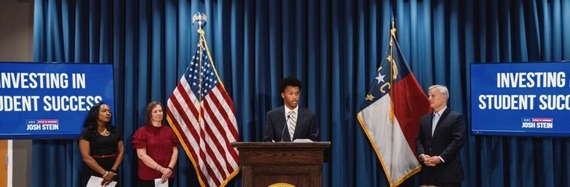
Image: Jeremiah Tucker, student body president at Broughton High School, speaks in favor of the teacher pay raises included in the recent state budget. (Office of NC Governor)
Office of North Carolina Governor Josh Stein | August 20, 2026
As students and teachers prepare to return to classrooms across North Carolina, Governor Josh Stein held his latest NC Strong Update to highlight how the state is investing in student learning and teacher recruitment and retention. Governor Stein welcomed a student, teacher, and principal to underscore the importance of these investments to keep North Carolina’s public schools strong.
“Teachers are the single most important in-school factor in a student’s success, and they deserve to be valued accordingly,” said Governor Josh Stein. “For too long, North Carolina has struggled to be competitive in teacher pay and support, but this budget puts us back on track. While we still have more work to do, these raises begin to show teachers just how much we value them.”
“Teachers’ pay doesn’t reflect their sacrifices, the long hours they spend designing lesson plans for their kids, or the money they put toward school supplies from their own pockets,” said Jeremiah Tucker, student body president at Broughton High School. “That’s where the new budget bill comes in. It raises the bar and represents a very good first step into paying teachers what they’re worth. There’s still work to be done, but this budget puts North Carolina on track to do that work.”
“As a teacher who implements the science of reading in my classroom daily, I have seen the direct impact it has on students,” said Gina Holste, a literacy specialist and the 2026 Northwest Regional Teacher of the Year. “I have watched students close gaps and no longer need intervention services as well as teachers grow in the knowledge of the content they are asked to teach. The students in North Carolina deserve the best we have to offer and that begins with evidence-based practices.”
“North Carolina made a bold investment in the belief that leadership matters” said Principal LaTresha Wilson, the 2026 Southwest Region Principal of the Year. “Through the Principal Recruitment Supplement Program, the state provides up to $30,000 annually for three years to recruit and retain highly effective principals in some of its lowest-performing schools. When we place strong leaders in high-need schools, we create the conditions for students, teachers, and entire communities to thrive.”
Read the entire press release here.
VIDEO: NC Strong Update: Governor Stein Highlights Investments in Student and Teacher Success
Updated Employee Salary Schedules and Bonuses FAQ - All PSUs
NC Department of Public Instruction
The Department of Public Instruction's School Business Services (SBS) has updated the Employee Bonus FAQ on the What's New page to address additional questions received from the field.
Please review the updated guidance and direct any additional questions to Salary@dpi.nc.gov. SBS will continue to update the guidance as additional questions are received and new information becomes available.
-
State Salary Schedules (Updated August 5, 2026)
-
Employee Bonus FAQ (Updated August 18, 2026)
The Carolina Journal - Theresa Opeka | August 18, 2026
At a Monday press event at the Governor’s Mansion, Democratic Gov. Josh Stein vetoed “Election Law Changes” (House Bill 958) arguing that the election law changes would make voting more difficult and further politicize election administration. Republican supporters countered that the measure would strengthen oversight, improve accountability and bolster public confidence in the state’s elections.
One of the most significant changes in HB 958 is a provision reducing early voting from 17 days to 10 days for primaries, second primaries, and runoff elections. North Carolina currently has the longest early voting period in the nation. The bill would also direct the state auditor to conduct post-election performance audits of election systems and procedures in randomly selected counties, with every county board reviewed at least once every six years.
Video: Governor Stein's action on HB 958
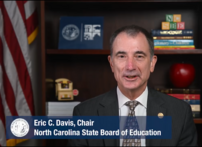
A new school year brings new opportunities to learn, grow and discover what’s possible. State Board of Education Chair Eric Davis encourages students to stay curious and make the most of every opportunity throughout the 2026-27 school year. Chair Davis thanks North Carolina’s educators for their dedication, compassion and expertise they bring to schools each day. Their work inspires students and helps them reach their potential.
Welcome back! We hope you have a great year!
|
SBE Task Force on Accountability of Public School Units
September State Board of Education Meeting
- Wednesday, September 2, 2026 at 10 a.m.
- Thursday, September 3, 2026 at 9 a.m.
Access all YouTube recordings of SBE meetings here.
|
Celebrate the Good in Public Education

Asheville City Schools Educator Named 2026 North Carolina History Teacher of the Year
Asheville High's (Asheville City Schools) history teacher, Tracey Barrett, is considered one of the best history teachers in the U.S. according to The Gilder Lehrman Institute of American History, which selected her as the 2026 North Carolina History Teacher of the Year! Barrett teaches U.S. History, Civics and AP African American Studies at the same high school where she attended and graduated!
The award, presented annually since 2004, highlights the importance of history education by honoring exceptional K-12 American history teachers.
Learn more about the program here. Congratulations Ms. Barrett!
|
Legislative Lookback: Week of August 17, 2026
The following education-related bills had action this week:
A Look Ahead: Adjournment until Monday, August 31
Pursuant to SJR 1091, the House and Senate may reconvene on the following dates:
- August 31-September 2
- September 28-30
- October 26-28
- November 16-19
- November 30-December 18
Items eligible for consideration include: veto override votes, appointment and confirmation matters, election law issues, litigation-related actions, impeachment proceedings, constitutional amendments, simple resolutions, conference reports, and resolutions to further adjourn the legislative session.
The NCGA legislative calendar is updated frequently, so be sure to check the NCGA Homepage for the most up-to-date information on committee meetings, voting sessions, press conferences, and more. Current Legislative Calendar
K-12 Education Bills
Education Bills to Watch
-
HB 171 Equality in State Agencies/Prohibition on DEI.
-
HB 301 Social Media & AI Safety.
-
HB 832 Education Omnibus.
-
SB 69 Various Local Provisions V.
-
SB 177 Continuing Budget Adjustments.
Reminder: Bills ≠ Laws
Only a few dozen bills typically make it “across the finish line” and become law each legislative session.
|
|
|
Other Legislative Resources
2026 NCGA Candidate Information
State Budget Information & Resources
2026 State Budget Information
2025 Enacted "Mini Budgets"
Other State Budget Resources
K-12 Education Legislation Resources
|
Useful Acronyms
DPI = Department of Public Instruction
GS = General Statute
HB/SB = House Bill/Senate Bill
JR = Joint Resolution
LB/LOB = Legislative Building/Legislative Office Building
LEA = Local Education Agency
NCGA = North Carolina General Assembly
PCS = Proposed Committee Substitute
PSU = Public School Unit
SBE = North Carolina State Board of Education
SL = Session Law
For the glossary of education acronyms/terms, click here.
For the glossary of legislative terms, click here.
|
|
In Other News
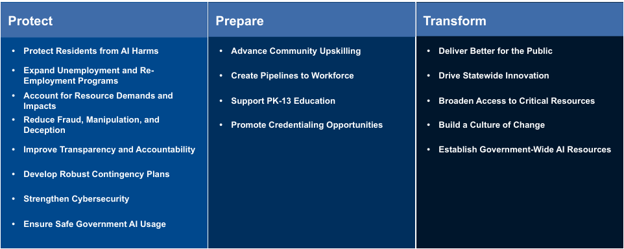
North Carolina's AI Leadership Council, created by Governor Stein's Executive Order 24, has released a Statewide AI Strategic Roadmap with 17 goals across three areas: Protect, Prepare, and Transform.
-
Protect focuses on safeguarding North Carolina residents through responsible AI use and strong risk mitigation practices.
-
Prepare strengthens AI literacy and readiness for students, workers, and communities.
-
Transform outlines how state government can modernize and leverage AI to improve services for the public.
For PK-13 leaders, the key recommendation is to partner with NCDPI to adopt an AI policy, AI guidelines, and an AI-focused professional learning plan by March 2027 aligned with NCSBA Policy 3220 and NCDPI’s GenAI Guidelines.
U.S. Department of Education Press Release | August 20, 2026
The U.S. Department of Education released new guidance to help states, school districts, educators, families, and education technology providers make informed decisions about the responsible use of technology in classrooms.
As technology increasingly plays a key role in education, states and local communities should continue to lead decisions about how such tools are used. A “Dear Colleague Letter (DCL),” encourages a focus on instructional value over recreational engagement when selecting and using technological tools in the classroom. It also urges states to pair innovation with evidence, educator judgement, transparency for parents, and a relentless focus on student outcomes.
This letter follows a July 2025 letter to states from U.S. Secretary of Education Linda McMahon that outlined five principles for the responsible use of AI: education technologies should be educator-led, ethical, accessible, transparent, and protective of student data.
Read the full letter on the use of education technology here.
Access NCDPI's "Guidance for Purposeful Screen Use in Schools" here.
Educational Programs and Opportunities
LAST CALL: 2026-27 School Resource Officer Grants - Deadline Monday!
The Center for Safer Schools (CFSS) is pleased to announce that the 2026-2027 School Resource Officer Grant application period is open. The purpose of this program is to improve safety in public school units by providing grants for services for the hiring and/or training of school resource officers (SRO) in elementary and middle schools.
Funding applications must be submitted by closing time: Noon on Monday, August 24. No exceptions.
Know a Champion? Submit a nomination by Monday, August 31, 2026.
myFutureNC is now accepting nominations for the 2027 Champions for Attainment! Champions for Attainment recognizes exemplary work happening at the local, regional, or state levels to increase educational attainment across North Carolina. Honorees demonstrate meaningful progress through one or more of myFutureNC’s Evidence-Based Attainment Practices and offer examples that can inspire and inform work in communities across the state.
We’re looking for organizations, partnerships, initiatives, and individuals whose work is making a measurable difference in helping more North Carolinians access and complete education and training beyond high school.
A note about future-focused work: K–12 initiatives may also be nominated when the work is directly connected to an Evidence-Based Attainment Practice and demonstrates a clear connection to future postsecondary access and attainment.
2027 Champions for Attainment will be officially announced on February 23, 2027, during the State of Educational Attainment in North Carolina.
|
Your Direct Admission Opportunity is Here!
In Fall 2026, every public high school senior on track to graduate with a diploma will be directly admitted to college in North Carolina!
NC College Connect is North Carolina’s direct admission program. This year, all North Carolina public high school seniors in membership and on track to graduate with a diploma are eligible for direct admission at participating colleges and universities through NC College Connect. Public high school students, including charter school students, with a weighted GPA of 2.8 and above who meet NC College Connect requirements are offered direct admission based on their academic profile to select colleges and universities.
And it doesn’t end there-- through NC College Connect, all students will also be offered direct admission to their local community college. In September, current seniors who are on track to graduate will receive an official letter to participate in the program and will be able to see their respective list in their CFNC portal on September 15. The higher a students' GPA, the more colleges to which they'll be admitted!
|
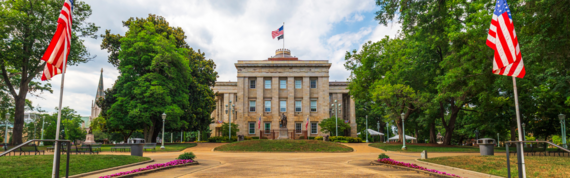 |
Image: DNCR Capital Area Visitor Services website
Capital Area Visitor Services (CAVS), part of DNCR’s Office of K-12 Education & Outreach, is central hub for coordinating group visits to Raleigh’s premier sites, including:
The CAVS team helps schools and other groups maximize their time by efficiently scheduling multi-site visits. CAVS’s oversight of site-specific protocols, capacity limits, timing logistics, and bus traffic ensures a seamless and enriching experience for every group. Make your reservation here.
Group Tour Requirements
- Tours for groups of 10 or more can be made for our venues through this platform.
- Our Chaperone Policy requires one adult per ten students.
- All reservations must be made at least two weeks in advance.
 Go Outside (GO) Grant applications are now LIVE on the North Carolina Youth Outdoor Engagement Commission website — Secure up to $5,000 in funding for your next field trip with outdoor activities and learning components!
Who Can Apply? | Applicants must qualify as either a North Carolina Public or Private K-12 school or nonprofit organization.
Applicant Requirements | Any member of a school’s faculty or administrative staff may apply for a GO Grant. Parent Teacher Associations, nonprofit organizations, and outdoor activity center staff may apply on behalf of a school or in partnership with a school, but the school’s administrative staff must sign off on the application.
Field Trip Funding | Up to $3,000 for single-day field trips or up to $5,000 for overnight field trips. An extra $1,000 is available per night’s stay up to the $5,000 cap. Field trips must include an outdoor learning component/activity and may include visits to National/State Parks, city/county parks, outdoor recreation areas, outdoor activity/education centers, and historical sites.
- You must create a free account with Grant Lifecycle Manager to apply.
- Questions or issues, please contact Anna.McKnight@nc.gov.

The Cash Club will be a statewide financial literacy initiative led by the North Carolina Department of State Treasurer; the organization named the 2026 Government Organization of the Year for Financial Literacy by the Institute for Financial Literacy. You have the opportunity to serve as one of the first schools for this initiative.
Who: Any high school or out of school organization with education curriculum
What: Weekly club to make financial literacy easily accessibly
When: Beginning in Fall semester of 2026-2027 school year
Where: Your school, home school or where your outside of school club typically meets
Why: Only 65% of adults can correctly answer basic financial literacy questions, and that number drops significantly among young people. The Cash Club exists to change that.
Mission: The club's mission is straightforward: to give students real, practical financial knowledge before they graduate. Most students encounter these topics too briefly and too late in high school, with little time to develop any real understanding. The Cash Club fills that gap. Meetings are built around the award-winning Finance Fridays newsletter, with each topic expanded into teaching slides, activities, discussions, review questions and scholarship spotlights every week. Guest speakers can be brought in throughout the year to connect these concepts to real careers and real decisions students will face after graduation.
Are you interested in launching a club at your school? Or your church group? Or out of school groups? Do you have questions? Email: FinanceFridays@nctreasurer.gov
|
Click here to subscribe to the weekly legislative update or other NC Department of Public Instruction topics.
To view previous K-12 Education Legislative Updates, click here.
NCDPI Office of Government Affairs
Anne Murtha – Legislative Specialist
|
|
|
|
|