Friday, July 17, 2026
Highlights
NCDPI recognized for high-quality educator professional learning and college and career readiness
NC DPI Press Release | July 14, 2026
The North Carolina Department of Public Instruction (NCDPI) received the Southern Regional Education Board's (SREB) 2026 State Leadership Award, presented at SREB's Making Schools Work Conference in Nashville, Tennessee.
The award recognizes NCDPI for creating professional learning experiences for educators and for implementing college and career readiness strategies. SREB's State Leadership Award honors states that have established continuous improvement structures and processes to help schools transform school and classroom practices, establish and sustain change, and increase student achievement.
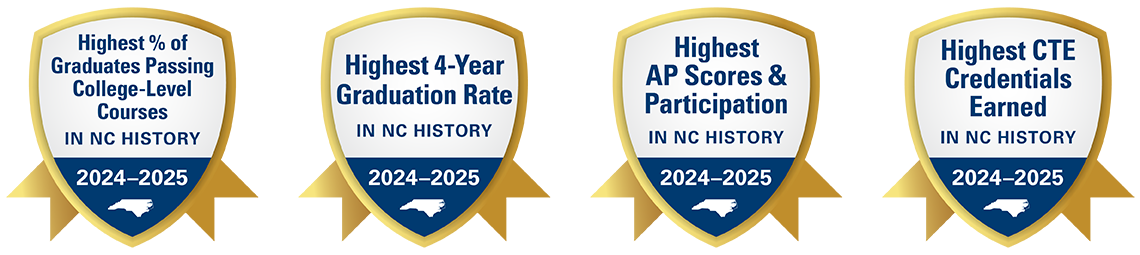
"This award belongs to North Carolina's educators," said North Carolina Superintendent of Public Instruction Maurice "Mo" Green. "It belongs to the teachers and principals who show up every day and do the patient, demanding work of preparing students for what comes next. Our students are proving what is possible. They are graduating at the highest rate in our state's history and earning college credit and industry credentials at record levels. I am grateful to SREB for this recognition, and grateful for a partnership that helps sixteen states solve together what none of us could solve alone. Our goal is to make North Carolina the best state in the nation for public education. We are not there yet, but we are on our way."
"North Carolina is creating opportunities for each student to achieve career and college readiness," said Dale Winkler, SREB senior vice president for school improvement.
SREB cited North Carolina for progress in providing educators with professional learning that is engaging, job-embedded and ongoing, noting that schools across the state have implemented the Making Schools Work key practices and built a culture of continuous improvement. Through its work with SREB, North Carolina has made long-term commitments to career and technical education teacher induction, stronger mathematics instruction and family engagement, and the state is a regional leader in aligning curricula to college and career-ready standards.
The recognition aligns with NCDPI's 2025-2030 strategic plan, Achieving Educational Excellence, and its goal of making North Carolina's public schools the best in the nation by 2030.
SREB is a nonprofit, nonpartisan interstate compact based in Atlanta, created in 1948 by Southern governors and legislators to advance education and improve the social and economic life of the region. Governor Josh Stein serves on the SREB board ex officio.
The Carolina Journal - Annie Dance | July 15, 2026
North Carolina Gov. Josh Stein is promoting a new workforce development initiative to prepare students for electrical careers, a priority that has received support from business leaders and policymakers across the political spectrum as the state faces growing demand for skilled workers.
Stein, a Democrat, visited Cleveland Community College on July 13 to highlight the Careers Electric Summer Electrical Academy, one of 12 programs launched this summer to train high school students for jobs in electrical trades, energy, and infrastructure.
The Careers Electric initiative is a partnership between state education leaders, community colleges, school systems, and private employers.
Students in the program can earn college credit, obtain industry-recognized credentials, complete a registered pre-apprenticeship, and gain hands-on experience with employers. The program is free to participating students, and graduates receive a $2,000 completion stipend.
The initiative was launched in North Carolina with a $9.25 million investment from the Siemens Foundation. Organizers say the goal is to train 25,000 North Carolinians for energy and infrastructure jobs during the program’s first decade.
The Careers Electric program includes 220 high school students across 12 community college locations statewide.
WUNC News - Colin Campbell | July 16, 2026
Public schools in North Carolina are facing billions of dollars in unfunded school construction projects, and a lottery-supported grant program is only able to address a fraction of the requests it receives.
Many rural counties rely on the Needs-Based Public School Capital Fund, which typically funds about $400 million in construction projects each year. Other proceeds from the lottery are divided up between school districts based on population.
The Needs-Based Capital Fund was created nearly a decade ago and prioritizes projects in lower-wealth counties. Districts are more likely to win grant funding if they’re building a new school that consolidates several smaller ones. School districts applied for nearly $2 billion from the grant program during the latest funding cycle, so about 80% of those requests didn’t get funded.
The new state budget continues directing lottery funding to the school construction grant program, but it doesn’t increase the amount.
Stein's request for more school funding to be distributed "evenly" among districts isn't in the budget. But state lawmakers did fund some school construction projects in individual communities, many of them for school athletic facilities in counties represented by Republicans.
Caldwell County — home of House Speaker Destin Hall — will receive $1.2 million for "facility improvements" at three high schools. Mount Airy Schools will receive $3 million for "athletic field improvements." And Haywood County will receive $500,000 to renovate a middle school stadium.
Education Week - Mark Lieberman | July 16, 2026
The Trump administration is using an obscure and typically routine federal budget procedure to delay or withhold more than $2 billion for education that Congress approved in February.
Lawmakers belatedly approved a fiscal 2026 budget for the U.S. Department of Education on Feb. 3. Before the agency can actually spend those dollars, the federal Office of Management and Budget (OMB) by law must “apportion” the correct amounts, or dispense them, into the agency’s accounts.
During past presidencies, the vast majority of apportionments occurred no later than a month and a half after lawmakers approved the federal budget, according to publicly available documents and former OMB staffers.
The second Trump administration has taken a markedly different approach. As of July 16, OMB has yet to apportion the full amount Congress appropriated for 28 separate education programs.
For 24 of those programs, OMB has apportioned little or no fiscal 2026 funding. Congress appropriated $1.17 billion combined for those programs.
OMB has also apportioned only a fraction of the money Congress approved for:
-
the department’s research arm ($205 million of the budgeted $790 million for the Institute of Education Sciences)
-
community revitalization grants ($22 million of the budgeted $91 million for Promise Neighborhoods)
-
mental health and school safety grants ($65 million of the budgeted $190 million)
-
school desegregation grants ($50 million of the budgeted $139 million for the Magnet Schools Assistance Program)
Seven additional programs—for improving civics instruction, training new teachers, strengthening colleges and universities, and supporting migrant college students—got their full amounts apportioned more than four months after Congress approved the budget law. Funding for all seven now sits at the Department of Labor, which struck agreements with the Education Department to manage the day-to-day operations of those programs.
Education Week is closely tracking OMB apportionment disclosures using the OpenOMB transparency portal operated by the nonprofit Protect Democracy.
K-12 Dive - Kara Arundel | July 14, 2026
Former federal officials who were responsible for overseeing special education implementation in states and districts are urging Congress to reject the U.S. Department of Education’s plans to move programs serving students with disabilities to another federal agency, according to a July 13 letter sent to lawmakers.
In June, the Education Department announced four interagency agreements, including one to move certain special education activities to HHS. At the same time, the Education Department said it was transferring some civil rights activities from its Office for Civil Rights to the U.S. Department of Justice.
The Education Department has now publicly announced 14 interagency agreements with six other federal agencies.
August State Board of Education Meeting
- Wednesday, August 5, 2026 at 10 a.m.
- Thursday, August 6, 2026 at 9 a.m.
NC State Board of Education in the News:
EdNC - Molly Steur | July 9, 2026
The State Board of Education convened virtually for its monthly meeting, discussing the new state budget, which was passed by the General Assembly last week and signed into law by Gov. Josh Stein.
The Department of Public Instruction’s (DPI) Senior Director of Government Affairs and Strategy Geoff Coltrane led the presentation on legislative updates of interest to the Board, including the budget and other bills that were passed by the General Assembly since the Board last met.
Starting with the state budget, Coltrane detailed the Board’s legislative priorities and how those asks were met in the budget. Specifically, he compared how the “budget aligned with the priorities that the State Board and DPI put forward.”
Some of the priorities identified by the Board and DPI were not included in the budget. Coltrane highlighted that the budget didn’t restore master’s pay, address nearly $13 billion in school construction needs, or place a moratorium on Opportunity Scholarship program.
You can listen to the full presentation, along with the Board’s discussion, starting at the 1:02:00 minute mark of the meeting on YouTube.
Access all YouTube recordings of SBE meetings here.
|
General Assembly reconvenes on Monday, July 27
The NC General Assembly has temporarily adjourned until Monday, July 27, 2026.
-
HJR 1243 Adjournment Resolution - A joint resolution adjourning the 2025 regular session of the General Assembly to a date certain and providing for the matters that may be considered upon reconvening.
The NCGA legislative calendar is updated frequently, so be sure to check the NCGA Homepage for the most up-to-date information on committee meetings, voting sessions, press conferences, and more. Current Legislative Calendar
K-12 Education Bills
Education Bills to Watch
-
HB 171 Equality in State Agencies/Prohibition on DEI.
-
HB 301 Social Media & AI Safety.
-
HB 832 Education Omnibus.
-
SB 445 Regulatory Reform Act of 2026.
Reminder: Bills ≠ Laws
Only a few dozen bills typically make it “across the finish line” and become law each legislative session.
|
|