|
Do you know someone who doesn't get our emails?
Share this email with them and encourage them to sign up for the Arts Education listserv!
 In This Issue
- CAEC Registration Is Now Open!
- Get Your CAE Swag in the ArtsNC Store
- Honors Implementation Support Webinars this August!
- What's Behind the Numbers
- Explore Rapping and Hip Hop Culture in the Music Will JamZone
- Opportunities to join NCDPI's Innovation Leadership Council
NC Arts Council Corner
- Summer Recharge Through the Arts
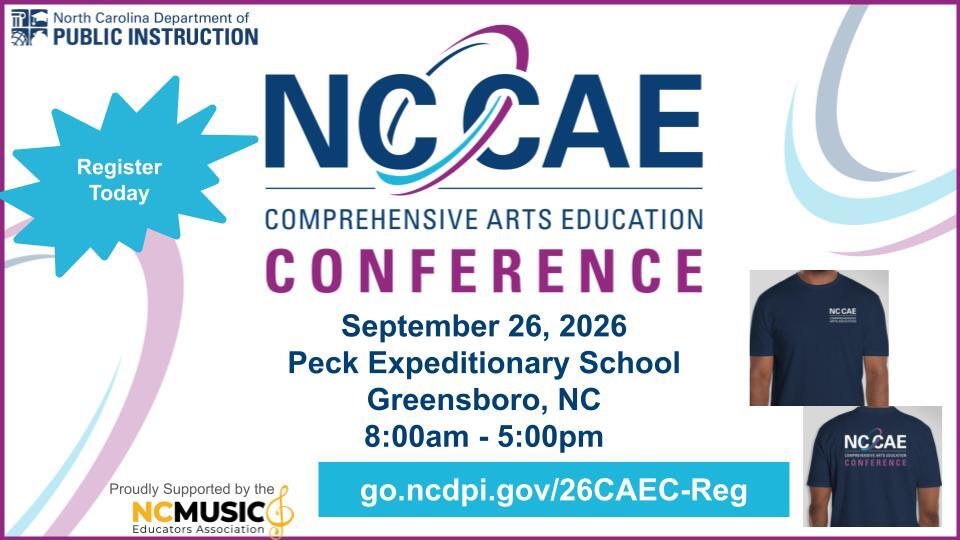 Register to attend the Fall Comprehensive Arts Education Conference, Saturday, September 26th at PECK Expeditionary Learning School, in Greensboro, NC!
This day-long conference serves as a statewide professional development opportunity for dance, music, theatre, and visual arts educators, district arts education leaders, teaching artists, arts integration specialists, and pre-service teachers from across North Carolina working in K-12 programs, independent studios, performing arts organizations, and higher education institutions.
The mission of this conference is to support the three essential components of the North Carolina Comprehensive Arts Education Model: Arts Education, Arts Integration, and Arts Exposure. Sessions will be centered on the four K-12 Arts Education Standards core strands of Connect, Create, Present, and Respond and aid to reinforce the 2024 standard course of study.
This event is proudly supported by the North Carolina Music Educators Association. All conference participants will receive a boxed lunch and a NC CAEC T-shirt with registration. Stay tuned for future posts about this event on Facebook and Instagram!
Register today!
https://go.ncdpi.gov/26CAEC-Reg
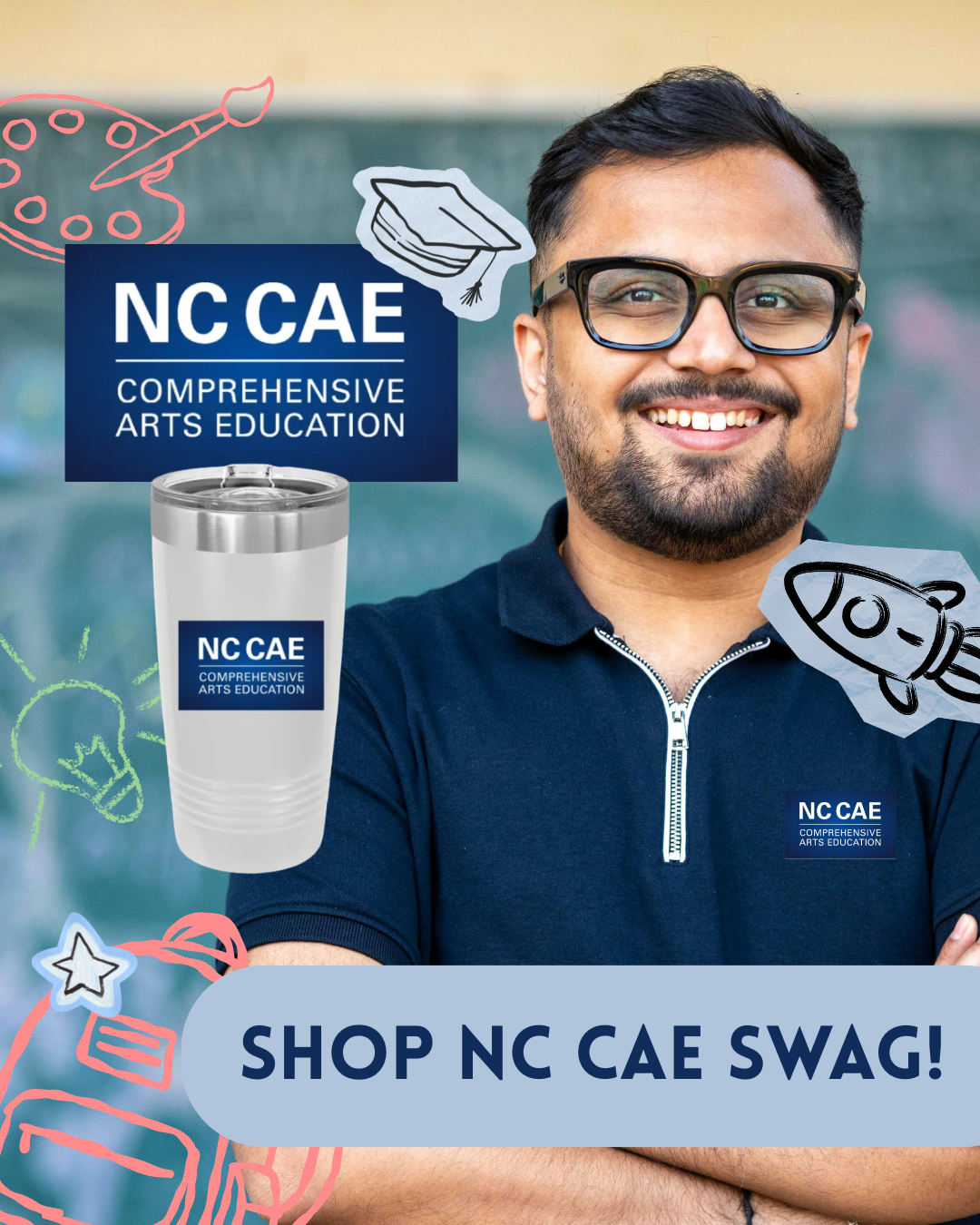 Show your support for Comprehensive Arts Education everywhere you go!
 This three-part webinar series will support schools in preparing for the launch of Honors-level Arts Education courses at the Novice, Developing, Beginning, and Intermediate levels in 2027–28. Participants will explore state expectations for Honors coursework to begin developing locally aligned honors tasks, assessments, and instructional approaches that reflect authentic arts rigor. These sessions are for High School Arts Educators, District Arts Education Leaders, and Honors Implementation Coordinators. Registration is required.
All webinars are scheduled from 4pm - 5pm and will be archived in the Arts Education PD Catalog for future access.
- August 5: Understanding the Honors Framework
- August 12: Understanding the Advanced Learning Indicators
- August 19: Examining Depth & Complexity
 This new feature in the arts ed newsletter highlights data from the National Arts Education Data Project and how others are using the data to shape conversations around the nation.
To start conversations about NC Arts Education data, visit the dashboard at:
artsednc.org/resources/arts-education-data-project/
On its own, a number like 83.3% does not actually tell us very much.
Is it good? Is it exceptional? Is it equitable? Without context, it is just a statistic. Numbers only become powerful when we understand who is being counted and whether all students have the same opportunities to participate.
In this case, context changes everything.
In New York, 83.3% represents the overall arts enrollment rate for the 2025 school year. That means more than four out of every five students are enrolled in at least one arts course. While the rate dipped slightly from 2024, it remains among the highest participation rates observed across the Arts Education Data Project and reflects substantial growth since 2021.
According to the data:
This represents an increase of 7.1 percentage points since 2021.
However, the statewide average masks important differences between school sectors.
Traditional public schools continue to maintain exceptionally high levels of arts participation statewide.
Charter schools have made significant gains over the past five years, increasing arts enrollment by more than 22 percentage points.
This number reflects a state with exceptionally high overall arts participation, but it also reveals a significant difference between traditional public schools and charter schools.
Several structural patterns are evident:
-
Overall arts enrollment remains exceptionally high statewide.
-
Traditional public schools have sustained participation rates above 85%.
-
Charter schools have made substantial gains since 2021, increasing from 33.1% to 55.7%.
-
Despite that progress, charter school participation remains far below traditional public school participation.
The statewide average of 83.3% can make it appear that arts access is nearly universal. For many students, that is true. However, the experience is very different depending on the type of school they attend.
A student attending a charter school is still substantially less likely to participate in the arts than a student attending a traditional public school.
An 83.3% participation rate signals a strong statewide arts education system.
What it confirms:
-
Arts participation in New York remains among the highest levels observed across states.
-
Participation has increased significantly since 2021.
-
Many schools have successfully expanded and sustained arts access.
What it also reveals:
-
Large disparities in access remain between school sectors.
-
Charter school students continue to participate in the arts at much lower rates than students in traditional public schools.
-
Progress in charter schools has not yet closed the gap.
Statewide success should not obscure persistent differences in opportunity.
Use 83.3% together with the sector-level data.
Talking points:
-
“More than four out of five New York students participate in the arts.”
-
“Traditional public school participation exceeds 85%.”
-
“Charter school participation has improved substantially since 2021.”
-
“Despite that progress, charter school participation remains nearly 30 percentage points lower than traditional public schools.”
Why are charter school students substantially less likely to participate in the arts than students in traditional public schools, and what would it take to close that gap?
New York’s overall participation rate is a success story. The challenge now is ensuring that students have equitable access to arts education regardless of the type of public school they attend.
 The Rapping and Hip-Hop Culture course on Music Will’s JamZone is an engaging instructional series designed to teach the fundamentals of hip-hop history, rhythm, and lyrical composition. Across comprehensive lessons, teachers and students explore the core elements of hip-hop culture, learn how to count bars, and practice essential songwriting techniques like multi-syllable rhyming, word association, and building catchy hooks.
A standout feature of the course is its integration of real-world artist perspectives; for instance, Chicago-based Hip-Hop artist Pinqy Ring leads this course, guiding teachers and students through creative brainstorming and shares professional insights to help everyone confidently write and perform their own 12-bar rap verses over professional backing tracks.
If you’re new to Music Will, check out the Getting Started with Music Will page for information on professional learning, special events, resources, and more.
NCDPI is accepting applications for the Innovation Leadership Council, a new statewide advisory council focused on identifying, vetting, and elevating innovative and evidence-based practices across North Carolina public schools.
The ILC will bring together leaders from districts, charter schools, lab schools, higher education, partner organizations, and NCDPI to help strengthen cross-sector learning and elevate promising practices that can benefit students across varied contexts.
Applications are due July 22, 2026.
Learn more and apply:
https://www.dpi.nc.gov/districts-schools/office-research-promising-practices/innovation-leadership-council
 Welcome to the North Carolina Arts Council Arts Education Corner! The North Carolina Arts Council Arts Education Corner is a new monthly newsletter feature supporting arts educators statewide. Each month, we'll share valuable resources, highlight opportunities for teachers and students, and showcase the incredible work of schools, organizations and teaching artists who are making an impact in their communities.
Summer Recharge Through the Arts
With the slower rhythm of summer finally here, teachers often find themselves balancing well‑deserved relaxation with moments of creative planning. This season can be an ideal time to explore new ideas, revisit favorite subjects, and discover fresh materials for the year ahead.
Teachers are the most valuable resource our students have. We hope you have a restful and restorative summer.
Check out these handy resources in visual art, music, dance, poetry, research, and cultural history to enrich your summer and energize your teaching.
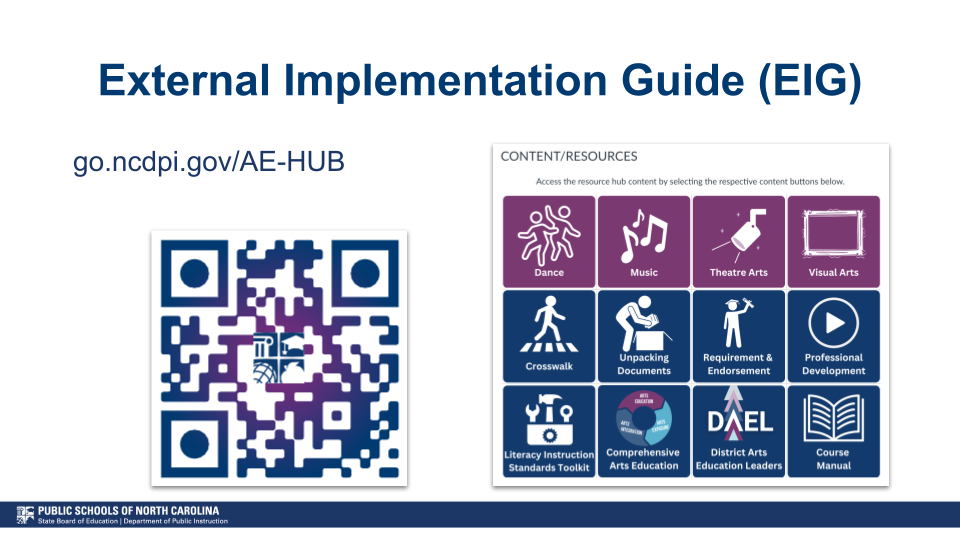
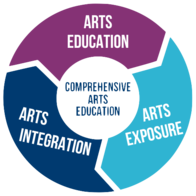
North Carolina's Vision for Comprehensive Arts Education
In today's globally competitive world, innovative thinking and creativity are essential for all school children. High quality, standards-based instruction in the arts develops these skills and effectively engages, retains, and prepares future-ready students for graduation and success in an entrepreneurial economy. Dance, music, theatre arts, and visual arts, taught by licensed arts educators and integrated throughout the curriculum, are critical to North Carolina's 21st century education. (Senate Bill 66: Comprehensive Arts Education Task Force, 2010)
Learn More about Comprehensive Arts Education
NCDPI Arts Education - NCDPI Arts Education Website
@ncartsed - NCDPI Arts Education Instagram
@nck12artsed - NCDPI Facebook
Contact Us!
Laura Stauderman: K-12 Dance and Visual Arts Consultant
Brandon Roeder: K-12 Music and Theatre Arts Consultant
|
Disclaimer Statement
The links on this page will bring you to third-party websites, owned and operated by independent parties over which NCDPI has no control. Any link you make to or from these 3rd Party Websites will be at your own risk. Any use of these 3rd Party Websites and any information you provide will be subject to and governed by the terms of the 3rd Party Website, including those relating to confidentiality, data privacy, and security.
Unless otherwise expressly agreed in writing, NCDPI is not in any way associated with the owner or operator of any of the 3rd Party Websites or responsible or liable for the goods and services offered by them or for anything in connection with such 3rd Party Websites. NCDPI does not endorse and makes no warranties, representations or undertakings relating to the content of any 3rd Party Website.
|