|
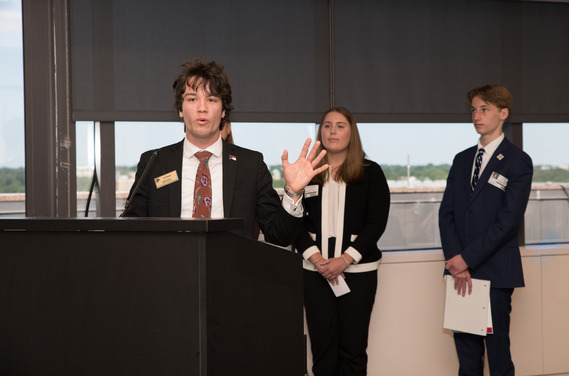
One of the final presentations from outgoing State Board of Education Student Advisor Ian House highlighted a project that has grown from a single student-led initiative into a statewide effort to elevate student voice in education policy. The Student Voice Alliance was launched in 2024 with a simple goal: create stronger connections between students across North Carolina and ensure their perspectives are part of conversations about the policies that affect them every day.
Working alongside a team of student leaders from six school districts, House has helped develop a network that gathers student feedback through surveys, publishes student-friendly policy updates, engages students through social media, and creates new opportunities for civic participation. To date, nearly 450 students from 37 school districts and charter schools have participated in Student Voice Alliance surveys on topics ranging from cell phones and class rank to advanced coursework and proposed mathematics course titles.
A centerpiece of the initiative is the new Student Ambassador Program, which will train students to serve as liaisons between their peers and local boards of education. Ambassadors will learn about education policy, governance, advocacy, and public speaking while helping ensure student perspectives are represented in local and state-level discussions. The program is designed to create meaningful opportunities for students to engage with decision-makers while developing the next generation of education leaders.
The Student Voice Alliance has also launched Student Policy Pulse, a student-centered policy briefing series that explains complex education issues in accessible language, and has built a growing social media presence to reach students where they are. The organization's content now reaches thousands of students each month and includes short videos explaining education legislation, governance, and student opportunities.
Board members praised the students' work and its alignment with the Strategic Plan for Achieving Educational Excellence. Vice Chair Alan Duncan reflected on the importance of ensuring student perspectives help inform decision-making, noting that “there's nothing that we do that matters if it doesn't help students.” While House will soon begin his college career, he and his fellow student leaders plan to continue expanding the initiative through broader statewide outreach, new partnerships, and a sustainable organizational structure that will help ensure student voices remain part of education conversations for years to come.
The State Board of Education received the Department of Public Instruction’s annual Opportunity Scholarship Financial Impact Report, a report required by state law that examines the financial difference between Opportunity Scholarship awards provided to students who previously attended public schools and the average state per-pupil allocation for those students.
This year’s report identified 12,252 Opportunity Scholarship recipients who had previously been enrolled in North Carolina public schools. Those students represented approximately 11.5% of the more than 106,000 scholarship recipients statewide during the 2025-26 school year.
Based on the methodology required by statute, DPI calculated that scholarship awards provided to these students totaled $71.6 million, compared with an estimated $97.3 million in average state per-pupil funding. The resulting difference, combined with the prior year’s calculation, produced a cumulative reinvestment amount of $35.75 million.
The report is tied to language adopted by the General Assembly expressing its intent to reinvest in public schools any savings realized when Opportunity Scholarship awards for former public school students are less than the state’s average per-pupil allocation.
Alongside the report, State Board Chair Eric Davis transmitted a letter to legislative leaders requesting that the full $35.75 million be appropriated to a public school reinvestment fund. In the letter, Chair Davis noted that while North Carolina families pursue a variety of educational options, public schools continue to educate the vast majority of the state’s children and remain the cornerstone of educational opportunity in every community. He wrote that reinvesting these funds would help strengthen educational services, student supports, educator recruitment and retention efforts, and academic opportunities for students across North Carolina.
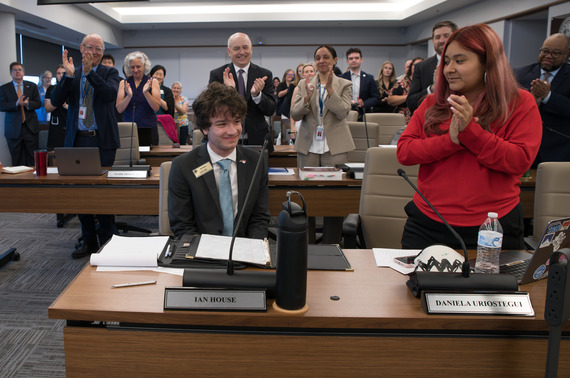 The June meeting marked the conclusion of service for three valued advisors to the State Board of Education: 2024 Wells Fargo North Carolina Principal of the Year Beckie Spears, 2025 A. Craig Phillips North Carolina Superintendent of the Year Dr. Freddie Williamson, and Student Advisor Ian House.
Together, their remarks reflected a shared belief in the power of public education to transform lives, strengthen communities, and create opportunity for every child.
Spears, principal of Wilkesboro Elementary School, reflected on more than three decades as an educator and the countless moments that have shaped her career. Drawing on her personal motto, “Be where your feet are,” she encouraged leaders to remain grounded in the children, families, and communities they serve. She spoke passionately about the importance of public schools as places where every child belongs and where educators continue to show up each day with hope, resilience, and unwavering commitment.
“Public education is a community deciding together that all children matter,” Spears said. “Not some children, not convenient children, not children who are easiest to teach. All children.”
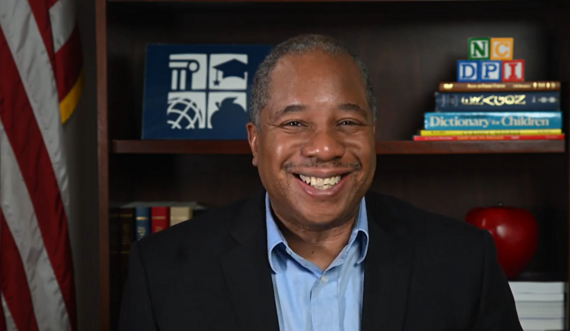
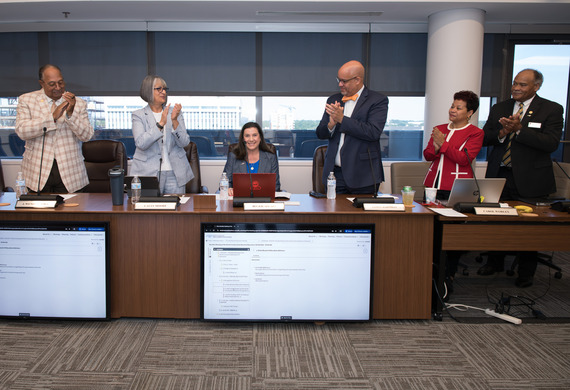 Williamson offered a brief but powerful message centered on leadership and collaboration. He praised the partnership between the State Board and Department of Public Instruction and expressed confidence in the future of public education in North Carolina.
“It is so refreshing to see this Board work together and work with our State Superintendent,” Williamson said. “There is no question where we're going to be in 2030.”
House, who completed two years as Student Advisor to the Board, reflected on the importance of maintaining North Carolina’s tradition as “a state on the go” by continuing to invest in education and student success. He urged policymakers to work closely with students, educators, and communities when developing solutions to educational challenges and emphasized that meaningful progress depends on keeping students at the center of every decision.
In one of the most memorable moments of the meeting, House shared that the day he began his service on the State Board was “the best day of my life,” because it allowed him to witness firsthand the care and commitment Board members bring to serving North Carolina’s students.
The Board extends its gratitude to all three advisors for their service, leadership, and advocacy. Their voices helped strengthen Board discussions, elevate the experiences of educators and students, and advance the shared mission of ensuring educational excellence for every child in North Carolina.
|