North Carolina lawmakers reached a deal on the broad strokes of a comprehensive state budget, ending a yearlong standoff over state spending priorities, legislative leaders said Tuesday.
Under the agreement, all state employees would receive raises of at least 3%, which is less than the annual rate of inflation: 3.8% as of April, the federal government revealed Tuesday. Teachers would receive higher raises, averaging about 8%. Other details of the deal were expected to be released in the coming weeks.
“Today’s announcement is only a framework, but if the final budget actually includes real salary increases, it would be welcome,” Governor Stein wrote in a statement.
Senate Democratic leader Sydney Batch, D-Wake, was dismissive of the news of a budget deal. "I am not about to give Republicans any credit for finally showing up to do the job they were elected to do after 316 days of delay and failure — especially when they still don't have a full plan, and especially when, yet again, no Democrats were invited to the table to help build one," she wrote in a statement.
House Minority Leader Robert Reives, D-Chatham, also criticized the proposed raise levels, citing rising inflation and increased health care costs for state employees. “Any pay raise that falls below inflation and the increased cost of the State Health Plan will effectively be a pay cut for employees who serve our state,” Reives said.
WRAL News - Paul Specht, Will Doran and Caroline Yaffa | May 13, 2026
North Carolina’s legislative leaders say they’re still searching for ways to pay for state employee raises. Tax hikes for sports betting, state job cuts and the elimination of diversity programs are among the considerations. Video: 'Anything Is Possible': NC's New Budget Deal Could Come With Cuts
Party leaders said they reached agreements on taxes, a planned children’s hospital, and pay raises for teachers and other state workers. But the two chambers have a number of other differences to work out, either in the budget or in other future legislation. House leadership released a calendar indicating they hope to finish the bulk of their work by early July.
Asked at a news conference to name some issues on which the two sides remain apart, House Speaker Destin Hall and Senate GOP leader Phil Berger turned to each other and smirked. Hall replied, “That’s going to take a long time to go through all those.”
Berger told reporters: “If things go smoothly, we could be in a place to have a vote on a conference report by the middle of June. I think it’ll take that much time to get the details worked out.”
Here are six big policy debates that weren’t addressed in the budget framework:
3. Helene Relief - Republican leaders say they plan to provide another round of relief for Western North Carolina. They’ve already approved roughly $2 billion to date.
4. Election Law Changes - Berger called for reducing the early voting window, particularly in primary elections.
6. Data Centers - Republican leaders have expressed an interest in revisiting a sales tax exemption that lets data centers that cost at least $75 million avoid paying taxes on construction, equipment, and electricity costs. Stein has also called for lawmakers to reconsider that tax break.
May 2026 Revised Consensus General Fund Revenue Forecast
Upward Revision from March 2026 Consensus Revenue Forecast
Higher Expected FY 2025-26 Overcollections - The revised forecast anticipates overcollections of $979M in FY 2025-26, which is $609M higher than in the March 2026 consensus forecast. The upward revision is due to strong tax collections across multiple major revenue sources in March and April.
Statement from North Carolina
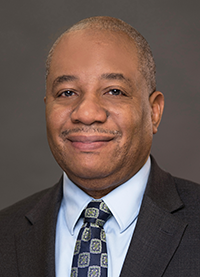
Superintendent Maurice "Mo" Green
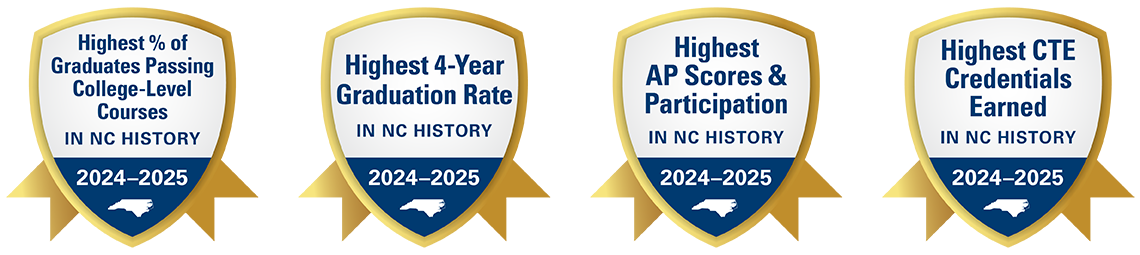
I'm grateful North Carolina General Assembly leadership announced a budget framework that includes meaningful pay increases for our public school educators. Our educators deserve to be revered for the work and dedication behind North Carolina's historic achievements in graduation rates, Advanced Placement participation and performance, Career and Technical Education credentials, and the percentage of graduates who passed a college-level course while still in high school. Paying educators well is an important way to show that reverence, and these pay raises would be a long-awaited step in the right direction.
I look forward to seeing the full budget, as I hope to see more investments in public education throughout its pages that will support our collective effort to build the best public education system in the nation by 2030.
Dr. Mariah Walker, principal of Wake Young Women's Leadership Academy (WYWLA), is the 2026 Wells Fargo Principal of the Year. The announcement was made today at an awards luncheon honoring Walker and eight other regional finalists at the Umstead Hotel in Cary.
With experience at nearly every grade level throughout the past two decades, Walker began her principalship at Hillburn PreK-8 Academy before her current role at WYWLA, serving young women grades 6-13 within the Wake County Public School System. Under her leadership at WYWLA, students have achieved a 100 percent graduation rate each of the past four years and exceeded growth the past two years.
Uniting her colleagues through transitional operations, Walker successfully moved WYWLA’s Early College program from Saint Augustine’s University to Wake Technical Community College and now to its current home at Shaw University. Walker builds community by inviting families to be part of the work of developing young women as leaders to extend beyond the walls of WYWLA.
A lifelong learner, Walker is a four-time NC State University graduate with a bachelor’s, two master’s and a doctorate degree. Walker holds various leadership roles within Wake County, including currently serving as the president of the Wake County Division of Principals and Assistant Principals.
Walker will spend the 2026-27 school year traveling the state as an ambassador for the profession, with financial support from Wells Fargo and the North Carolina Department of Public Instruction. She will receive a mobile device from Lenovo, an engraved award, a gift from the Carolina Hunger Initiative and a custom-made NC Principal of the Year signet ring from Jostens. She will also have the opportunity to participate in the Truist Leadership Institute and attend the International Society for Technology in Education conference.
“My leadership is centered around this truth, ‘How you make room at your table determines whether your guest wants to eat,’” Walker said. “At Wake Young Women’s Leadership Academy, we make room for every student by confronting inequity with courage, care and collective responsibility.”
In addition, Walker will compete nationally for the honor of the National Association of Secondary School Principals Distinguished Principal of the Year.
Walker was recognized alongside eight additional regional Principal of the Year finalists. These school leaders were also recognized today:
Northeast: Kelly E. Flora, Nags Head Elementary School (Dare County Schools)
Southeast: Dr. Marlow Artis, Craven Early College High School (Craven County Schools)
Sandhills: Dr. Latreicia Allen, John Griffin Middle School (Cumberland County Schools)
Piedmont-Triad: Dr. Darrell A. Harris, Jr., Eastern Guilford High School (Guilford County Schools)
Southwest: LaTresha Wilson, Tuckaseegee Elementary School (Charlotte-Mecklenburg Schools)
Northwest: Dustin Farmer, Ashe County High School (Ashe County Schools)
Western: Jennifer McBrayer, CHASE Middle School (Rutherford County Schools)
Charter: Deborah Brown, The Exploris School (Raleigh, NC)
North Carolina has recognized outstanding principals through its Principal of the Year program since the 1980s, helping promote the profession through advocacy and support while recognizing principals who are implementing best practices in schools across North Carolina.
DPI staff presented to lawmakers an update on student achievement in North Carolina, originally presented to the Blue Ribbon Commission on Public Education.
Michael Maher, Ph.D., Chief Accountability Officer, Division of Accountability and Research
NC Political News | May 13, 2026: The Senate Education/Higher Education Committee is taking up a three-bill education package that would affect K-12 school funding studies, student records, community college workforce training, digital credentials and math instruction. The agenda listed Senate Bill 990, the Students First Act; Senate Bill 991, the Community College Workforce Readiness Act; and Senate Bill 1044, the Foundational Mathematics Act.
The Carolina Journal - David N. Bass | May 13, 2026: Senate Bill 1044, Foundational Mathematics Act, would require three diagnostic math screenings per year for every kindergarten through eighth-grade student. The measure would also mandate at least 60 minutes of daily math instruction. Any student not performing at grade level would require an individualized remediation plan. The bill allocates $21 million in recurring funds to the Department of Public Instruction (DPI) and $2.5 million in nonrecurring funds for related studies.
EdNC - Ben Humphries | May 13, 2026: The House Finance Committee moved forward House Bill 1089, which aims to amend the North Carolina constitution to require the General Assembly to limit local property tax rates. Senate President Pro Tempore Phil Berger, R-Rockingham, told reporters during the announcement of a newly reached budget framework that both chambers will pass HB 1089.
The Public School Forum’sLocal School Finance Studyexamines the capacity and actual effort of counties to support public schools. Data from the most recent year revealed that 26% of total funding for operational costs for public school districts came from local governments.
EdNC - Ben Humphries and Chantal Brown | May 14, 2026: The Senate Education/Higher Education Committee advanced three bills on Wednesday, including one, Senate Bill 990, that would fund a work group to examine how North Carolina could implement a weighted student funding model. North Carolina’s current funding model for schools uses a hybrid of a resource-based and program-based allocations.
A Look Ahead: Week of May 18, 2026
The NCGA legislative calendar is updated frequently, so be sure to check the NCGA Homepage for the most up-to-date information on committee meetings, voting sessions, press conferences, and more. Current Legislative Calendar
Education Commission of the States - Kathryn Lynch-Morin | May 12, 2026
Artificial intelligence is not something that’s coming down the road — it is already here, reshaping how students learn, how educators teach and how work gets done.
States and districts will receive an additional $144 millionthis year for services to infants, toddlers, children and young adults with disabilities, according to an announcement by the U.S. Department of Education. Education Department spokesperson said by email that the $144 million for special education comes from non-expiring funds that have been returned to the agency in recent years. It will be distributed through formula grants to states and territories on July 1 and Oct. 1. About $123.6 million will go toward Part B grants, and $20.5 million to Part C grants.
With NC College Connect, you will be directly admitted to participating colleges and universities where you already meet admissions requirements. No essays, test scores, or recommendation letters needed. Yes, it’s that easy.
NC College Connect is a program that directly admits North Carolina public high school seniors on track to graduate to participating UNC System universities, North Carolina Independent Colleges and Universities, and their local North Carolina community college where they already meet admissions requirements. Have a weighted GPA of 2.8 or higher?The higher your GPA, the more schools to which you’ll be directly admitted.