|
The Board took up four proposed remote academies for the 2026–27 school year, ranging from small, fully virtual programs to larger “face virtual” models that include some in-person interaction. Staff noted that districts had worked through the application process and met the requirements outlined in law. As discussion unfolded, however, it became clear more questions remained.
Board members asked for more clarity on how instruction would work day to day, such as how often students would interact with teachers, what that interaction would look like, and who would be delivering instruction.
There were also broader questions about quality. Remote instruction continues to carry both promise and uncertainty, and board members raised the need to better understand what effective virtual learning looks like, particularly given past concerns about performance in remote settings. Without clearer evidence on instructional models and outcomes, several members signaled hesitation about approving new programs.
Ultimately, the Board chose not to act on first reading. Instead, members asked for additional information and a deeper dive into remote instruction before making a decision.
That conversation will continue at next month’s planning and work session, where the Board will spend time examining digital learning models and remote instruction as it works to ensure decisions are grounded in both clarity and confidence.
See the Remote Academies and Remote Charter Academies Report presented to the State Board in October and November HERE.
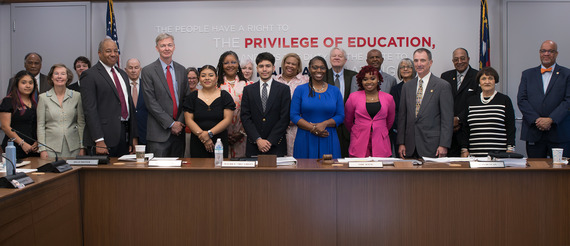
The State Board received the annual report from the State Advisory Council on Indian Education (SACIE), a body that brings forward the voices, experiences, and priorities of American Indian students and communities across North Carolina. This year’s report, titled Beyond the Numbers, emphasizes a simple but powerful idea: data alone cannot tell the full story of student success.
The presentation began with a moment of recognition—both of the ancestral lands on which North Carolina sits and of a historic milestone. After nearly 70 years of advocacy, the Lumbee Tribe has received federal recognition, joining the Eastern Band of Cherokee as federally recognized tribes in the state. Board member Olivia Oxendine reflected on the significance of this moment and the long-term impact it will have on students, families, and communities.
At the heart of the report are two key recommendations. First, SACIE calls for the establishment of a formal tribal consultation protocol to ensure that tribal voices and expertise are consistently included in statewide decision-making. Second, the council emphasizes the need for stronger, more accurate data systems to better identify and support American Indian students across all public school units.
But the report goes beyond policy. SACIE leaders underscored the importance of seeing students as whole people—grounded in culture, community, and identity. As one student shared, “Being American Indian is a living responsibility, carrying my people with pride and honoring the resilience of my ancestors.” These perspectives highlight that cultural connection is not separate from academic success—it is foundational to it.
Aligning Work to Strategic Priorities
The State Board of Education is making important updates to its committee structure, designed to better align how the Board works with what it has committed to in North Carolina’s Strategic Plan for Achieving Educational Excellence.
The restructuring aims to ensure that Board committees are directly aligned to the plan’s eight pillars. A key shift in this model is moving from a chair/vice chair structure to co-chairs. Co-chairs will share responsibility for setting agendas, guiding decisions, leading meetings, and presenting to the full Board. This approach is intended to elevate more voices, distribute leadership more evenly, and strengthen decision-making through collaboration.
The updated committee structure includes:
-
Student and School Excellence Committee (Pillars 1 & 6)
Co-Chairs: Jill Camnitz and Catty Moore
-
Educator Excellence Committee (Pillar 2)
Co-Chairs: Olivia Oxendine and Janet Mason
-
Parent, Community and School Support Committee (Pillars 3 & 4)
Co-Chairs: Reginald Kenan and Wendell Hall
-
Business Operations Committee (Pillar 5)
Co-Chairs: Alan Duncan and John Blackburn
-
Audit Committee (adjunct to Business Operations)
Co-Chairs: Alan Duncan and John Blackburn
-
Government and Community Affairs Committee (Pillars 7 & 8)
Co-Chairs: Wendell Hall and John Blackburn
-
Strategic Planning Committee
Co-Chairs: Catty Moore and Jill Camnitz
This new structure will take effect at the May meeting.
Today, the Leandro case was addressed again by the North Carolina Supreme Court in a lengthy opinion exceeding 240 pages. Given the scope and complexity of the decision, we are carefully reviewing it in full, including consultation with our legal counsel, to understand its implications for our public schools, students, and educators.
While we take the necessary time to review the court’s opinion, one thing remains clear: every measure we have seen over time demonstrates that North Carolina’s public schools have been chronically under-resourced. Ensuring that our children receive the education they deserve is not just a constitutional responsibility; it is a moral and economic imperative for the future of our state.
At the same time, we are incredibly proud of what our students and educators are accomplishing despite these challenges. In 2025, North Carolina reached historic highs in graduation rates, participation in advanced coursework, and career and technical education. Notably, 54% of our public high school graduates last year successfully completed a college-level course while in high school. This is an extraordinary and historic achievement that reflects the dedication, talent and resilience present in classrooms across our state.
Our educators and students continue to pursue educational excellence, even in the face of resource constraints. They are doing their part. Now, we must ensure that our systems and investments match their efforts.
We remain committed to working with all partners to support strong public schools and to ensure that every child in North Carolina has the opportunity to succeed in our public school system.
|