|
If you have information or opportunities you'd like to share in the monthly K-12 Science newsletter, please send a request to gavin.fradel@dpi.nc.gov no later than the third Monday of every month. Note: Not all requested items are guaranteed to be included.
Accessibility Updates
As part of our ongoing commitment to providing an accessible online experience, the Office of Teaching and Learning is updating website content to comply with the Web Content Accessibility Guidelines (WCAG) 2.1 AA standards. These updates ensure that our digital services are usable by everyone.
During this process, some documents and materials on our website may be temporarily removed or unavailable while they are being reviewed and remediated for accessibility.
If you need access to a document that is currently unavailable, please contact the corresponding person and content area below. We will provide the requested materials as quickly as possible.
Thank you for your understanding and support as we continue to enhance our website’s accessibility for all users.
Office of Teaching and Learning General Information, Global Education - kelly.schultz@dpi.nc.gov
Science, Math, and STEM - charles.aiken@dpi.nc.gov
Social Studies, Arts Education, Character Education, Gizella Abramson Holocaust Education Act - lori.carlin@dpi.nc.gov
English Language Arts, English Language Development, Literacy Instruction Standards, World Languages, Dual Language/Immersion - stacy.daniel@dpi.nc.gov
Healthy Schools - ellen.essick@dpi.nc.gov
K-12 Science Support Documents Updates
The NCDPI K-12 Science Team released updates to the K-12 Science Support Documents in September, 2025. These updates reflect feedback collected from the field and our grade level/content area Science Leadership Teams. Thank you for your ongoing dedication and input, which help us strengthen these resources for everyone. Please continue to provide feedback on these documents using the .
To make changes easier to locate, a spreadsheet with detailed updates for each grade and course is available on the Canvas Hub under the “” page.
2025-2026 NCDPI K-12 Science Office Hours
The K-12 Science Section will offer office hours during the 2025-26 School Year. Each session will focus on a particular topic and target a specific audience. A certificate of attendance will be issued for participants attending the full hour. Information about upcoming sessions and registration can also be found on the DPI website as well as on the Professional Development Button found on the NC K-12 Science Standards Resource Hub. You can view the session descriptions, intended audience, as well as register for the upcoming Office Hours on the Registration button below.
Professional Development and Classroom Opportunities
 For more information, contact Kelly Schultz at Kelly.Schultz@dpi.nc.gov
Zoo Educator Advisory Collaborative
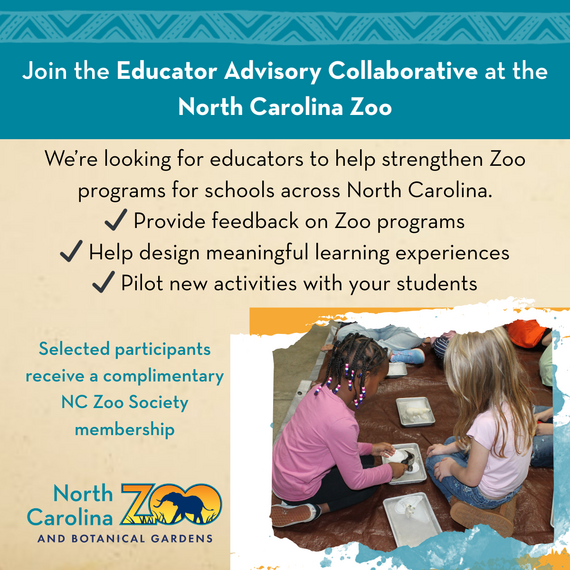 We are launching an Educator Advisory Collaborative and would love for classroom teachers, instructional leaders, specialists, and other education professionals to consider applying. Our goal is to strengthen and refine the programming we provide both on-site at the Zoo and in schools across the state.
We firmly believe that educators in the field know better than anyone:
- Which standards we should prioritize
- What meaningful learning experiences teachers are seeking when they bring students to the Zoo
- How we can better design impactful, standards-aligned programs
This collaborative will allow us to gather direct input from practicing educators so that our programs truly meet classroom needs.
Here is the link to the application for interested participants. As this is our first year piloting this initiative, we plan to keep the group to approximately 10–16 members to ensure meaningful collaboration and engagement.
We are also excited to share that the North Carolina Zoological Society has generously agreed to provide a complimentary one-year membership to all selected participants. Additionally, participating educators may have opportunities to pilot or test new Zoo programming with their classes before it is widely released.
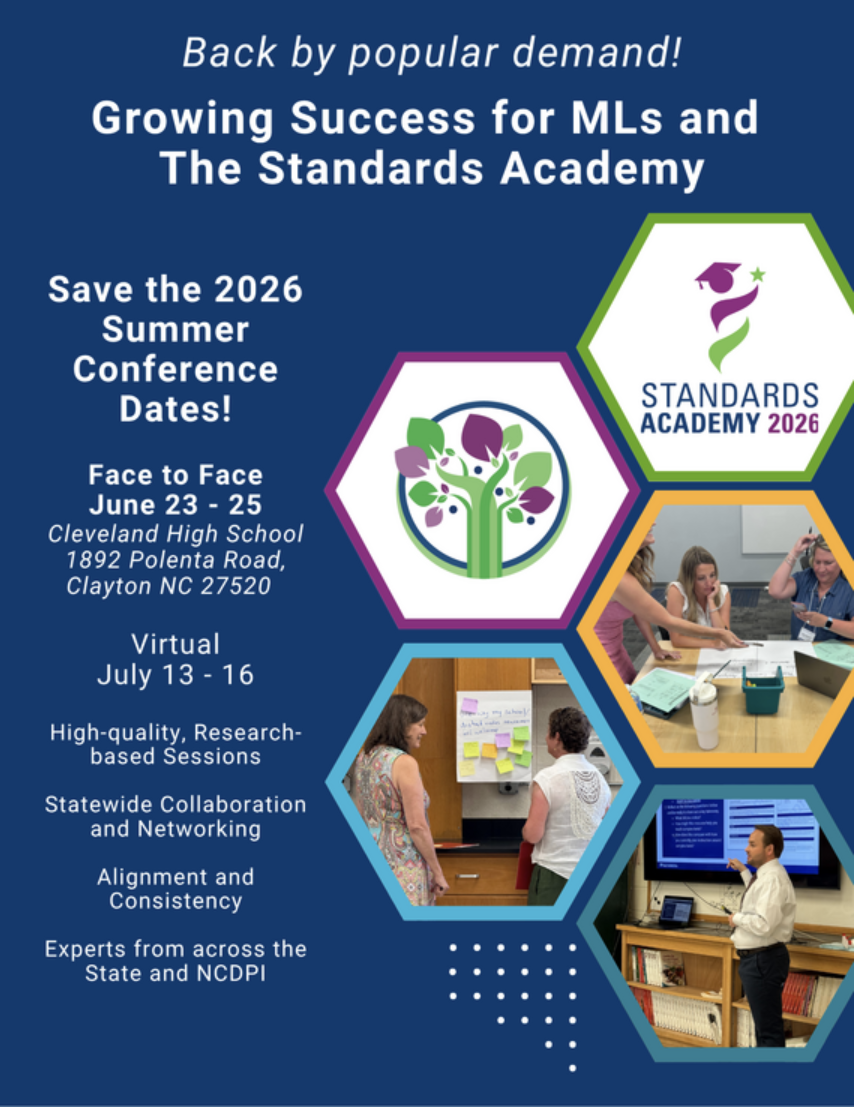
Multilingual Learners Webinar Session
Effective Content Instruction for ML Students in Reading and Listening
April 8th, 2026
3:30 PM - 5:00 PM
Turn reading and listening into exciting adventures for your multilingual learners! Join us for a lively professional development session where you’ll discover creative, research-backed strategies to boost ML students’ skills while diving deep into meaningful content. Unlock the secrets to blending explicit language instruction with engaging, content-rich activities that make reading and listening come alive.
Registration
Land Rights in Africa: K-12 Teacher Workshop
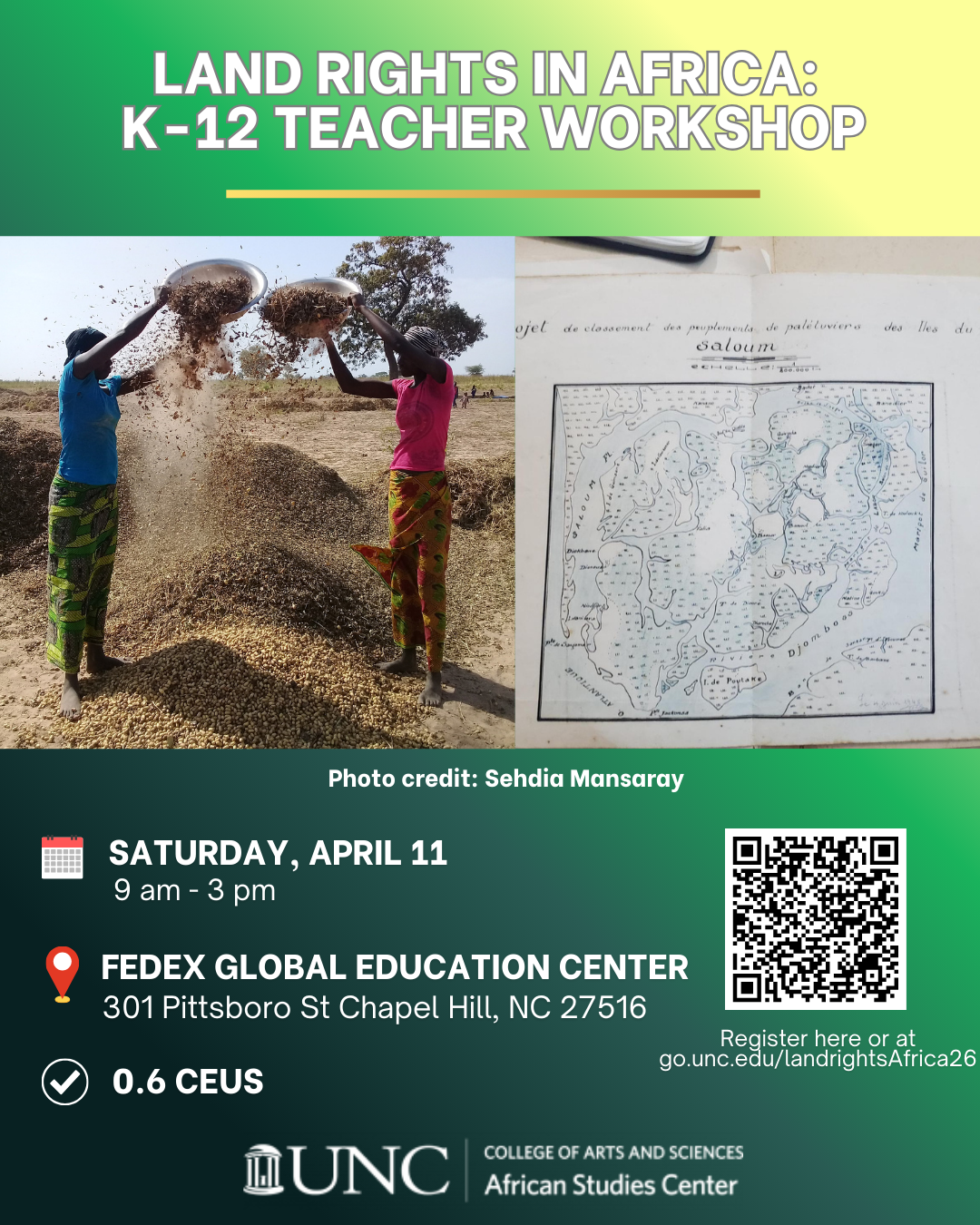 What can land rights in Africa teach K-12 classrooms about sustainability, citizenship, and social equality? How does land stewardship connect to economic prosperity and environmental justice?The UNC African Studies Center invites K-12 teachers to register for this interdisciplinary workshop on Saturday, April 11, at the FedEx Global Education Center.Drawing on examples from Ghana, Senegal, Kenya, and the African diaspora, these sessions will include lectures, resources, and critical discussions for the classroom.
Participants will earn 0.6 CEUs! Lunch will be provided. Learn more and register here or at go.unc.edu/landrightsAfrica26.
Be a Presenter at the 2026 North Carolina Science Teachers Association (NCSTA) Conference!
The North Carolina Science Teachers Association invites you to share your expertise with this year's audience of science educators at our annual Professional Development Institute (PDI). We are offering 3 options for presenting:
- 50 minute concurrent sessions
- 5-7 minute lightning sessions
- Share-a-Thon
Please select one of these options on the application form. The lightning sessions will consist of multiple sessions of similar content during a 50 minute time period, followed by a Q&A opportunity. The Share-a-Thon will be held in the Benton foyer on Thursday afternoon.
Presenter Information Packet
This year's conference theme is Making Connections in the Science Classroom with the following strands:
-
Connecting Effective Teaching and Learning Using Assessment - Sessions highlight how assessment functions as part of the learning process, not just a final measure. Educators will explore formative strategies that provide timely, actionable feedback and help teachers adjust instruction in real time to improve student outcomes.
-
Connecting Science and Emerging Technologies - Sessions showcase how emerging technologies support scientific discovery, data analysis, modeling, and problem-solving. Emphasis is placed on collaboration, critical thinking, and ethical, responsible technology use.
-
Connecting the Disciplines - Sessions demonstrate how scientific phenomena can anchor cross-curricular learning by integrating science with literacy, math, social studies, and other subjects. Focus is on interdisciplinary approaches that foster collaboration and higher-order thinking.
-
Connecting Students to Be College and Career Ready - Sessions feature relevant, real-world learning that links science to students’ lives, communities, and future pathways. Emphasis is on applying science to solve authentic problems while building durable skills for college, careers, and informed citizenship.
Submit your session by June 30 for NCSTA 2026 PDI!
© 2026 North Carolina Science Teachers Association
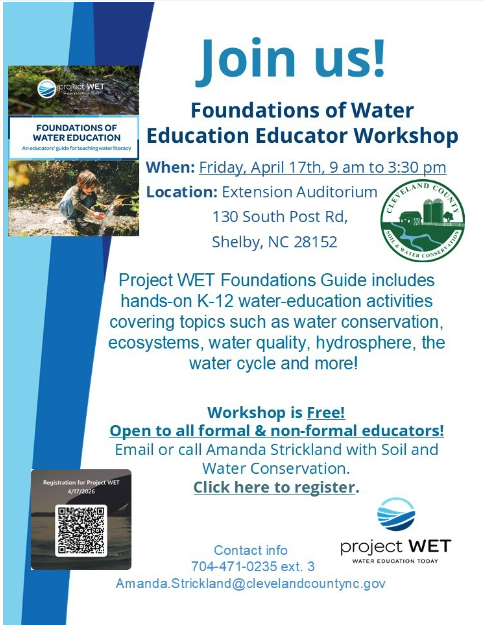
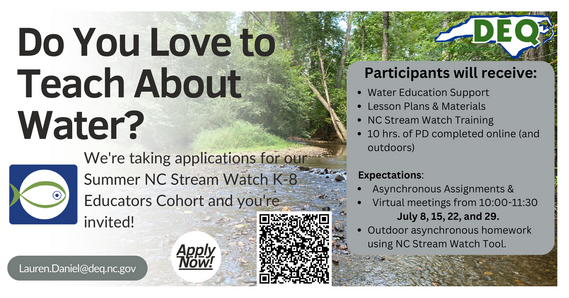 We are excited to announce the NC Stream Watch Summer Cohort, held each Wednesday in July beginning July 8, 2026.
Who: K–8 educators—both formal and nonformal—who teach about water, watersheds, or ecosystems. Feel free to forward this opportunity to your colleagues.
What/When: This cohort provides a broad overview of water-related concepts through four virtual sessions:
-
July 8: Kickoff, Introduction to NC Stream Watch, and Stream Monitoring for Education (10:00–11:30 a.m.)
-
July 15: Watersheds and Water Movement (10:00–11:30 a.m.)
-
July 22: Human Impacts on Watersheds (10:00–11:30 a.m.)
-
July 29: Identifying Problems and Designing Solutions (10:00–11:30 a.m.)
Additional components include interviews with water professionals, classroom-ready resources on water planning in North Carolina, and opportunities for collaboration with fellow educators.
Where: The course includes four live Zoom sessions and independent outdoor assignments that involve local stream exploration.
Why: This cohort is designed to support hydrosphere and ecosystems instruction. Our goal is to help educators feel confident teaching about North Carolina’s watersheds, water management, and stewardship practices.
How: If you’re interested, please use the application form button below to apply. NC Stream Watch is at the heart of this program, so be sure to be familiar with NC Stream Watch before applying.
We look forward to hearing from you! Please reach out if you have any questions.
How to Teach Outdoors: Survey
Greetings!
Thanks to funding from NAAEE's ee360+ program, the Environmental Educators of North Carolina (EENC) has been able to partner with Tanya Poole of Western Carolina University and Sandy Benton of Field Edventures in Wisconsin to collaborate on the development of a new course intended to provide activities and resources centered on best practices for teaching in the outdoors.
The goal of this project is to develop and pilot a comprehensive “deep dive” course on outdoor teaching and group management and we hope that this course will support classroom teachers, young professionals in EE, and science communicators who need more outdoor teaching experience. This course will address a critical gap in both North Carolina’s and Wisconsin’s environmental education communities by providing practical and accessible preparation for educators looking to gain outdoor learning settings.
We’d like to build this course using feedback from you as educators! You don’t have to have outdoor teaching experience, and if you do, use this survey reflectively to consider what would have supported you to feel more empowered to teach in outdoor settings. This survey should take fewer than 10 minutes to complete, and we appreciate you sharing your time and thoughts. We’re collecting final data by April 15, 2026.
For more information, contact Michelle Pearce, Programming Lead at Environmental Educators of North Carolina at programs@eenc.org.
NCDPI Accountability Dashboards
The North Carolina Department of Public Instruction has developed dashboards to give stakeholders access to test performance, school performance grades, and cohort graduation rates.
The dashboards feature an easy-to-read format, as well as historical data for further research. The intent of the dashboards is to provide an expanded view of the data to assist stakeholders in making informed decisions.
Dr. Debra Hall
K-5 Science
debra.hall@dpi.nc.gov
Gavin Fradel
6-8 Science
gavin.fradel@dpi.nc.gov
Benita Tipton
9-12 Science
benita.tipton@dpi.nc.gov
Alexis Wood
9-12 Science
kathryn.wood@dpi.nc.gov
Additional Contacts
Dr. Charles Aiken
Section Chief K-12 Mathematics, Science and STEM
charles.aiken@dpi.nc.gov
Howard Ginsburg
K-12 Integrative STEM Specialist
howard.ginsburg@dpi.nc.gov
Disclaimer Statement
The links on this page will bring you to third party websites, owned and operated by independent parties over which NCDPI has no control. Any link you make to or from these 3rd party websites will be at your own risk. Any use of these 3rd party websites and any information you provide will be subject to and governed by the terms of the 3rd party website, including those relating to confidentiality, data privacy, and security.
Unless otherwise expressly agreed in writing, NCDPI is not in any way associated with the owner or operator of any of the 3rd party websites or responsible or liable for the goods and services offered by them or for anything in connection with such 3rd party websites. NCDPI does not endorse and makes no warranties, representations or undertakings relating to the content of any 3rd party website.
|