Thursday, April 2, 2026
Highlights
WFAE - James Farrell | April 2, 2026
The North Carolina Supreme Court on Thursday overturned its own 2022 decision in the long-running Leandro school funding case, potentially ending the decades-long quest to force the General Assembly to significantly increase school funding.
That decision had ordered the state to fund a multi-billion-dollar plan to improve the state’s school system, after decades’ worth of court rulings had established the state was failing to meet its constitutional obligation to give students a sound, basic education.
The court ruled in a 4-3 decision, with Republican Justice Richard Dietz dissenting alongside the court’s Democratic minority. The court’s 244-page opinion argues the trial court lacked subject matter to rule on the case, and that the problem of resolving a dispute over how much funding certain programs should receive is not the judiciary's place. The justices dismissed the case with prejudice, meaning it can't be re-filed.
North Carolina routinely ranks near the bottom of national lists that track per-pupil spending, teacher pay and school funding.
Read the entire Supreme Court of North Carolina Opinion
NCDPI Press Release | April 2, 2026
Today, the Leandro case was addressed again by the North Carolina Supreme Court in a lengthy opinion exceeding 240 pages. Given the scope and complexity of the decision, we are carefully reviewing it in full, including consultation with our legal counsel, to understand its implications for our public schools, students, and educators.
While we take the necessary time to review the court’s opinion, one thing remains clear: every measure we have seen over time demonstrates that North Carolina’s public schools have been chronically under-resourced. Ensuring that our children receive the education they deserve is not just a constitutional responsibility; it is a moral and economic imperative for the future of our state.
At the same time, we are incredibly proud of what our students and educators are accomplishing despite these challenges. In 2025, North Carolina reached historic highs in graduation rates, participation in advanced coursework, and career and technical education. Notably, 54% of our public high school graduates last year successfully completed a college-level course while in high school. This is an extraordinary and historic achievement that reflects the dedication, talent and resilience present in classrooms across our state.
Our educators and students continue to pursue educational excellence, even in the face of resource constraints. They are doing their part. Now, we must ensure that our systems and investments match their efforts.
We remain committed to working with all partners to support strong public schools and to ensure that every child in North Carolina has the opportunity to succeed in our public school system.
Public School Forum of North Carolina
This year’s annual NC Legislators in Schools Week will be held the week of April 13-17. During the week, members of the North Carolina General Assembly will visit local public schools in the communities which they represent and engage in conversations with superintendents, educators and students.
“Legislators in Schools Week is about connection. It opens our doors so policymakers can see the real stories, challenges, and successes happening in our classrooms while students have the opportunity to meet leaders from their own communities,” said 2025 Burroughs Wellcome NC Teacher of the year Rachel Candaso, “When lawmakers sit beside students and educators, they see how public schools prepare young people for life and careers. This is an amazing opportunity to build trust between legislators and their community to ensure their decisions truly reflect the students they serve.”
This event is organized by current and former members of the North Carolina Teachers and Principals of the Year cohorts with support from the Public School Forum of North Carolina.
New Tax Trigger Analysis Highlights Need for a Responsible Budget
Speaker Destin Hall Press Release | March 31, 2026
New analysis published by the Carolina Leadership Coalition (CLC), a pro-business conservative group, underscores the importance of a fiscally responsible approach to tax reform, aligning with the North Carolina House's position as budget discussions continue.
The analysis, authored by economist and tax reform advocate Jared Walczak, highlights both the success of North Carolina’s Republican-led pro-growth tax cuts and the risks posed by the current revenue trigger structure.
Walczak notes: "The eventual target, a 2.49% flat-rate individual income tax, would further enhance North Carolina’s tax competitiveness… The triggers adopted in 2023, however, are a poor way to get there." [The current triggers] have the potential to implement rate reductions at the wrong time, giving lawmakers an unenviable choice: cancel or reverse a tax cut, or risk an avoidable budget shortfall."
With the state now projected to hit a second revenue trigger in 2028, the findings reinforce the House’s commitment to responsible tax relief that protects North Carolinians while safeguarding the state’s long-term fiscal health.
As House Speaker Destin Hall recently stated in an interview with WRAL: "Both sides—the House and the Senate—want to continue to cut income taxes in this state. It's not that we want to stop income taxes or freeze those. But we want cuts to continue at the same pace that we've been doing it now for 15 years… The Senate plan would go much quicker than that, and the danger in that is that the state's growth may not keep up with those cuts in a way that we would wind up with deficits."
"North Carolina is a destination state. We've got a great tax policy. We've got a great business environment. That's the reason people are moving here in droves."
Celebrate the Good in Public Education
More Than Half of NC Graduates Earned College-Level Credit in High School — A First
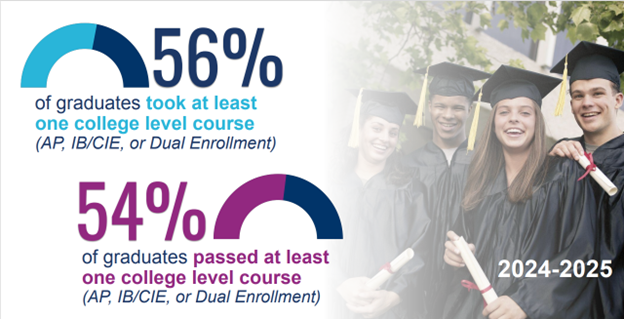 For the first time in state history, more than half of North Carolina's public high school graduates — 54% of the Class of 2025 — successfully completed at least one college-level course or exam while still in high school, whether through Advanced Placement, the Career and College Promise dual enrollment program, International Baccalaureate or other college-level coursework. That figure has never been higher. Nearly 87,000 students participated in Career and College Promise in 2024-25, a 10% increase from the prior year, and 38% of all graduates enrolled in at least one CCP college course — also an all-time high. Among students in North Carolina's 138 Cooperative Innovative High Schools, 6,560 graduated in 2024-25 and 3,498 earned an associate degree alongside their high school diploma. These results come alongside the state's record 87.7% graduation rate, record AP participation and performance, and a record 382,964 Career and Technical Education credentials earned — making 2024-25 a year of historic achievement across North Carolina public schools.
Read the full press release
April State Board of Education Meeting
Government and Community Affairs
Access all YouTube recordings of SBE meetings here.
|
The Results Are In - Thank You for Completing the Survey!
Teaching conditions in schools are important. The North Carolina Department of Public Instruction and the North Carolina State Board of Education have made a sustained commitment to listening to educators and reforming schools to create the working conditions necessary for student and teacher success. This biennial survey collects the anonymous voices of educators across North Carolina to determine strengths and improvement opportunities in schools and districts.
|
NC Superintendent’s Student Advisory Council
NOW OPEN - 2026 Advisory Council Application
Calling all rising juniors (current 10th graders) in high school! Apply today to serve as a Student Advisor on State Superintendent of Public Instruction Mo Green's Student Advisory Council. If you are interested in state K-12 education issues, advocating on behalf of your peers, and serving as an advisor to decision-makers in K-12 education, this opportunity is for you!
About the Council
The Superintendent’s Student Advisory Council (SSAC) is a strong and diverse group of high school students from across the state’s eight education regions. The SSAC meets virtually each month, and members serve a two-year term that concludes at the end of their senior year of high school.
Throughout their appointment, advisors hear from experts at the Department of Public Instruction, State Board of Education, the General Assembly, and the Governor's Office, among others, to learn about issues facing our state and share their input on what can be done to support students, teachers and our local school districts and charter schools.
At the conclusion of each year, advisors have the opportunity to participate in a Student Advocacy Day at the North Carolina General Assembly. The council members will also meet with the Superintendent of Public Instruction during their visit to Raleigh.
This survey closes on May 1, 2026 at 11:59pm. APPLY HERE
Education Committee Meeting
-
Date: Tuesday, March 31, 2026
-
Presiding: Representative Cotham
Update on DPI Math Standards Rewrite
-
Maurice "Mo" Green, Superintendent of Public Instruction, NC Department of Public Instruction
-
Dr. Stacey Wilson-Norman, Chief Academic Officer, NC Department of Public Instruction
-
Dr. Kristi Day, Director for Office of Teaching and Learning, NC Department of Public Instruction
Advanced Teaching Roles and TeachReadyNC
-
Brenda Berg, President and CEO, BEST NC
-
Jonathan Harris, Project Manager, TeachReadyNC
Progress on Reaching the State's Postsecondary Attainment Goal – NC's Workforce Pipeline and Educational Attainment
-
Cecilia Holden, President and CEO, myFutureNC
Cell Phone Usage in Schools – NC Phone and Tech in Schools Study
-
Dr. Kaitlyn Burnell, Director of Research, The Winston Center on Technology and Brain Development
EdNC - Ben Humphries | April 1, 2026: At the Joint Legislative Education Oversight Committee meeting on Tuesday, lawmakers heard a presentation on the N.C. Department of Public Instruction’s (DPI) in-progress revision to K-12 math standards; the results of a survey on cellphone use in classrooms; and funding requests for advanced teaching roles, teacher apprenticeships, and workforce initiatives.
- DPI math standards presentation redux
- Advanced teaching roles and TeachReadyNC
- Postsecondary attainment progress report from myFutureNC
- UNC researcher gives update on cellphones in schools
WUNC - James Farrell | April 1, 2026: North Carolina is working on a major overhaul of its math standards that state officials hope will better connect what students learn in the classroom to the real world. The draft proposal would eliminate Math 3 and give students the chance to choose two courses, with a goal of giving students options that align with potential career aspirations.
CBS 17 News - YouTube Video | March 31, 2026
|
K-12 Education Bills
Bills To Watch
The following bills have been placed on the House Calendar for Monday, April 6, 2026.
-
HB 87 Educational Choice for Children Act (ECCA).
-
HB 171 Equality in State Agencies/Prohibition on DEI.
-
SB 50 Freedom to Carry NC.
-
SB 153 North Carolina Border Protection Act.
-
SB 227 Eliminating "DEI" in Public Education.
Reminder: Bills ≠ Laws
Only a few dozen bills typically make it “across the finish line” and become law each legislative session.
- For the current 2025 legislative session, 1,800+ total bills were introduced.
- Of these, 108 bills have become law so far.
- Of these 108 new laws, NCGA staff have noted 42 laws relate to education in some way.
|
|