|
Friday, March 13, 2026
Highlights
Office of Governor Josh Stein Press Release | March 10, 2026
Governor Josh Stein, President Pro Tem Phil Berger, and Speaker of the House Destin Hall announced the formation of a Blue Ribbon Commission on Public Education. The Blue Ribbon Commission is tasked with examining teacher training and student advancement, administrative operations, educational leadership, and accountability. Members of the Blue Ribbon Commission were jointly appointed by the Governor, the President Pro Tempore of the Senate, and the Speaker of the House.
Office of Governor Josh Stein Press Release | March 9, 2026
Governor Josh Stein called on the General Assembly to fast-track a $1.4 billion Critical Needs Budget focused on addressing North Carolina's most urgent needs while lawmakers continue work on a comprehensive state budget.
Respecting Teachers - An investment in North Carolina’s teachers is an investment in North Carolina’s future. However, the state’s teachers have been waiting for a meaningful pay raise, and the state remains in the bottom 10 nationally in average teacher pay. Governor Stein knows that competitive compensation is essential to attracting and retaining the best educators. That's why his budget raises starting and average teacher pay, restores master's degree pay, and increases compensation for senior teachers and other critical school personnel who keep students safe and healthy.
EdNC - Sergio Osnaya-Prieto and Hannah Vinueza McClellan | March 12, 2026
North Carolina public schools received $12.75 billion in state funding and $1.1 billion in federal funding during the 2025-26 school year — excluding child nutrition and the last of federal relief funds — according to the Department of Public Instruction’s (DPI) latest “Highlights of the North Carolina Public School Budget” report.
The annual report includes information on the number of students, teachers, and schools in North Carolina, along with things like class size ratios, how many districts are considered low wealth or small, and more.
“Funding public education in North Carolina is a complex and integrated process,” the report says. “This booklet presents charts and tables which describe how state and federal funds are distributed to North Carolina’s Public Schools. It also reviews the changes in average daily membership (ADM) and school personnel.”
There were 1,533,889 students funded and 100,169 teachers across North Carolina schools during the 2025-26 school year, according to the report, reflecting a slight decrease in enrollment, from 1,538,563 students and 100,072 teachers in 2024-25.

MIC3 March Meeting
- Thursday, March 19, 2026, from 10:00am - 12:00pm
- Eastern NC Regional Skills Center, Burton Industrial Park, 261 NW Corridor Blvd, Jacksonville, NC 28540
The agenda is available via this link.
|
Five NC High School Students Selected as Finalists for Operation Homefront's Military Child of the Year Award
Congratulations to five North Carolina high school students who have been selected as finalists for Operation Homefront's Military Child of the Year Award, a national honor celebrating leadership, service and academic excellence.
Our state's finalists include:
- Army - Kinsey Robinson, West End
- Coast Guard — Victoria Vanacore, Kill Devil Hills
- Marine Corps — Virginia Burks, Havelock
- Marine Corps — Hannah Kirksey, Sneads Ferry
- National Guard — Genesis Hall, Marion
Operation Homefront's Military Child of the Year Award reflects the positive impact that these young people have made on their military families, their schools and their communities. Finalists will be celebrated at a gala in Washington, D.C. in April.
April State Board of Education Meeting
- Wednesday, April 1, 2026 at 10 a.m.
-
Thursday, April 2, 2026 at 9 a.m.
Access all YouTube recordings of SBE meetings here.
|
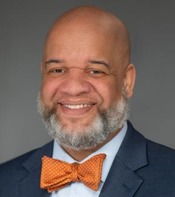
2025 NC Principal of the Year Jason Johnson Named 2026 National Principal of the Year Finalist by National Association of Secondary School Principals (NASSP)
Congratulations to Jason Johnson, our 2025 Wells Fargo NC Principal of the Year on being named a 2026 National Principal of the Year Finalist by the National Association of Secondary School Principals (NASSP)! Johnson was selected by the NASSP for his commitment to student success, school improvement and strong educational leadership.
The NASSP National Principal of the Year program honors principals who provide high-quality learning opportunities and demonstrate outstanding leadership. For 2026, each of the 50 states, the District of Columbia, the U.S. Department of State Office of Overseas Schools (DoSOS), and the Department of Defense Education Activity (DoDEA) selected one middle level principal and one high school principal to represent their state.
The 2026 National Principals of the Year will be announced April 17 at the National Education Leadership Awards (NELA) in Washington, D.C.
|
K-12 Education Bills

Bills To Watch
The following bills have been placed on the House Calendar for Monday, April 6, 2026.
-
HB 87 Educational Choice for Children Act (ECCA).
-
HB 171 Equality in State Agencies/Prohibition on DEI.
-
SB 50 Freedom to Carry NC.
-
SB 153 North Carolina Border Protection Act.
-
SB 227 Eliminating "DEI" in Public Education.
Reminder: Bills ≠ Laws
Only a few dozen bills typically make it “across the finish line” and become law each legislative session.
- For the current 2025 legislative session, 1,800+ total bills were introduced.
- Of these, 108 bills have become law so far.
- Of these 108 new laws, NCGA staff have noted 42 laws relate to education in some way.
|
|
|
North Carolina General Assembly
2026 NCGA Candidate Information
The NCGA is currently scheduled to reconvene on the following remaining dates pursuant to SJR 776: Adjournment Resolution Changes. Legislative action on these dates, if any, is still to be determined:
o April 6, 2026 - April 9, 2026
o April 21, 2026 — Start of 2026 Short Session
State Budget Information & Resources
2025 State Budget Proposal
2025 Enacted "Mini Budgets"
2023 State Budget
Other State Budget Resources
K-12 Education Legislation Resources
Enacted Hurricane Helene Recovery Legislation
|
Useful Acronyms
DPI = Department of Public Instruction
GS = General Statute
HB/SB = House Bill/Senate Bill
JR = Joint Resolution
LB/LOB = Legislative Building/Legislative Office Building
LEA = Local Education Agency
NCGA = North Carolina General Assembly
PCS = Proposed Committee Substitute
PSU = Public School Unit
SBE = North Carolina State Board of Education
SL = Session Law
For the glossary of education acronyms/terms, click here.
For the glossary of legislative terms, click here.
|
|
Open March 2- 31, 2026
Your Voice Matters.
Teaching conditions in schools are important. The North Carolina Department of Public Instruction and the North Carolina State Board of Education have made a sustained commitment to listening to educators and reforming schools to create the working conditions necessary for student and teacher success. This biennial survey collects the anonymous voices of educators across North Carolina to determine strengths and improvement opportunities in schools and districts.
Message From Superintendent Mo Green on the Teacher Working Conditions Survey
Need More Help? Please email NCTWC@dpi.nc.gov if you have any NC TWC questions for NCDPI. Individual educators should reach out to their NC TWC Coordinator if they need a survey code or have questions about participation. TWC Coordinators can reach out to the Survey Support team to update educator counts, if they have questions, or need additional assistance.
|
Professional Development Opportunity - Voices of Freedom: Exploring History Through Place and Performance at Historic Stagville
The NC Department of Natural and Cultural Resources (DNCR) invites educators to a free, powerful professional development opportunity to connect history, place and performance.
Voices of Freedom: Exploring History Through Place and Performance at Historic Stagville
- Part I: Sunday, April 26 at Historic Stagville (10 a.m.-4 p.m.) 5828 Old Oxford Highway, Durham, NC, 27712
- Part II (optional): Monday, April 27 at Durham Performing Arts Center (7-10 p.m.) | Attending teachers will receive a free ticket to “Biscuits & Banjos presents: Rhiannon Giddens’ Beloved Community"
Attending educators will receive:
- A $50 stipend
- A ticket to “Biscuits & Banjos presents: Rhiannon Giddens’ Beloved Community” at DPAC (up to a $120 value)
- A private tour of Stagville and performance by the acclaimed Mary D. Williams
- 1 CEU
- Lunch
- Access to classroom resources
- The chance to network with other educators, as well as the opportunity to engage with DNCR/Historic Sites staff ready to serve as a source of support for work in the classroom
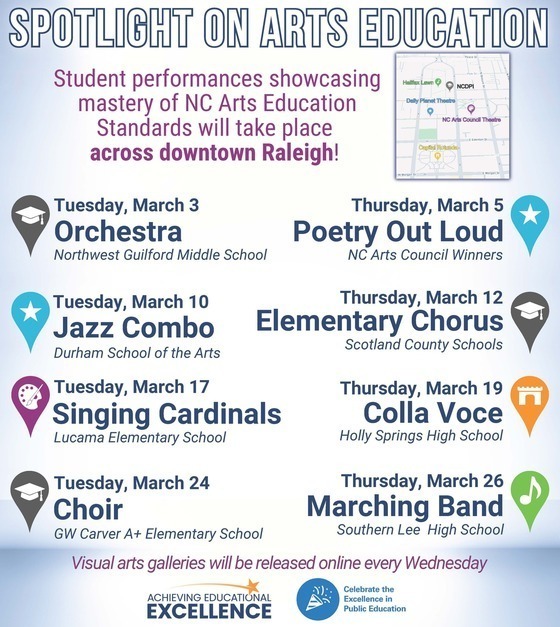
Arts in Our Schools Month - Student Performances
Please join the NCDPI Office of Teaching and Learning Arts Education Team to celebrate the excellence in public education and recognizing the importance of arts programming in our K-12 schools as we showcase the artistic talents of these North Carolina Students. Join us for in-person performances throughout downtown Raleigh and live-streamed performances and virtual visual arts galleries in celebration of Arts in Our Schools Month this March. All viewings are from 11:30 a.m.-12 p.m. and are free to attend or watch on YouTube.
Lucama Elementary School Singing Cardinals, Wilson County Schools
- Tuesday, March 17
- Location: NC Arts Council
Arapahoe Charter & Pinecrest High School, Arapahoe Charter and Moore County Schools
Holly Springs High School Colla Voce, Wake County Public Schools
- Thursday, March 19
- Location: Capitol Rotunda
In Other News
EdNC - BEST NC | March 12, 2026
As many as 30 of the highest-need schools across North Carolina have a great opportunity for the 2026-27 school year. The state provides these schools with $30,000 per year for three years to recruit proven, high-performing principals whose leadership can change the trajectory of a school.
Since its launch in 2019, North Carolina’s Principal Recruitment Supplement Program has sought to address one of the most persistent challenges in education — ensuring that the schools facing the greatest academic challenges have access to the strongest leadership.
Qualifying schools
Qualifying schools, as defined in G.S. 115C-105.37, include low-performing schools receiving an overall School Performance Score in the bottom 5% of all schools statewide in the prior school year. Given low utilization (below 50%) of the program over the past five years, the State Board of Education recently recommended expanding the program’s eligibility to include all low-performing schools.
- State statute defines low-performing schools as schools that earn an overall School Performance Grade of D or F and a School Growth Status of “met expected growth” or “not met expected growth.”
- Eligible schools are announced to districts between January and April. District leaders are encouraged to reach out to the N.C. Department of Public Instruction (DPI) in January to learn if they have qualifying schools in their district.
- Around 120 schools across North Carolina have been eligible under the current statutory definitions. DPI recommends expanding the program to all low-performing schools, which is over 628 schools in the 2025-26 school year.
Qualifying principals
Qualifying principals include those who are paid on the “Exceeded Growth” column of the Principal Salary Schedule. A principal’s placement on the salary schedule is tied to the performance of their school. If a school exceeds growth for two out of the previous three years, they receive the “Exceeded Growth” payment on the salary schedule.
Funding and availability
There is $1.3 million in recurring funds available for this program, enough to support about 40 principals to participate in the program each year. If fully implemented, about 13 new principals would be added each year, with 13 first-year, 13 second-year, and 13 third-year principals utilizing the program at any given time.
The most recent report by DPI on the impact of the Principal Recruitment Supplement Program can be found here. While program participation is currently limited to the very lowest performing schools, its high level of investment in the schools who need it most has proven effective in turning these schools around.
Education policy is shaped by each state’s constitution and laws, how leadership roles are structured and filled, and the authority different state policymakers hold. This resource provides a national overview of constitutional language across states and explores how constitutional and statutory language provides for appointments as well as powers and duties of key policymaking roles in K-12 education policy.
Education Provision
The General Assembly shall provide by taxation and otherwise for a general and uniform system of free public schools, which shall be maintained at least nine months in every year, and wherein equal opportunities shall be provided for all students. | Source: N.C. Const., art. IX, § 2
Funding Provision
Section 2. (1) General and uniform system: term. The general assembly shall provide by taxation and otherwise for a general and uniform system of free public schools, which shall be maintained at least nine months in every year, and wherein equal opportunities shall be provided for all students.
(2) Local responsibility. The general assembly may assign to units of local government such responsibility for the financial support of the free public schools as it may deem appropriate. The governing boards of units of local government with financial responsibility for public education may use local revenues to add to or supplement any public school or post-secondary school program.
Section 6. The proceeds of all lands that have been or hereafter may be granted by the United States to this state, and not otherwise appropriated by this State or the United States; all moneys, stocks, bonds, and other property belonging to the State for purposes of public education; the net proceeds of all sales of the swamp lands belonging to the State; and all other grants, gifts, and devises that have been or hereafter may be made to the state, and not otherwise appropriated by the state or by the terms of the grant, gift, or devise, shall be paid into the state treasury and, together with so much of the revenue of the State as may be set apart for that purpose, shall be faithfully appropriated and used exclusively for establishing and maintaining a uniform system of free public schools.
Section 7. (a) Except as provided in subsection (b) of this section, all moneys, stocks, bonds, and other property belonging to a county school fund, and the clear proceeds of all penalties and forfeitures and of all fines collected in the several counties for any breach of the penal laws of the state, shall belong to and remain in the several counties, and shall be faithfully appropriated and used exclusively for maintaining free public schools. (b) The general assembly may place in a State fund the clear proceeds of all civil penalties, forfeitures, and fines which are collected by state agencies and which belong to the public schools pursuant to subsection (a) of this section. Moneys in such State fund shall be faithfully appropriated by the general assembly, on a per pupil basis, to the counties, to be used exclusively for maintaining free public schools.
How is the state board of education selected?
Appointed by the governor | Source: N.C. Gen. Stat. Ann. § 115C-10
What is the composition of the state board of education?
13 members, including: District Representatives, General Members | Source: N.C. Gen. Stat. Ann. § 115C-10
Are there term limits and/or lengths for the state board members?
Members serve eight-year terms. | Source: N.C. Gen. Stat. Ann. § 115C-10
How is the chief state school officer selected?
Elected | Source: N.C. Const. art. III, § 7
Are there term limits and/or lengths for the chief state school officer?
The chief serves a four-year term. | Source: N.C. Const. art. III, § 7
Click here to subscribe to the weekly legislative update or other NC Department of Public Instruction topics.
To view previous K-12 Education Legislative Updates, click here.
NCDPI Office of Government Affairs: Anne Murtha – Legislative Specialist
|
|
|
|
|