|
Highlights
Council of Chief State School Officers - February 2, 2026
The U.S. House of Representatives voted 217-214 to pass a fiscal year (FY) 2026 appropriations package through the end of the fiscal year, Sept. 30, 2026. This package includes five federal spending bills, including the Labor, Health and Human Services, Education, and Related Agencies (LHHS) bill, which funds the U.S. Department of Education (ED).
Here are notable changes in K-12 funding levels over last year’s funding levels:
- ESEA Title I: $20 million increase, to total $18.427 billion
- IDEA Grants to States (Part B): $20 million increase, to total $14.234 billion
- Rural Education: $5 million increase, to total $225 million
- Head Start and Child Care Development Block Grants: $85 million increases to each program
- Education Innovation and Research: $24 million decrease, to total $235 million
- Most other K-12 programs are level funded at FY 2025 funding levels
This Penn Hill Group memo provides additional information about all education funding provided in the FY 2026 LHHS legislation. The bill text can be found here. The text of the explanatory statement can be found here.
News & Observer - Dawn Baumgartner Vaughan | January 29, 2026
Starting teacher pay ‘critical’ for the House - Hall said in a November interview with The News & Observer that issues he talked about when he started his job in early 2025 remain. A big issue is teacher pay, including Hall’s pitch to raise starting pay for teachers to the highest in the Southeast. The House proposal passed in May would have raised starting teacher base pay to $50,000 by July 2026.
Hall said that raising starting teacher pay “is something that’s critical to (House Republicans). We want to be pro-education on all fronts — school choice and in our public schools. And so that’s one of the reasons that you see us holding out (in) the budget debate.”
February State Board of Education Meeting
-
Wednesday, February 4, 2026 at 10 a.m.
-
Thursday, February 5, 2026 at 9 a.m.
-
Government and Community Affairs
-
Career and Technical Education (CTE) and Credential Data
NC State Board of Education in the News:
NCDPI Press Release | February 4, 2026: North Carolina Career and Technical Education (CTE) students earned a record 382,964 industry-recognized credentials during the 2024-2025 academic year, the highest total in state history, according to a report released by the North Carolina Department of Public Instruction (NCDPI). The state ranks second nationwide for the percentage of K-12 students participating in CTE, with 36.1% of all students enrolled in a CTE course. Only Nebraska ranks higher. The credential achievement represents a 59% attainment rate, meaning students earned nearly six out of every 10 credentials available to them through their CTE coursework.
EdNC - Hannah Vinueza McClellan | February 5, 2026: Reports of crime and violence in North Carolina public schools decreased during the 2024-25 school year for the second consecutive year, according to an annual report from the Department of Public Instruction (DPI) presented to the State Board of Education this week. The report — which is required by state law and tracks discipline, alternative learning, and dropouts across the state — “shows strong levels of safety” in North Carolina public schools, according to a DPI press release. Nearly 80% of schools had five or fewer acts of reportable criminal offenses last year, the release said, and “only 9,966 students or approximately 0.66%, committed a reportable offense.”
Access all YouTube recordings of SBE meetings here.
|
Seven N.C. Students Selected as Military Child of the Year Semi-Finalists
Congratulations to seven North Carolina high school students who have been selected as semi-finalists for Operation Homefront's Military Child of the Year Award, a national honor celebrating leadership, service and academic excellence. Out of 68 semi-finalists nationwide and overseas, these students represent the best of North Carolina’s military-connected youth.
Our state's semi-finalists include:
🏅 Army - Natalie Perez, Fayetteville and Kinsey Robinson, West End
🏅 Coast Guard — Victoria Vanacore, Kill Devil Hills
🏅 Marine Corps — Virginia Burks, Havelock; Hannah Kirksey, Sneads Ferry and Daniel Prane, Swansboro
🏅 National Guard — Genesis Hall, Marion
The Military Child of the Year Award is a tribute to military-connected youth, honoring their resilience and positive impact on families, schools and communities. Finalists will be named in February, with seven award recipients—one from each service branch—announced in March and celebrated at a gala in Washington, D.C. in April.
Scheduled Education Committee Meeting
-
Date: Tuesday, February 10, 2026
-
Time: 10:00 AM
-
Location: 643 LOB | Streaming Link
-
Agenda: TBD
-
Presiding: Senator Overcash, Co-Chair
-
Note: February 3 meeting was cancelled due to adverse winter weather
|
K-12 Education Bills

Bills To Watch
The following bills have been placed on the House Calendar for Monday, February 9, 2026, although no votes are expected at this time.
-
HB 87 Educational Choice for Children Act (ECCA).
-
HB 171 Equality in State Agencies/Prohibition on DEI.
-
SB 50 Freedom to Carry NC.
-
SB 153 North Carolina Border Protection Act.
-
SB 227 Eliminating "DEI" in Public Education.
Reminder: Bills ≠ Laws
Only a few dozen bills typically make it “across the finish line” and become law each legislative session.
- For the current 2025 legislative session, 1,800+ total bills were introduced.
- Of these, 108 bills have become law so far.
- Of these 108 new laws, NCGA staff have noted 42 laws relate to education in some way.
|
|
|
North Carolina General Assembly
2026 NCGA Candidate Information
Voters affiliated with any political party may vote the ballot of candidates for their party only. Some recognized political parties in North Carolina may not have primary ballots. Unaffiliated voters may choose to vote any one political party’s ballot or a nonpartisan ballot (if available). A voter cannot vote in more than one party’s primary.
-
Feb. 6, 2026: Voter registration deadline (5 p.m.).*
-
Feb. 12, 2026: In-person early voting begins.
-
Feb. 17, 2026: Absentee ballot request deadline (5 p.m.).*
-
Feb. 28, 2026: In-person early voting ends (3 p.m.).
-
March 3, 2026: Primary Election Day.
-
March 3, 2026: Absentee ballot return deadline (7:30 p.m.).*
-
*Voter registration and absentee voting deadlines are different for military and overseas citizen voters.
The NCGA is currently scheduled to reconvene on the following remaining dates pursuant to SJR 776: Adjournment Resolution Changes. Legislative action on these dates, if any, is still to be determined:
o Feb. 9, 2026 - Feb. 12, 2026
o March 9, 2026 - March 12, 2026
o April 6, 2026 - April 9, 2026
o April 21, 2026 — Start of 2026 Short Session
State Budget Information & Resources
2025 State Budget Proposal
2025 Enacted "Mini Budgets"
2023 State Budget
Other State Budget Resources
K-12 Education Legislation Resources
Enacted Hurricane Helene Recovery Legislation
|
Useful Acronyms
DPI = Department of Public Instruction
GS = General Statute
HB/SB = House Bill/Senate Bill
JR = Joint Resolution
LB/LOB = Legislative Building/Legislative Office Building
LEA = Local Education Agency
NCGA = North Carolina General Assembly
PCS = Proposed Committee Substitute
PSU = Public School Unit
SBE = North Carolina State Board of Education
SL = Session Law
For the glossary of education acronyms/terms, click here.
For the glossary of legislative terms, click here.
|
|
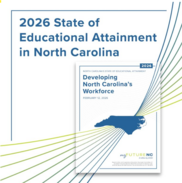
Less than one week until the myFutureNC virtual 2026 State of Educational Attainment in North Carolina broadcast scheduled for February 12, 2026 from 3:00–3:30 p.m.
myFutureNC will dig into new statewide and county-level insights and the steps to strengthen local talent development in the year ahead. See the data shaping NC’s future — tailored to your region.
Register by your region:
Not sure which region you’re in? Find your NC Prosperity Zone here.
|
In Other News
2026 Nationwide Education Survey Among Likely Voters
The Hunt Institute partnered with Burson Insights, Data & Intelligence to conduct a nationwide survey of voters and parents to learn about their priorities and concerns in education.
Key Findings
-
Voters across the political spectrum overwhelmingly agree on a student and teacher-centered education agenda, demonstrating bipartisan alignment on core priorities. What’s more, there’s an expectation among voters for elected officials to elevate education in the national conversation.
-
The education system is at an inflection point. With many voters viewing public schools as performing only “just okay,” there’s a heightened need to double down on investments and resources to secure stronger outcomes.
-
Educators need more support. Educators balance a deep love and commitment to the profession with a sense of mounting pressure, bureaucracy, and burnout.
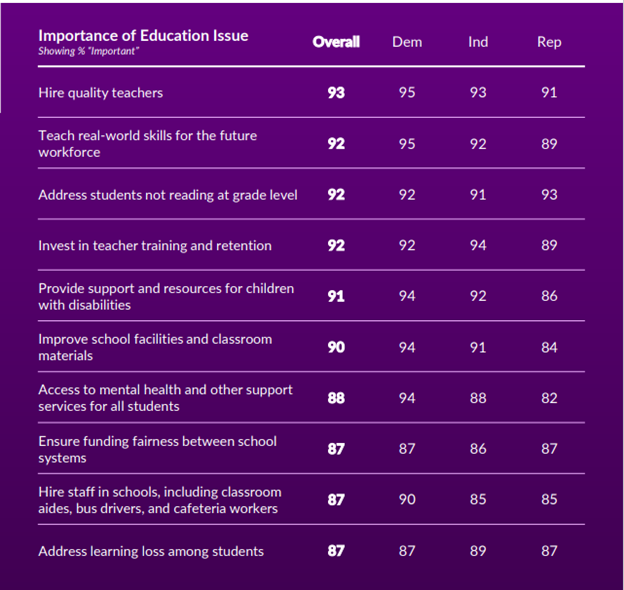
Voters from across the aisle are in alignment on what they most want public officials to prioritize.
Across the Aisle Suvey 2026 - Top Educational Priorities
HOW DO VOTERS FEEL ABOUT EDUCATION STAKEHOLDERS?
Across party lines, voters express substantially stronger confidence in educators than in elected officials or
senior education leaders.
WHAT ARE THE PAIN POINTS VOTERS SEE IN EDUCATORS’ LIVES?
Voters are increasingly concerned about the sustainability of the teaching profession.
HOW CAN WE SUPPORT EDUCATORS?
Supports to alleviate administrative duties and rebuild trust between educators, parents, and policymakers
will be essential to keeping great teachers in the classroom.
WHAT DO VOTERS AGREE ON WHEN IT COMES TO TEACHERS?
Voters believe that public schools must be resourced and representative.
WHO ARE TRUSTED EDUCATION MESSENGERS?
Teachers are far-and-away the most trusted voice for public school transformation, followed by parents,
while local elected leaders and state legislators register considerably lower confidence levels.
Read the entire extensive report HERE.
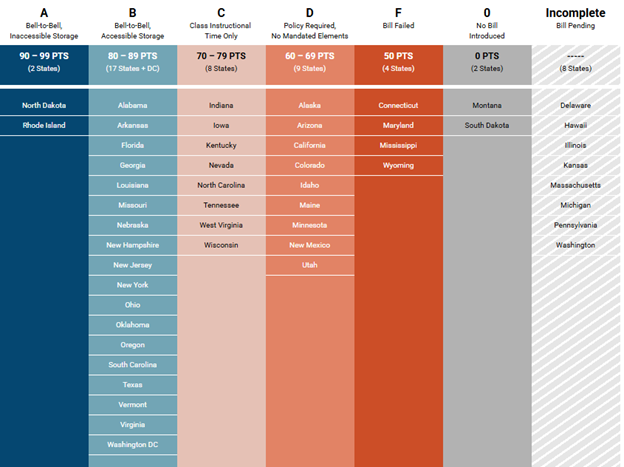
For a detailed breakdown of all state and D.C. laws, click here.
At-A-Glance List of States by Grade - Click on the image for a larger view
Click here to subscribe to the weekly legislative update or other NC Department of Public Instruction topics.
To view previous K-12 Education Legislative Updates, click here.
NCDPI Office of Government Affairs: Anne Murtha – Legislative Specialist
|
|
|
|
|