December Content
- Campaign For Tobacco Free Kids' 2026 Youth Advocates of the Year Awards
- Project AWARE Featured as Success Story
- Family-Friendly Healthy Habits Resources from Healthier Generation
- SHAC 101 Scheduled for January 9th at 9am
- North Carolinians for a Tobacco Free Generation Released New Podcast Episode
- Webinar: Bringing Everyday Kindness to Classrooms & Communities
- From the Boardroom: How Whole Child NC and Statewide Wellness Efforts Converge to Support Student Well-Being
- December / January Health Observances

Campaign For Tobacco Free Kids' 2026 Youth Advocates of the Year Awards
Know an Amazing Youth Advocate? Help them apply!
Applications are now open for the Campaign for Tobacco Free Kids’ 2026 Youth Advocates of the Year Awards scholarships. The deadline to apply is January 16, 2026, at 2:59 am ET. This year's awards ceremony will take place on May 7, 2026, at the Smithsonian National Portrait Gallery in Washington, D.C.
They will honor: (1) Barrie Fiske National Youth Advocate of the Year ($10,000 scholarship) (1) Group Youth Advocates of the Year ($2,500 grant). Past recipients have demonstrated extraordinary passion and creativity in advocating for effective tobacco prevention policies in their communities. From rallying peers to testifying before local government and state legislatures, they have been on the front lines calling for change.
Award recipients and finalists have received additional leadership opportunities uplifted by the Barrie Fiske Youth Leadership Fund, which fosters a new generation of advocates to counter the tobacco industry’s influence and spread the truth about smoking, vaping and nicotine addiction.
Learn more about the Youth Advocates of the Year Awards and apply here.
|
  NC Project AWARE/ACTIVATE: Sustaining Mental Health Delivery
In 2018, North Carolina embarked on a bold new journey to transform how schools support student mental health. With funding from SAMHSA, the state launched Project AWARE/ACTIVATE in three rural pilot districts, communities where access to services had long been a challenge. The goals were ambitious yet clear: (1) Increase awareness of youth mental health issues, (2) Provide training to school staff on youth mental health issues, (3) Connect students and families to mental health services.
Over the course of a five-year grant, the Project AWARE team worked tirelessly to implement school mental health programming into these districts, and the results speak for themselves. In the first cohort of three districts, 88% of students who were referred to mental health services received services. In the end, AWARE served 10,980 students from 2020-2023, a dramatic shift from where they started. AWARE’s early successes led to them being awarded a second SAMHSA-funded grant in 2021.
Despite the significant success of these two AWARE cohorts, the project had to face a new, yet all too common challenge: how to sustain programming when grant funding ends.
The Center for Mental Health Implementation Support (CMHIS) has spotlighted NC Project AWARE/ACTIVATE in their Success Stories From the Field: Sustaining Mental Health Service Delivery
Family-Friendly Healthy Habits Resources from Healthier Generation
Schools across North Carolina are helping kids build healthy habits that reduce the risk of type 2 diabetes—through balanced meals, daily movement, and routines that stick. As we recently celebrated Diabetes Awareness Month and head into the holiday season here are some family-friendly resources that mirror what schools are doing and make it easy to bring healthy habits home:
🍎 Healthy Eating
❄️ Movement & Activity
💙 Whole Child, Whole Family Health
Each resource reflects the diabetes-prevention practices we help schools implement every day —nutrition lessons, movement breaks, and wellness strategies—while also making it easy to bring families into the work and reinforce the same habits at home. Feel free to share these ideas and resources throughout the season to help families enjoy a healthier, happier holiday!
Learn more about our Healthier Generation Healthier North Carolina (HGHNC) work supported by NovoNordisk here→ North Carolina
 SHAC 101 Scheduled for January 9th at 9am
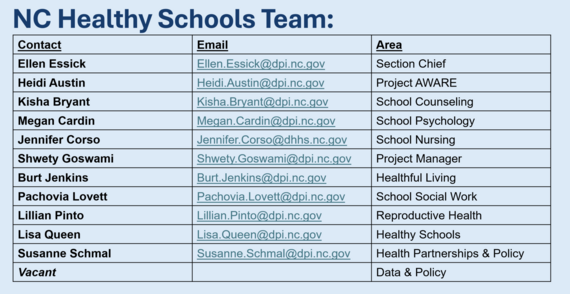
if you are interested in participating in the January 9th SHAC 101 Virtual Session, please email Susanne.Schmal@dpi.nc.gov to be included in the meeting invitation. If you are unable to attend but would like to attend a future session, please email, as well.
SHAC 101: Opportunities for Leadership and Outcomes
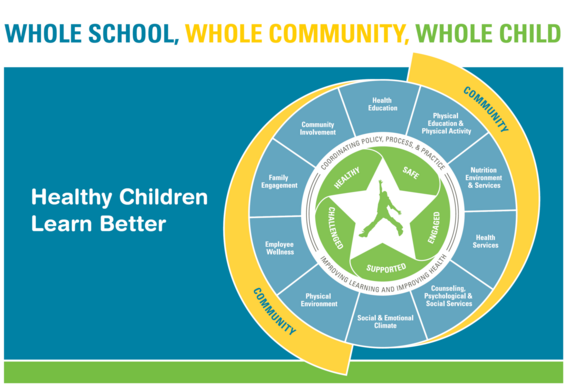
New to School Health Advisory Committees (SHACs) or you’re looking for some tips to revive your current engagement? Join us to learn about the essential steps to develop your SHAC; the Whole School, Whole Community, Whole Child model; building your team; creating an action plan; sharing out your successes, and more. It is also an opportunity to meet other SHAC leaders, share about your work, and ask the questions you always wanted to know…
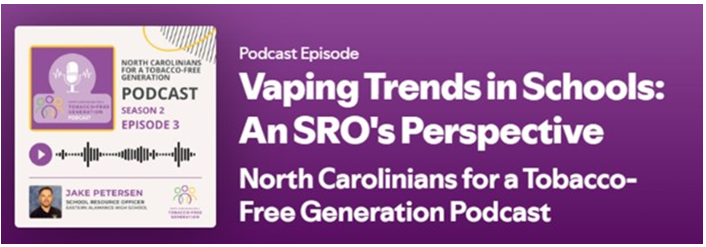 North Carolinians for a Tobacco Free Generation Released New Podcast Episode
In this podcast episode, Jake Peterson, a school resource officer (SRO) at Eastern Alamance High School in North Carolina, discusses his experiences with students engaging in vaping and e-cigarette use. Peterson emphasizes the importance of building trust with students beyond a traditional law enforcement role to effectively address and mitigate vaping incidents. The challenges faced by schools include students perceiving vaping as less harmful due to the lack of cigarette smell and colorful vape devices. Educating students and integrating anti-vaping messaging into school and community programs are crucial strategies highlighted for prevention. Listen to the episode on Spotify.
Webinar: Bringing Everyday Kindness to Classrooms & Communities
Join us as we launch February’s Character Challenge
February 2, 2026 | 3:00-4:00 PM EST
#KindnessMattersNC — a month-long celebration dedicated to spreading kindness, compassion, and positivity across North Carolina schools and communities. Inspired by the uplifting stories of Steve Hartman, this initiative helps teachers, leaders, students, and families weave kindness into everyday life. Learn how to:
- Integrate daily acts of kindness into morning meetings and content-area classes
- Use daily videos and journal prompts for reflection and writing activities
- Encourage students to create and share kindness stories of their own
Register: https://ncgov.webex.com/weblink/register/rf91a853e3f8a71092dbd7b19ab1df773
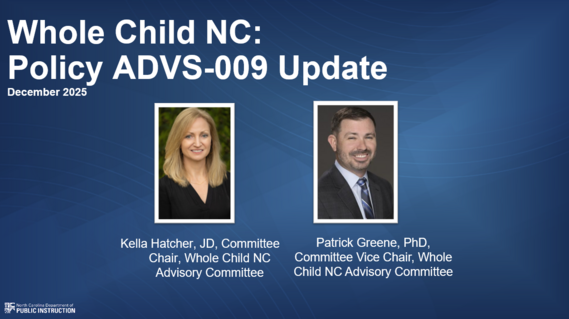 From the Boardroom: How Whole Child NC and Statewide Wellness Efforts Converge to Support Student Well-Being
The Board’s December meeting highlighted a powerful throughline: North Carolina’s students can only thrive academically when their basic needs, physical health, and emotional well-being are intentionally supported. Two presentations—one from the Whole Child NC Committee and another summarizing statewide Healthy Active Children and School Mental Health reports—came together to paint a clear picture of where schools are making progress and where persistent gaps still demand attention.
Whole Child NC opened with a reminder of its charge: identifying nonacademic barriers that prevent students from receiving a sound basic education and recommending practical solutions. The committee revisited four recommendations made earlier this year—expanding specialized instructional support personnel (SISPs), fully funding DPI’s school psychology recruitment position, providing master’s pay for school social workers, and increasing access to school-based health centers. Members also underscored how strongly these recommendations align with the Board’s Achieving Educational Excellence strategic plan. Each item, developed before the plan’s adoption, naturally reinforces the plan’s commitments around school climate, student well-being, community partnership, and celebrating the essential professionals who make learning possible.
The committee then introduced a new recommendation: moving North Carolina toward requiring a master’s-level social worker in every school. Dr. Patrick Green emphasized that this would not be a short-term shift but a multi-year effort requiring thoughtful planning, workforce development, and collaboration with higher education.
But the need is clear. With one in five children living in food-insecure households, one in five adolescents seriously considering suicide, and more than half of students reporting difficulty accessing mental-health treatment, schools are increasingly the first and sometimes only place where students can receive timely support. A master’s-level social worker can conduct psychosocial assessments, provide short-term counseling, and deliver crisis interventions on the spot—capabilities beyond the scope of bachelor’s-level training.
The Board then received its annual updates on physical health and mental-health services across the state. The Healthy Active Children report shows bright spots—nearly all elementary students receiving 30 minutes of daily physical activity, more schools strengthening wellness policies, and continued community partnerships that expand access to supports. But the data also highlight challenges: uneven physical education minutes, limited resources for School Health Advisory Councils, and ongoing concerns about recess being withheld as discipline despite clear Board policy prohibiting it.
The School Mental Health report reflected similar themes. Districts are increasingly using data to guide decisions, improving professional development for staff, and strengthening early-intervention systems. Yet the needs remain significant, especially around funding, staffing ratios, and ensuring consistent crisis-response and re-entry procedures. DPI continues to pursue federal grants to bolster the pipeline of school psychologists, counselors, and social workers, including re-specialization programs, hiring incentives, and paid internships to attract talent into high-need districts.
Together, these presentations reinforced a simple truth: students cannot focus on academics when they are hungry, unsafe, or struggling emotionally. North Carolina’s strategic plan makes well-being a central pillar of academic success, and December’s discussions reflected a shared commitment to building the systems, workforce, and community partnerships needed to honor that promise for every child.
December / January Health Observances Include:
- December is National Safe Toys and Gifts Month
--------------------------------------------
- January is Cervical Health Awareness Month
- January is Blood Donor Month
- January is National Human Trafficking Prevention Month
- January is Thyroid Health Awareness Month
- January 18th - 24th is Healthy Weight Week
Interested in Subscribing?
If you are not directly subscribed to this newsletter and would like to be, you can select the button below, enter your email address, and select "NC Healthy Schools, WSCC and SHACs" within the "Department and Division News" topics.
Or you can email Susanne.Schmal@dpi.nc.gov.
|