Draft 3 of the Proposed 2025 ELA SCOS Standard-by-Standard Survey Closes This Week
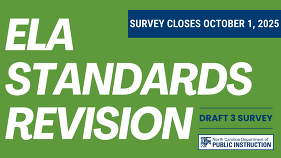
Survey Closes Wednesday, October 1, 2025
Only one week remains to provide input on Draft 3 of the Proposed 2025 ELA Standard Course of Study!
State Board of Education policy specifies that the NC Department of Public Instruction will formally collect feedback on the draft revised standards from educators, administrators, parents, students, institutions of higher education, business/industry representatives, and other education agencies.
The purpose of the Draft 3 Standard-by-Standard Survey (K-2, 3-5, 6-8, and 9-12) is to obtain input from educators and stakeholders familiar with the English Language Arts (ELA) Standard Course of Study in order to inform further revision decisions. As such, the ELA team requests your thoughtful input and comments on the draft revised academic standards for ELA to inform the revision process.
To support completion of the standard-by-standard survey, view this previous listserv regarding the ELA Standards Timeline. This listserv explains key reasons for the delay in the revision timeline for the Proposed 2025 ELA Standard Course of Study. Also, this Survey Companion Document provides context for revisions made to Drafts 1-3 of the Proposed 2025 ELA SCOS.
|
PDF versions of the Draft 3 surveys are available to view, if needed. NCDPI thanks you for your time and input. Your feedback is extremely valuable to the ELA standards revision process.
ELA Standards Update Webinar Series
Mark your calendars for the 2025-2026 school year ELA Standards Update Webinars!
Join the NCDPI ELA Team throughout the 25-26 academic year to learn more about the proposed English Language Arts Standard Course of Study.
Webinars will allow participants to:
- Gain a greater understanding of the proposed standards
- Explore proposed revisions to the 2017 SCOS
- Dive deeper into the proposed SCOS organization and structure
- Receive updates on the installation timeline and supporting resources
Upcoming Webinars
Register today for the remaining hour-long learning opportunities, and consider sharing the flyer with colleagues who would be interested in joining!
Previous Webinars
View recordings of previous webinars to catch up on information you may have missed or share the recordings with colleagues to keep them in the loop! Recordings to previous webinars are available in the ELA Virtual Implementation Kit (VIK) on the Professional Learning Page under On-Demand Resources.
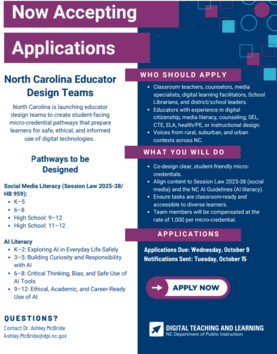
Help Build North Carolina’s Student Micro-Credentials on Digital Well-Being (Session Law 2025-38) & AI Safety
North Carolina is forming educator design teams to build two sets of student micro-credential pathways:
- Social Media Literacy (required by Session Law 2025-38): ensuring all students understand the mental, social, emotional, and physical impacts of social media, including misinformation, manipulation, cyberbullying, online safety, reporting, and digital permanence.
- AI Literacy & Ethics: a forward-looking initiative helping students build the skills to use AI responsibly, critically, and creatively across academic, personal, and career settings.
Classroom teachers, counselors, media specialists, digital learning leaders, and administrators statewide are invited to apply by October 9, 2025. Accepted applicants will be notified by October 15, 2025 and will co-design practical, student-facing micro-credentials (clear learning goals, student tasks, and rubrics) ready for classroom use. View the flyer for additional information.
-
Applications Due: October 9, 2025
-
Acceptance Notification: October 15, 2025
-
Timeframe/Format: Collaborative design sprints with asynchronous drafting and brief synchronous check-ins.
|
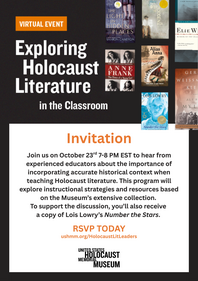
Exploring Holocaust Literature in the Classroom
United States Holocaust Memorial Museum
Free, Virtual Program for Educators | October 23rd 7-8 PM EST
Registration is open for Exploring Holocaust Literature in the Classroom, taking place October 23, 2025. During this free virtual program, educators will discuss the importance of incorporating accurate historical context when teaching Holocaust literature. The program will also highlight instructional strategies that strengthen literacy skills and explore resources based on the Museum’s primary source collection that help students understand how and why the Holocaust happened.
Key Participant Takeaways:
- Approaches for learning essential historical context while building literacy skills
- Effective strategies to practice key skills, such as close reading, writing, analysis, research, listening, speaking, and reflection
- Introduction to foundational teaching resources supporting exploration of Holocaust literature
- Information about professional development opportunities
- Advantages of cross-curricular connections
Free Book: To provide an example and support the discussion, a copy of Number the Stars will be mailed to program registrants (details apply).
Register now for this virtual professional learning opportunity!
|
Disclaimer: The links on this page will bring you to third party websites, owned and operated by independent parties over which NCDPI has no control. Any link you make to or from these 3rd Party Websites will be at your own risk. Any use of these 3rd Party Websites and any information you provide will be subject to and governed by the terms of the 3rd Party Website, including those relating to confidentiality, data privacy, and security.
Unless otherwise expressly agreed in writing, NCDPI is not in any way associated with the owner or operator of any of the 3rd Party Websites or responsible or liable for the goods and services offered by them or for anything in connection with such 3rd Party Websites. NCDPI does not endorse and makes no warranties, representations or undertakings relating to the content of any 3rd Party Website.
|