'In It Together': Superintendents Endorse NC’s Five-Year Plan for Public Schools
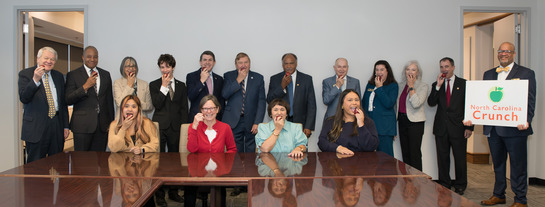
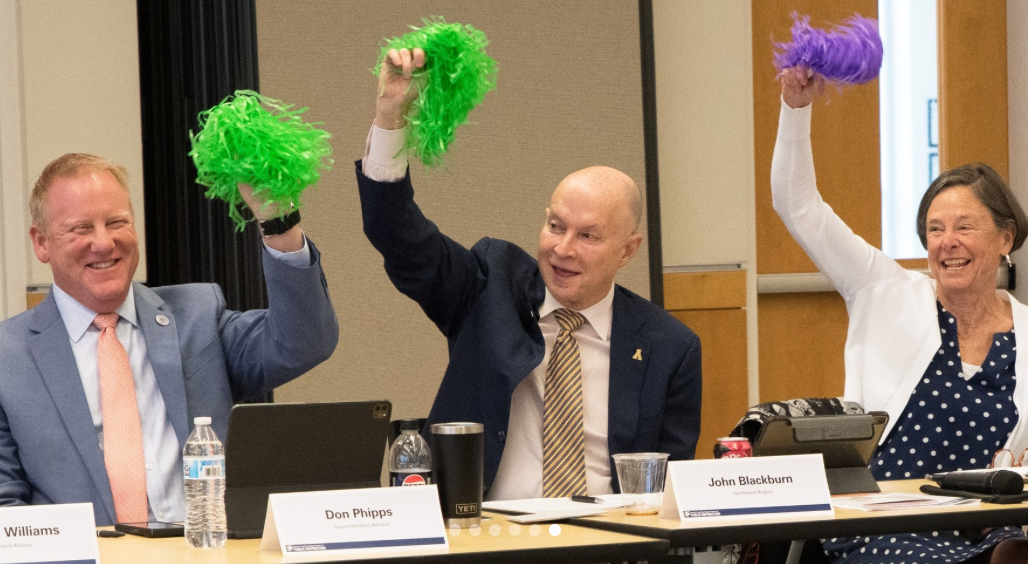
At this month’s State Board of Education meeting, local and state leaders came together to show strong, unified support for the Achieving Educational Excellence Strategic Plan. Dr. Don Phipps, Superintendent of Caldwell County Schools and President of the North Carolina School Superintendents’ Association (NCSSA), spoke on behalf of school superintendents across the state, as well as the North Carolina Association of School Administrators (NCASA) and its 8,000 members. Together, they offered what Dr. Phipps called their “enthusiastic support” for the plan’s vision of making North Carolina’s public schools the best in the nation by 2030.
Dr. Phipps highlighted that the NCSSA, in partnership with FranklinCovey, is bringing nationally recognized leadership training to North Carolina’s district leadership teams, principals, and other school leaders. The professional development series includes well-known programs such as The Speed of Trust, The Four Essential Roles of Leadership, and The Six Critical Practices for Leading a Team. According to Phipps, this investment in leadership capacity will strengthen trust, collaboration, and accountability while uplifting educators and ensuring supportive learning environments for all students.
“This initiative is fully aligned to North Carolina’s new Achieving Educational Excellence Strategic Plan for 2025–2030,” Phipps emphasized. “It represents a powerful investment in leadership capacity, ensuring we are well positioned to help every student succeed today and prepare for their future.”
The message of unity and alignment resonated strongly with State Superintendent Mo Green, who reflected on his own time as a local superintendent. “This means something extra special to me as a former local district superintendent, to have my colleagues say this is something we want to be a part of and will make successful,” Green shared. “I am overwhelmed at the moment that we have leaders across the state who are willing to say, ‘let’s band together to make this happen.’”
This moment underscored the growing statewide coalition rallying behind the strategic plan—leaders from classrooms to central offices aligning their efforts with a shared goal: excellence for every student in every North Carolina public school.
|
North Carolina Launches Task Force to Redesign School Accountability
The State Board of Education took a major step toward rethinking how we measure school success. DPI’s Chief Accountability Officer Michael Maher and Director of State Board Operations & Policy Rupen Fofaria, introduced the vision and scope for a new Task Force on Accountability Redesign. The initiative stems directly from the Achieving Educational Excellence Strategic Plan, which calls for developing a multi-indicator model that better reflects student growth, readiness, and the full range of learning in North Carolina schools.
For nearly 30 years, North Carolina has been a leader in accountability—from the ABCs program in the 1990s, to federal NCLB requirements in the 2000s, to today’s A–F school performance grades. But as Dr. Maher explained, the current model—heavily weighted on end-of-grade and end-of-course exams—“is a limited reflection of readiness for college, career, and life.” Educators, students, and families alike have long expressed that a single test score does not capture the full picture of a school’s work.
The new task force will be charged with exploring a broader set of indicators that measure both proficiency and growth, while also recognizing other essential dimensions of student learning. “Our students deserve an accountability system that recognizes their progress, a true measure of their growth and their readiness for the future,” Fofaria said. “Our educators deserve a system that reflects the full scope of their work. And our communities deserve transparent information that builds trust and drives improvement.”
Board members engaged in a robust discussion, raising important perspectives. Dr. Olivia Oxendine emphasized the need to ensure that proficiency in reading and math remains central. Student advisor Ian House lifted up feedback from students, who asked that schools also be measured on participation, durable skills from the Portrait of a Graduate, and extracurricular opportunities. Other members stressed that growth should be recognized alongside proficiency so that no child’s progress is overlooked.
Board Chair Eric Davis formally established the task force, noting that while much work lies ahead, this is an opportunity for North Carolina to lead once again. “Our current model distracts us from our ultimate mission—to understand what we’re successfully teaching, what learning is not occurring, and how to get better,” Davis said. The task force will begin work this fall, with updates to the Board throughout 2026, and aims to bring forward a framework that reflects a more complete and accurate picture of how schools are serving students.

GRAD-009 Update: Transcript System, Next Steps on Class Rank and FF policy
The Board revisited GRAD-009 (High School Transcript Standards) to clarify how DPI’s statewide transcript system serves both district and charter schools. Staff explained that the new Student Information System (SIS) now lets charter schools generate an official standardized transcript without displaying class rank—consistent with legislation—while still ensuring those students are captured for NC College Connect as long as GPA is entered.
Board members noted the policy team’s responsiveness since the item first appeared this summer. “This is a perfect example of policy coming together the right way,” Board member Olivia Oxendine said.
A robust discussion centered on class rank. Vice-Chair Alan Duncan voiced support for charter schools' option to omit class rank, but registered concern that traditional districts don’t have the same flexibility under current statute. “These are our public schools,” he said. “We are treating them differently… in a way that is not necessarily in the best interest of students.” Student advisor Ian House suggested, if rank must remain for districts, exploring alternatives—such as reporting top 10/20/30 percent or quartiles—to reduce unhealthy competition while preserving recognition.
The Board also clarified the scope of today’s action: a sentence that had been proposed to restate existing limits on the “FF” grade—“a student may not fail a course based solely on attendance”—was removed from this package to allow for additional field engagement on that topic.
In the end, the Board approved the GRAD-009 revisions (with the exception of the clarifying sentence to the FF policy) and will send correspondence to the General Assembly requesting that traditional public school units be granted the same option as charters to include or omit class rank now that the SIS can support both approaches. The goal is simple: a standardized, modern transcript that meets legal requirements, works for colleges, and supports healthier school cultures across all public schools.
|
Low-Performing Schools Update: Clear Timelines, Real Supports, and Local Wins
The Board heard a comprehensive update on low-performing districts and schools—what the law requires, where the data stand, and how DPI is organizing support. The statutory timeline is tight: after the Board finalizes accountability data (Oct. 2), local boards must approve preliminary improvement plans within 30 days and notify parents; final plans are due to the State Board by early December. Also, superintendents must formally report a personnel decision for each principal in a designated school—retain, retain with a plan, transfer, or dismiss—by Oct. 31.
The latest landscape shows 685 schools designated as low-performing, with regional maps and year-to-year shifts highlighting clusters where attention and support should concentrate. Presenters noted that some schools move in and out of designation from one year to the next, often right at the “line” between categories, underscoring the need for sustained focus on both proficiency and growth.
DPI’s newly consolidated Office of District and School Support & Services (ODSSS) walked through a coordinated system of help: NCSTAR planning tools and needs assessments, leadership coaching, MTSS, regional support teams, curriculum coaching, and targeted pilots like Golden LEAF Schools. The through-line is simple: strong districts → strong schools → strong classrooms → student success. As Dr. Monique Felder emphasized, what matters most is core instruction—done well and consistently—because that’s what ultimately addresses student needs.
Two districts illustrated what this looks like on the ground. Cleveland County described aligning goals State→District→School→Team, building flat leadership structures, and insisting that “growth is not accidental”—it’s the product of intentional systems, coaching, and collaborative problem-solving. Montgomery County shared how a priority partnership with ODSSS is strengthening leadership capacity, standardizing curriculum, and running learning-walk and feedback cycles. Superintendent Dr. Karen Roseboro put it plainly: school turnaround “is not for the tired, the timid, the weak, or the weary,” and it must start with a healthy core.
|