|
Highlights
Letter from State Board Chairman Eric Davis and State Superintendent Maurice “Mo” Green
August 2025
To the People of North Carolina,
We are proud to share with you Achieving Educational Excellence: 2025 – 2030 Strategic Plan for North Carolina Public Schools. The plan is a declaration: Public education is the foundation of North Carolina’s future. The plan represents the shared vision of the North Carolina State Board of Education (SBE) and the North Carolina Superintendent of Public Instruction – to have our public schools be the best in the United States of America.
To be clear – to be the best is the only option.
Grounded in eight transformative pillars that come from listening to North Carolinians expressing their hopes for our public schools, this plan is both a commitment and a call to action – to prepare each student for their next phase in life, to elevate and revere our educators, to strengthen family and community partnerships and to ensure that our schools are safe, healthy and inclusive spaces for all. Through focused efforts to modernize operations, scale innovation and celebrate the value of our public schools, we aim to ensure that public education remains an excellent choice for families.
Implementation of this plan will require coordinated effort and transparency, as well as the voices and leadership of educators; students; families; federal, state and local government officials; and partners across every region of North Carolina. That’s why this plan was built not only by SBE and North Carolina Department of Public Instruction (NCDPI) leaders, but in collaboration with our students, public school units (PSUs), parents and caregivers, members of the North Carolina General Assembly, community partners and state and national networks. This is a living, evolving framework – and it will only succeed through shared ownership and collective commitment.
We are excited about the path forward and grateful to walk it with you. Together, we will deliver on the promise of public education – for every child, in every community, across North Carolina.
With shared purpose,
Eric C. Davis
Chair, North Carolina State Board of Education
Maurice “Mo” Green
North Carolina Superintendent of Public Instruction
DPI Press Release | August 6, 2025: Five-year plan "Achieving Educational Excellence" presented to State Board, sets ambitious goals through 2030. Following approval by the North Carolina State Board of Education (SBE) on Thursday, the groundbreaking strategic plan "Achieving Educational Excellence: 2025-2030 Strategic Plan for North Carolina Public Schools" will be publicly launched on Wednesday, August 20, with events featuring Governor Josh Stein, North Carolina Superintendent of Public Instruction Maurice "Mo" Green and education leaders from across the state.
Evening Public Launch
WHEN: Wednesday, Aug. 20, 2025 | 6–7 p.m.
WHERE: Neuse River Middle School, 2700 Old Milburnie Rd., Raleigh, NC 27604
WHO: Superintendent Green, State Board members, 2025 Teacher of the Year Rachel Candaso, 2025 Principal of the Year Jason Johnson, students
AUDIENCE: Educators, elected officials, community members
FORMAT: Public celebration with student performances and strategic plan presentation
RSVP: Fill out this form to let us know you plan to attend the public evening event.
Plan Highlights:
The "Achieving Educational Excellence" plan establishes eight strategic pillars:
-
Prepare Each Student for Their Next Phase in Life – Expanding rigorous pathways, dual enrollment and character development
-
Revere Public School Educators – Competitive compensation and career advancement opportunities
-
Enhance Parent, Caregiver and Community Support – Strengthening family engagement and partnerships
-
Ensure Healthy, Safe and Secure Learning Environments – Physical and emotional safety with mental health support
-
Optimize Operational Excellence – Modernizing systems and eliminating administrative burdens
-
Lead Transformative Change – Research-driven innovation and accountability reform
-
Celebrate the Excellence in Public Education – Comprehensive messaging to highlight successes
-
Galvanize Champions to Fully Invest in and Support Public Education – Building coalitions for increased investment and pride in our schools
Key Goals by 2030:
- 92% four-year graduation rate (currently 86.9%)
- ACT composite score of 20 (currently 18.5)
- 30% AP participation among 10th-12th graders (currently 21.5%)
- 41% Career Technical Education (CTE) participation among all K-12 students (currently 36.1%)
- 89% of school-aged children enrolled in public schools
- Lead the Southeast in educator compensation
- National leadership in National Association for Educational Preparedness (NAEP) reading and math scores
North Carolina's Strategic Plan for Educational Excellence | NC DPI
Read the entire Press Release here.
|
State Board of Education
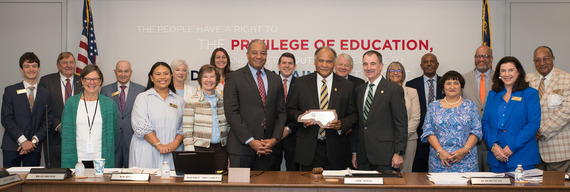
State Board of Education August Meeting
-
Wednesday, August 6 at 10 AM
-
Thursday, August 7 at 9 AM
-
Government and Community Affairs
-
Approval of 2025-2030 Strategic Plan for North Carolina Public Schools -- Achieving Educational Excellence
-
NC College Connect
- Sneha Shah-Coltrane, Senior Director, Office of Advanced Learning and Gifted Education
-
NC College Connect Presentation | Website: NC College Connect
- NC College Connect is a program that offers North Carolina public high school students with a weighted GPA of 2.8 and above who meet NC College Connect requirements direct admission to select colleges and universities participating in the NC College Connect program.
-
State Board of Education Temporary Rule Adoption - Qualifications of School Nurses
About the State Board of Education
YouTube recordings of SBE meetings HERE.
|
K-12 Education Bills

Bills in the News:
WRAL News - Staff | August 6, 2025: North Carolina Gov. Josh Stein announced Wednesday that he had signed a so-called "mini budget" to fund state government, as well as a bill aimed at cracking down on squatters. He also vetoed school choice legislation known as House Bill 87. He has urged state lawmakers to pass a comprehensive budget soon. "We've got teachers and students counting on real raises,” Stein said Tuesday at a monthly meeting of the Council of State, which consists of the state’s top executive office holders. “We've got law enforcement who need real raises so that we can address the vacancies that exist throughout state government and in local government. Inflation is real, and there are no pay raises for state employees in this mini-budget." House and Senate budget writers haven't made progress on a full budget deal since going home at the end of June. The leaders of the two chambers disagree on tax cuts and other major policy items, but they say they’re still willing to negotiate toward a final budget deal.
EdNC - Eric Davis | August 7, 2025: The mini-budget takes some actions so that our schools can continue operating and our educators can keep doing their work. But we must also speak the truth that this mini-budget stops short of providing the resources our public schools and our public school educators so desperately need. There are no new raises for educators, and it cuts or reallocates funds in ways that reduce our Department of Public Instruction’s flexibility. The best investment our state can make is to fully fund our public schools by passing a budget on time. We’re called to do more than react to budgets. We’re called to lead with vision. Our students are watching. Our families are counting on us. History will judge us not by the obstacles we faced, but by how fiercely we pursued our mission to prepare every child for success. Let’s move forward with resolve. Let’s show this state and our nation what public schools can achieve when passion meets purpose, when vision meets action, and when adults put the future of children first. Let’s give our lawmakers a glimpse of what is possible so that all of us can see clearly how much further we can go with a fully-funded investment in our children and our state’s future.
|
New Session Laws Affecting K-12 Education
-
HB 125 Continuing Budget Operations. Ch. SL 2025-89
K-12 Education Bills to Watch
The following bills affecting K-12 education are still eligible for additional legislative action this session. Bills with an asterisk* have already been placed on the House Calendar for a potential veto override attempt on Tuesday, August 26, 2025. For a complete list of education bills to watch, see 2025-2026 Biennium K-12 Education Bills Tracking Link.
-
HB 87 Educational Choice for Children Act (ECCA). Vetoed 8.6.2025 | Veto Document
-
HB 171* Equality in State Agencies/Prohibition on DEI.
-
SB 50* Freedom to Carry NC.
-
SB 153* North Carolina Border Protection Act.
-
SB 227* Eliminating "DEI" in Public Education.
|
|
North Carolina General Assembly
State Budget Information & Resources
2025 State Budget Proposal
2025 State Budget Update
2023 State Budget
Other State Budget Resources
K-12 Education Legislation Resources
Enacted Hurricane Helene Recovery Legislation
|
Useful Acronyms
DPI = Department of Public Instruction
GS = General Statute
HB/SB = House Bill/Senate Bill
JR = Joint Resolution
LB/LOB = Legislative Building/Legislative Office Building
LEA = Local Education Agency
NCGA = North Carolina General Assembly
PCS = Proposed Committee Substitute
PSU = Public School Unit
SBE = North Carolina State Board of Education
SL = Session Law
For the glossary of education acronyms/terms, click here.
For the glossary of legislative terms, click here.
|
|
In Other News
EdNC - Sergio Osnaya-Prieto | August 6, 2025: The state’s pension plan generated $8 billion in investment returns in the first half of 2025, state Treasurer Brad Briner announced at a Council of State meeting in early July. Those gains are approximately $3.5 billion above the state Treasury’s original estimate, according to a July 9 press release. “That’s more than the stock market by itself would deliver and double what we need to make to keep our pension system solvent,” Briner said about the $8 billion returns in a video announcement. A 2023 study by Yale University found that it delivered an average return of just 4.9% over the previous three years — placing it last among the 50 state retirement systems. By comparison, the national average during that period was 7.84%.
Education Commission of the States | August 5, 2025: Education Commission of the States just updated two 50-State Comparisons with key data like this to help you understand the current landscape of teacher recruitment and retention and postsecondary education funding policies across states.
-
Teacher Recruitment and Retention: Explore state-specific data related to teacher shortages and a national comparison of state policies to recruit and retain teachers across the teacher pipeline. You’ll find state policies relevant to each stage of the pipeline with separate sections on state teacher workforce data and financial incentives, which are important state policy levers at every stage of the pipeline.
- Postsecondary Education Funding: Find summaries of key policy decisions state leaders make in funding higher education in their state, including: the state’s budget process, funding model and which factors drive funding allocations. This 50-State Comparison was developed in partnership with the National Center for Higher Education Management Systems (NCHEMS).
Treasury Brad Briner Press Release | August 5, 2025: An effort to keep state dollars in North Carolina came to fruition today at the N.C. Capital Facilities Finance Agency (NCCFFA) meeting. This group, chaired by State Treasurer Brad Briner, adopted new guidelines earlier this year aimed at making it easier for nonprofit institutions, particularly schools, to issue bonds in North Carolina. On August 5, two schools used the new flexibility to move forward with projects before the NCCFFA and the Local Government Commission: The Montessori School of Raleigh (Wake County) sought to refund $5 million in bonds. Pine Lake Preparatory (Iredell County) issued $37 million in conduit revenue bonds to refinance debt and fund new campus construction.
K-12 Dive - Kara Arundel | August 4, 2025: Special education legal experts say they don’t expect a significant uptick in lawsuits in the long term from the Supreme Court’s A.J.T. v. Osseo ruling. Education attorneys say school districts need to take several steps to ensure they don’t become vulnerable to civil rights claims for monetary damages related to supports and services for students with disabilities. That includes preventing discriminatory practices through training sessions about disability-related policies and practices, as well as addressing problems as soon as they are known. The unanimous Supreme Court ruling in A.J.T. v. Osseo Area Schools in June clarified that the “deliberate indifference” standard applied to education disability discrimination cases should apply universally, replacing the 8th U.S. Circuit Court of Appeals’ higher standard of “bad faith or gross misjudgment,” said Martín.
K-12 Dive - Roger Riddell | August 4, 2025
-
Artificial Intelligence— A recent “Dear Colleague” letter sent to district and state leaders from the U.S. Department of Education provided guidance on using existing federal grants to integrate artificial intelligence in schools. The letter, signed by U.S. Education Secretary Linda McMahon, said grantees may use federal funds to implement AI to enhance high-quality curriculum tools, high-impact tutoring, and college and career pathway advising.
-
Federal Education Funding — $79 billion is the proposed funding level for the Education Department in fiscal year 2026 by the U.S. Senate Appropriations Committee. The bipartisan proposal, approved in a 26-3 vote on Thursday [July 31], would prevent the executive branch from removing Title I and special education programs to agencies outside the Education Department.
-
DEI Hiring, Training— The U.S. Department of Justice released sweeping guidance Wednesday that limits the use of “unlawful” DEI practices in school district hiring and training practices, as well as the programming available to students.
EdNC - Mebane Rash | Updated August 4, 2025: In June 2025, the N.C. Department of Health and Human Services (NC DHHS) confirmed the first case of measles this year in North Carolina. In July, Haywood County first confirmed six active cases of pertussis, commonly called whooping cough, in children and teens, and that number has since increased to 13. The U.S. Centers for Disease Control (CDC) released new data last week showing “coverage with MMR, DTaP, poliovirus vaccine (polio), and varicella vaccine (VAR) decreased in more than half of states, compared with coverage the year before.”
Which vaccines are required for students in North Carolina? - According to NC DHHS, regardless of school setting, “North Carolina law requires that all children must get certain vaccines.” “School principals and child care operators are responsible for enforcing state immunization laws for school entry,” says the website. Here are the vaccine requirements for young children up to age four.
The Vaccines for Children (VFC) program helps eligible families get free vaccines. You can search by city or zip code to find a provider near you.
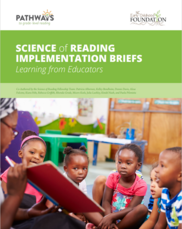
EdNC - NC Early Childhood Foundation | August 4, 2025: Reading proficiently by third grade is one of the most powerful indicators of future success, and North Carolina has made historic investments to get it right. But what happens after the training ends? How do we ensure that every classroom, school, and district can turn the Science of Reading knowledge into action?
The Science of Reading Implementation Briefs Series, co-authored by 11 educators and literacy leaders from across North Carolina, brings the classroom to the forefront. These eight briefs highlight the real-world insights, roadblocks, and breakthroughs experienced by teachers, coaches, and administrators as they implement structured literacy practices aligned with the Science of Reading (SoR).
Each brief tackles a specific challenge from aligning instruction across staff and grade levels to building inclusive schedules and supporting paraprofessionals. Together, these lessons offer a roadmap for sustainable, school-wide change that supports every child’s journey to reading proficiency.
NC Early Childhood Foundation - The NC Early Childhood Foundation works to marshal North Carolina’s great people, ideas, and achievements to build a foundation of opportunity and success for every child by the end of third grade.
|
Click here to subscribe to the weekly legislative update or other NC Department of Public Instruction topics.
To view previous K-12 Education Legislative Updates, click here.
NCDPI Office of Government Affairs: Anne Murtha – Legislative Specialist
|
|
|
|
|