Welcome to the first edition of Meeting the Challenge!
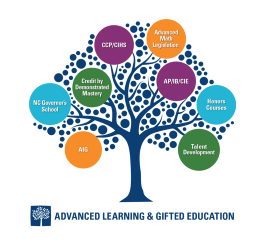
The purpose of this newsletter is to provide schools, parents, and students with information and updates regarding programs and opportunities available to the students of North Carolina through the Office of Advanced Learning and Gifted Education (OALGE) at the NC Department of Public Instruction. In this first edition, you will discover the ways the OALGE team can be of help to you in their fields of expertise. The areas under the OALGE umbrella are:
- Academically and/or Intellectually Gifted students and programming
- Advanced Placement/ International Baccalaureate/ Cambridge International Education CoursesAuto-Enrollment
- Advanced Math
- Credit by Demonstrated Mastery
- Dual enrollment programs for high school students with NC Institutes of Higher Education, including Career and College Promise and Cooperative Innovative High Schools
- Honors Level Courses
- NC Governor's School
- NC High School Diploma Endorsements
- US Presidential Scholars
|

Sneha's Two Cents
Sneha Shah Coltrane, Senior Director OALGE
In North Carolina, we are on a journey of Equity and Excellence in gifted and advanced education. The foundation for this journey rests on the mindsets below. I ask you to review and reflect on how the statements apply to your role in education. If I were to bet, I would say these statements would apply to your area in education too! They really apply to all education. We must reframe and address mindsets, policies and practices to make sustained change. It’s about expanding excellence, not limiting access. Join us on the journey.
What is Equity and Excellence in Gifted/Advanced Education? What is it not?
• It is not about ‘status’ or sacrificing needs of one group of students for another; it is meeting the needs
of all students.
• It is not seeing students at-risk; it is seeing students at-potential.
• It is not having multiple hoops to show a student’s perfection in everything; it is about multiple opportunities for students to demonstrate their potential.
• It is not providing the same services to all; it is adjusting services based on demonstrated needs of
students.
• It is not about all students receiving the same content at the same time at the same pace; it is about
personalized learning.
• It is not about putting up barriers and hurdles; it is about expanding access and opportunities.
• It is not based on a national comparison for local programs; it is based on local context and data.
• It is not only recognizing students who come with easily recognizable gifts and talents; it is about
being a talent scout and intentionally creating environments to recognize and develop talents not
yet tapped.
|
Academically and/or Intellectually Gifted (AIG) Students and Programming
What is the Impact? Creating equitable and high-quality learning environments that foster student achievement and success across the state by ensuring that AIG coordinators and other school leaders have the guidance and support needed to implement effective programs. This impacts access, opportunity, and success for students.
The goal is to continue to broaden access and success in areas around the state that do not currently offer a variety of advanced options in their schools. AIG, which includes the team’s equity and excellence strategic initiative, benefits students by shaping educational policies, setting standards, recognizing promising practices across the state, and providing resources that directly and indirectly impact the quality of education students receive.
Did you know? This year districts and interested charter schools are in the process of revising their Local AIG Plans and will submit their locally-approved 2025-2028 Local AIG Plans in July 2025.
Quick Guide: AIG Quick Guide
NC’s Promising Districts and Charters
The Office of Advanced Learning and Gifted Education (OALGE) has recognized 13 AIG Promising Districts and 2 AIG Promising Charter Schools in NC that have sustained, over time, many practices for expanding excellence and opportunities for students, teachers, and staff. The statewide Call to Action: Equity and Excellence initiative was launched in 2019-2020, and several promising districts have already been recognized for their approaches. These districts and charter schools have not only implemented the NC AIG Program Standards that are in State Board policy, but they have also mastered the connections in and between practices. The work of these schools and districts has resulted in a synergy of innovation and commitment to building capacity and systems within their district or school for the betterment of students so that they can thrive in our public schools.
| Buncombe County Schools |
Iredell-Statesville Schools |
| Charlotte-Mecklenburg Schools |
Kannapolis County Schools |
| Concord Lake STEAM Academy |
New Hanover County Schools |
| Cumberland County Schools |
Onslow County Schools |
| Durham Public Schools |
Pitt County Schools |
| Evergreen Community Charter School |
Rowan-Salisbury Schools |
| Guilford County Schools |
Watauga County Schools |
| Henderson County Public Schools |
|
Snapshots from under the OALGE Umbrella:
Did you know? A recent policy brief published by Johns Hopkins University, Automatic Enrollment in Advanced Courses: A Bipartisan Approach to Excellence and Equity in K-12 Schools, heralds North Carolina as a leader in support for and success in auto enrollment policy. The brief states that North Carolina’s Advanced Math Coursework policy provides a roadmap for other states and districts considering autoenrollment policies, and then outlines specific lessons others can learn from our example.
Advancing Excellence: Of the over 155,000 AP exams administered in North Carolina in the 2023-2024 school year, 65.4 percent resulted in a proficient score of 3 or better, exceeding the national average and increasing NC’s previous rate of 59 percent in 2022-23. This also marked the highest average score for NC students in the past 10 years.
Did you know? Student participation in the Career and College Promise program continues to grow. 36% of high school graduates in the 2023-24 school year took at least one dual enrollment college course while in high school.
Preparing for Continued Excellence: The Honors team from NCDPI has been delivering professional development to all eight state regions since last spring. District teams from across the state have been working hard to implement the Honors Policy.
Below are comments sent to the Honors Team from a district leader and an Honors teacher after attending Honors professional development:
- "This morning in preparation for addressing RL 11-12.5 (structure of texts), I had the class do the generative thinking of one thought or word on a post-it. Since we are going to be reading Faulkner's "A Rose for Emily," I gave them the word PAST. What they came up with was amazing. In this class, I have several with 504s, IEPs and accommodations by the way. The strategy still worked well! Thank you for sharing this strategy with us. I'm looking forward to sharing it with my colleagues here in my school." Valerie Person, AP/Honors English Teacher, Currituck County Schools
- "The feedback from our attendees has been extremely positive and the training fit so well in our journey to Honors attestation and bringing all our Honors staff to the same page of expectation and application. Thank you to your team for providing this opportunity." Betsy Gatchel, Director of Student Programming, Craven County Schools
Please visit Honors Level Coursework | NC DPI for additional information.
Did you know? The NC Governor’s School is the oldest summer residential program of its kind in the nation. Founded in 1963, over 25 other states have established similar Governor’s School programs.
|
For more information please visit the OALGE website!
|