- From the Executive Director
- AIM Conference
- Gun Safety Forums
- OCS Office Hours
- PPEERS Principal Fellows
- SRP/SRM Workshop
- BTAM Training
- National Bullying Prevention Month
- YMHFA Training
- SRMP Training
- Training Calendar
- Executive Director Tours
- Calendar of Events
- Follow Us
- Tell Us About It
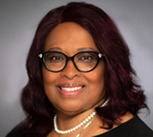
As we enter this season of gratitude, let’s take a moment to appreciate the ways we all help keep our school safer. Every one of you — students, teachers and staff — plays a role in creating a positive, safe environment where everyone can learn and grow.
Thank you to each of you for following safety procedures, being respectful to one another and speaking up when something doesn’t seem right. Your kindness and responsibility make a big difference, from helping out a classmate to keeping our school safer by being aware of your surroundings.
I encourage everyone to follow the Center for Safer Schools on social media to stay up to date with all the latest happenings.
Click here for my November video message, where I discuss Military Families Month and how CFSS staff supports mental health.
This month, let’s remember that looking out for one another and taking safety seriously is one of the best ways we can show gratitude for our school community. Together, we can continue building a safe and welcoming space for everyone! Have a Happy Thanksgiving!
— Karen W. Fairley
|
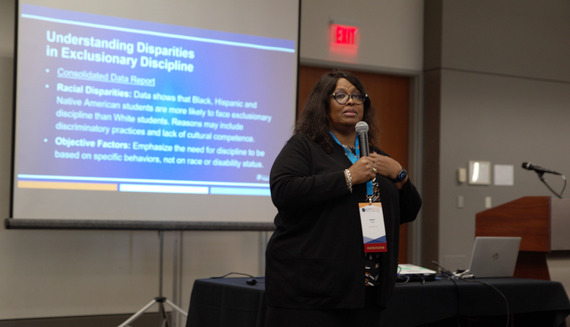 Center for Safer Schools Executive Director Karen W. Fairley speaks during the 2024 AIM Conference in Raleigh on Oct. 8. (CFSS photo)
Center for Safer Schools Executive Director Karen W. Fairley made a presentation on exclusionary discipline during the 2024 AIM Conference in Raleigh on Tuesday, Oct. 8.
In 2024, the CFSS was assigned oversight of ALPS, including establishment of processes, technical assistance and monitoring/evaluation. The CFSS Multidisciplinary Team and Parent Engagement Committee have subcommittees that addresses discipline and ALPS.
Fairley said the goal of discipline/ALPS is to keep schools as safe places that are conducive for learning, allowing the opportunity for students to learn in an environment that aligns with their learning style.
A particular focus has been on equity in discipline, Fairley said. Data shows that Black, Hispanic and Native American students are more likely to face exclusionary discipline than White students. Also, students with disabilities are disciplined more frequently than their peers.
“Discipline should be strictly based on behaviors,” Fairley said. “I have been diligent in ensuring that we’re talking about the behavior and not the individual.”
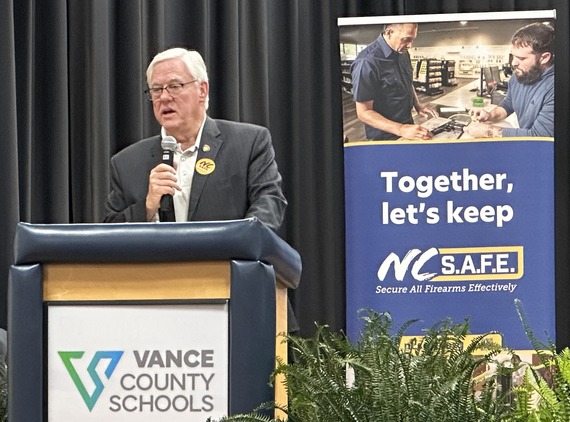 Rep. Frank Sossamon speaks during the Gun Safety Forum at Rollins Elementary School in Henderson on Oct. 10. (CFSS photos)
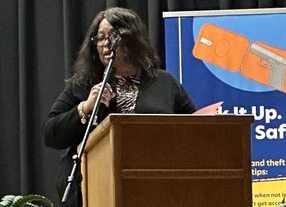
Center for Safer Schools staff members participated in panel discussions during Gun Safety Forums on Tuesday, Oct. 8 in Oxford and Thursday, Oct. 10 in Henderson.
The forums – hosted by Rep. Frank Sossamon – aimed to educate parents about the importance of gun safety. The evening events followed daytime presentations to students.
During the forum held at Rollins Elementary School in Henderson, Sossamon said gun safety is a critical issue that “needs to be discussed” with children and parents. The key to gun safety, he said, is preparation, including proper storage.
“That will reduce the accidents that are taking place across America,” Sossamon said.
During the forum held at Northern Granville Middle School in Oxford, CFSS Executive Director Karen W. Fairley (above) touted the Say Something Anonymous Reporting System and Educating Kids About Gun and Gang Violence (EKG2) programs as avenues for students to build positive relationships with trusted adults.
SSARS (sixth through 12th grades) was recently expanded to fifth grade, with fourth grade coming soon. Plans are in the works for EKG2 (seventh grade) to expand to ninth grade.
“EKG2 focuses on having children make better decisions,” Fairley said. “We want children in schools to develop that relationship with school resource officers.”
|
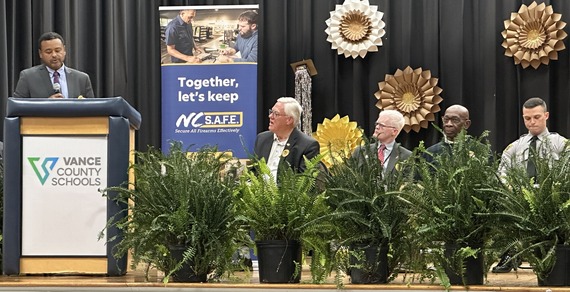 Center for Safer Schools Regional School Safety Specialist Michael Galloway (left) speaks during the Gun Safety Forum at Rollins Elementary School.
Center for Safer Schools Executive Director Karen W. Fairley on Tuesday, Oct. 22 made a virtual presentation on building a positive school climate.
During OCS Office Hours, held by the N.C. Department of Public Instruction’s Office of Charter Schools, Fairley said it’s important to engage with parents, educators and the community.
“Physical safety is primary to children having an environment conducive to learning,” she said. “It’s our way of creating an effective way of creating a positive school climate.”
The CFSS Student Engagement Team supports public school units in creating a positive school climate. Among their initiatives are the Safe Healthy Interactive Nurturing Empowerment (SHINE) program for middle schoolers and the Supporting, Educating, Empowering and Developing (SEED) program for high schoolers.
Fairley said those programs serve students who might not fit the traditional mold of a leader.
“They might not be in student government or honor roll, but they’re leaders nonetheless,” she said. “We’re letting them know they are leaders and they can make a difference.”
The CFSS is working to identify eastern and western SHINE/SEED cohorts for summer 2025. Fairley said concerns in one part of North Carolina – such as gangs – might not be as big of an issue in another part.
“The Center understands the regions are different,” she said. “We understand that climate is conducive to the geographic area they are in.”
For more information on the SHINE and SEED programs, send an email to CFSS Student Engagement Manager Chelsea King.
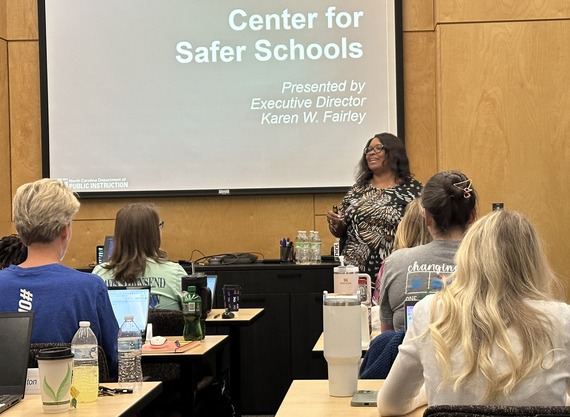 Center for Safer Schools Executive Director Karen W. Fairley makes a presentation to members of the Principal Preparation for Excellence and Equity in Rural Schools (PPEERS) Principal Fellows program at UNC-Greensboro on Tuesday, Oct. 22. (CFSS photo)
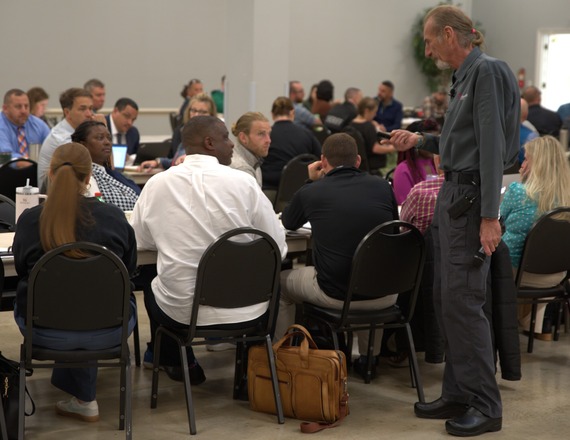 I Love U Guys Foundation co-founder John-Michael Keyes conducts an SRP/SRM Train the Trainer Workshop in Troy on Oct. 16. (CFSS photos)
The Center for Safer Schools hosted a Standard Response Protocol and Standard Reunification Method Train the Trainer Workshop in Troy on Wednesday, Oct. 16.
Both the SRP and SRM were developed by the I Love U Guys Foundation. The SRP is used when responding to critical incidents. The SRM is a coordinated effort to reunite families following a crisis or critical incident. Both initiatives are intended to remove communication barriers by implementing a common language.
The workshop, conducted by I Love U Guys Foundation co-founder John-Michael Keyes, introduced participants to the history, concepts and functionality of SRP and SRM and how to train the programs internally.
CFSS Executive Director Karen W. Fairley said it’s important for public school units and law enforcement to use common terms when facing critical incidents.
“When an incident happens, communication can break down quickly,” she said. “By utilizing common terms, both veteran and new school staff and law enforcement will know what’s happening as they work to handle the situation and keep everyone safe.”
SRP/SRM training is open to school safety directors and support staff. Safety directors and their respective “think partners” (school administrators, law enforcement, etc.) are encouraged to attend together.
Future SRP/SRM training dates will be listed on the CFSS Training Calendar. For more information, send an email to cfss@dpi.nc.gov.
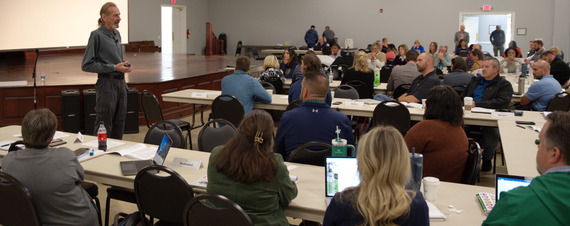
The Center for Safer Schools will hold Behavioral Threat Assessment and Management Training in November and December. Please see the dates below and visit the CFSS Training Calendar to sign up for both BTAM Training and BTAM Office Hours.
BTAM full-day training is an updated training based on Session Law 2023-78/House Bill 605 for PSUs to review legislative requirements and best practice in implementation and development of BTAM teams.
BTAM Office Hours are provided to PSUs to help provide technical assistance, consultation and support. Each BTAM Office Hours session begins with an implementation strategy for BTAM, and then PSUs are able to ask implementation questions and receive consultation and support.
Click the links below to register for BTAM Training. For virtual trainings, note that you must attend Part 1 prior to Part 2. Also, Parts 1 and 2 must be attended completely to receive credit.
For more information on Behavioral Threat Assessment and Management Training, send an email to CFSS Assistant Director-Behavioral Health Dr. Stephanie Ellis.
Virtual Training
- Thursday, Nov. 7 (Part 1); 8:30 a.m.-12:30 p.m.: Register
- Friday, Nov. 8 (Part 2); 8:30 a.m.-12:30 p.m.: Register
- Wednesday, Nov. 20 (Part 1); 8:30 a.m.-12:30 p.m.: Register
- Friday, Nov. 22 (Part 2); 8:30 a.m.-12:30 p.m.: Register
- Thursday, Dec. 5 (Part 1); 8:30 a.m.-12:30 p.m.: Register
- Friday, Dec. 6 (Part 2); 8:30 a.m.-12:30 p.m.: Register
In-Person Training
- Wednesday, Nov. 13 (Northeast Region); 8:00 a.m.-4:00 p.m.; Elizabeth City, N.C.: Register
Office Hours
- Thursday, Nov. 21, 1:00-2:30 p.m.: Register
- Thursday, Dec. 12, 9:00-10:30 a.m.: Register
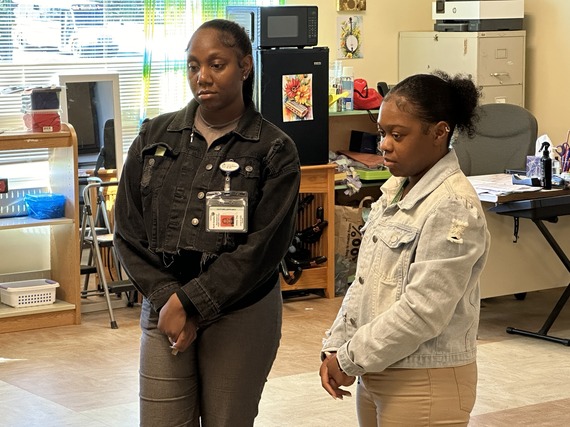 Center for Safer Schools Student Engagement Manager Chelsea King (left) and Student Engagement Coordinator Mya Batts make an anti-bullying presentation at Carolina International School in Concord on Oct. 10. (CFSS photo)
The Center for Safer Schools Student Engagement Team made an anti-bullying presentation at Carolina International School in Concord on Thursday, Oct. 10.
CFSS Student Engagement Manager Chelsea King and Student Engagement Coordinator Mya Batts spoke to nearly two dozen third- through sixth-graders as part of National Bullying Prevention Month. Topics included the consequences of bullying and cyberbullying.
“It’s not cool to be bullied or be the bully,” King said. “If you see someone being bullied, please say something. Stand up for them and help them out.”
During the presentation, King and Batts distributed different-colored paper hearts to indicate that everyone’s heart is different. They read scenarios including “I don’t want to be your friend anymore,” “If someone steals your phone” and “Took a snack from you.” The students were instructed to crumple a paper heart if a scenario would hurt their feelings and to explain why.
“What hurts your feelings may not hurt everyone else’s feelings,” Batts said. “It’s so hard to come back from a wrinkled-up, broken heart.”
As part of its anti-bullying resources, the CFSS has developed a Bully Awareness Toolkit for public school units. The toolkit offers user-friendly resources to help schools foster a safe and supportive environment.
For more information on how the Center for Safer Schools supports anti-bullying efforts, send an email to Student Engagement Manager Chelsea King.
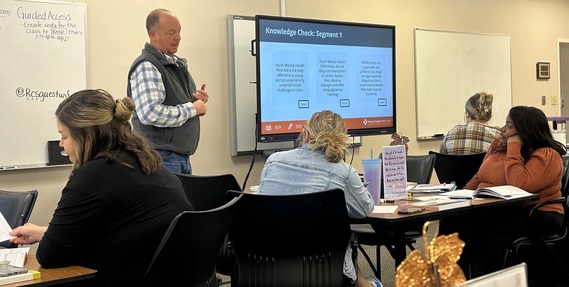 Center for Safer Schools Regional School Safety Specialists Robert Holland and Donna Hamilton (below) conduct Youth Mental Health First Aid Training in Richmond County on Oct. 21. (CFSS photos)
The Center for Safer Schools will hold Youth Mental Health First Aid Training on Thursday, Nov. 14 from 8:00 a.m.-4:00 p.m. at the Education Building in Raleigh. Click here to register. Space is limited, so please register before Thursday, Nov. 7 at noon.
Youth Mental Health First Aid teaches adults who regularly interact with youth how to identify, understand and respond to signs of mental health and substance use challenges among children and adolescents ages 12-18. Certified instructors are authorized to teach YMHFA both in-person and online. Those trained can include school staff and administrators, law enforcement, mental health professionals and social workers.
CFSS Programs staff and Regional School Safety Specialists are certified to teach Youth Mental Health First Aid in North Carolina public school units. To request YMHFA training facilitated by a CFSS staff member, send an email to schoolsafety@dpi.nc.gov.

The Center for Safer Schools will hold virtual School Risk Management Plan trainings in November and December. Please see the dates below and visit the CFSS Training Calendar to register.
After completing SRMP training, attendees will be able to:
- Input site-based school data to develop a comprehensive schematic diagram and plans into the SRMP portal.
- Both identify and discuss vulnerabilities and training gaps in their individual plans.
- At least once annually initiate a full schoolwide tabletop exercise on the procedures documented in the SRMP portal.
To obtain the most beneficial training within the SRMP system, charter school personnel should ensure that their school has been loaded into the SRMP and that they have an active NCID and are able to log into SRMP. LEA personnel should make sure they can log into SRMP using their NCID.
If you are not able to log in, click here to try to reset your NCID password first.
Attendees are encouraged to bring a laptop, as they will receive technical guidance to ensure their plans meet the necessary state requirements. All sessions are the same.
For more information on SRMP training, send an email to CFSS Assistant Director-Operations Karen Everett.
Virtual Training
- Monday, Nov. 18; 2:00-4:00 p.m.: Register
- Tuesday, Nov. 19; 1:00-3:00 p.m.: Register
- Tuesday, Dec. 3; 1:00-3:00 p.m.: Register
The Center for Safer Schools is providing public school units with a Training Calendar for the months of November and December. Each PSU attendee will need to register individually using the link located on the calendar entry. If you have questions, send an email to cfss@dpi.nc.gov.
Center for Safer Schools Executive Director Karen W. Fairley is touring North Carolina school districts and charter schools and would like to see anything they want to showcase regarding school safety. For school districts, this includes stops at an elementary school, a middle school and a high school. She also would like to take time to talk with a small group of students.
To schedule a tour, send an email to cfss@dpi.nc.gov. Thank you for your patience as she does what she can to get to as many public school units as possible.
Gang Psychology and Awareness
- Wednesday, Nov. 6; 10:00 a.m.-12:30 p.m.; Education Building, Raleigh, N.C.: Register
Active Assailant Simulation Training
- Thursday, Nov. 7; 8:30 a.m.-3:30 p.m.; Center for Safer Schools Training Center, Moore County, N.C.: Register
Virtual BTAM Training
- Thursday, Nov. 7 (Part 1); 8:30 a.m.-12:30 p.m.: Register
- Friday, Nov. 8 (Part 2); 8:30 a.m.-12:30 p.m.: Register
- Wednesday, Nov. 20 (Part 1); 8:30 a.m.-12:30 p.m.: Register
- Friday, Nov. 22 (Part 2); 8:30 a.m.-12:30 p.m.: Register
- Thursday, Dec. 5 (Part 1); 8:30 a.m.-12:30 p.m.: Register
- Friday, Dec. 6 (Part 2); 8:30 a.m.-12:30 p.m.: Register
In-Person BTAM Training
- Wednesday, Nov. 13 (Northeast Region); 8:00 a.m.-4:00 p.m.; Elizabeth City, N.C.: Register
BTAM Office Hours
- Thursday, Nov. 21, 1:00-2:30 p.m.: Register
- Thursday, Dec. 12, 9:00-10:30 a.m.: Register
Virtual SRMP Training
- Monday, Nov. 18; 2:00-4:00 p.m.: Register
- Tuesday, Nov. 19; 1:00-3:00 p.m.: Register
- Tuesday, Dec. 3; 1:00-3:00 p.m.: Register
Youth Mental Health First Aid
- Thursday, Nov. 14; 8:00 a.m.-4:00 p.m.; Raleigh, N.C.: Register
The Center for Safer Schools welcomes newsletter submissions about school safety events from school districts and charter schools across North Carolina. Email your information and photos to CFSS Public Relations Specialist Charles Kinnin.
|