- From the Executive Director
- "Protecting Our Students" Videos
- School Safety Grants
- Bully Awareness Toolkit
- Unity Day
- Kindness Changes Everything
- Training Calendar
- Active Assailant Simulation Training
- Gang Psychology and Awareness
- Start With Hello Week
- Safe Schools Week
- Great Southeast ShakeOut
- YMHFA Training
- BTAM Training
- Peer-to-Peer Support
- SRMP Training
- School Safety Grant Scoring
- Executive Director Tours
- Calendar of Events
- Follow Us
- Tell Us About It

Efforts to combat grooming have long been a priority for the Center for Safer Schools. Grooming, when it occurs, destroys the trust between students and school staff and can have long-lasting consequences.
N.C. General Statute 115C-105.57(2a) requires public school units to show students in grades 6-12 a video produced by the CFSS containing age-appropriate information about what grooming looks like. I appreciate your patience over the last few months as we worked with Capitol Broadcasting. We wanted to ensure that PSUs had the best possible videos and accompanying resources that would provide the most benefit to middle school students, high school students and school staff.
I am pleased to announce that the three "Protecting Our Students" videos are now available for PSUs. Read more about the videos later in this newsletter.
If the videos help you realize that you or someone you know has experienced grooming, please report it right away to a trusted adult. Also, the Say Something Anonymous Reporting System is available 24/7/365.
Finally, this month is National Bullying Prevention Month, which brings awareness to one of our biggest school safety issues. The CFSS Behavioral Health and Student Engagement staff has created a toolkit that includes valuable resources to aid PSUs in their anti-bullying efforts.
Read more about the toolkit and virtual session later in this newsletter. Also, click here for my October video message, where I discuss National Bullying Prevention Month and anti-bullying resources the CFSS offers.
Thank you as we work together to keep our schools safer.
— Karen W. Fairley
|
The Protecting Our Students Act Course Guide and Videos are available and were sent to Superintendents, Safety Directors and Principals. This essential programming was created in alignment with N.C. General Statute 115C-105.57(2a) and Session Law 2023-128/House Bill 142. A course guide and videos were developed by the North Carolina Center for Safer Schools in collaboration with Capitol Broadcasting Company, aimed at equipping K-12 school employees with vital information regarding inappropriate behavior and adult sexual misconduct in school environments.
As stipulated in N.C. General Statute 115C-105.57(2a), it is required that these videos be viewed by students in grades 6 through 12 across all public school units. The videos for school staff are strongly suggested to be viewed by all school personnel. School staff/adults should view their video prior to students reviewing the information so that adults are prepared to facilitate the middle and high schools courses/videos. School staff who are facilitating the middle/high school course/video should also read the facilitator guides provided with the student (high school and middle school) videos. We are sharing these materials to ensure compliance with this legislation and to provide you with the necessary resources. The Protecting Our Students Course Guide that has been shared with Superintendents, Safety Directors and Principals has all the details and information.
The Protecting Our Students Video Course Guide and Canvas Course has been designed to assist PSUs in delivering the “Protecting Our Students” Videos to both staff and students. This no-cost training package will help you understand how to access these videos within the Canvas system. Any staff that has NCEd Cloud access will be able to access Canvas courses through NCEd Cloud, even if the PSU does not have Canvas LMS. For staff that does not have NCEd Cloud, the materials can be uploaded to your own management system or utilized in platforms such as Google Classroom. The links are provided on the Protecting Our Students Course Guide, and each educational region has a unique link for each video/course (middle, high school and school staff).
All PSUs will be required to submit an attestation form confirming and verifying that they have shared the course and the videos for middle and high school students (grades 6-12). The attestation form is a required attestation form submission completed by the Human Resources Director and Superintendent of each PSU. Students do not sign attestation forms. This attestation form is for PSUs to submit indicating they have facilitated the course and videos with middle and high school (grades 6-12) students.
All adults working in schools are strongly suggested to complete a quiz to verify their completion of the “Protecting Our Students” videos. PSUs are strongly suggested to submit this attestation form to the NC CFSS confirming that all school staff — both classified and certified, along with any adult engaging with students during campus or school-related activities — have viewed the mandated “Protecting Our Students” videos in accordance with N.C. General Statute 115C-105.57(2a). In the Canvas course, school staff can have the option for a printable certificate. If school staff does not have an NCEd Cloud account to log into Canvas, a printable certificate is available in the course guide linked above.
Clear communication is vital for effective prevention. Together, we can establish a robust support network that empowers and protects our children. Our experiences have shown that proactive measures taken by adults are far more effective than relying on children to protect themselves from sexual abuse. It is crucial for students to receive accurate, age-appropriate information, along with reassurance that trusted adults are there to support and protect them. Additionally it is important for all staff to understand which inappropriate behaviors must be reported to foster a safe environment for all students.
If you have questions, send an email to schoolsafety@dpi.nc.gov. This email address is specifically designated for inquiries regarding these training videos and N.C. General Statute 115C-105.57(2a).
The application for the 2024-2025 School Safety Grants is live in CCIP. The Center for Safer Schools will award a total of $30 million in funding to North Carolina public school units for Safety Equipment, Services for Students in Crisis and Training to Increase School Safety.
The application deadline is Thursday, Oct. 31 at 11:59 p.m. The grant – titled “Equipment, Services for Students in Crisis, and Training to Increase School Safety” – can be found under CCIP, FY 2025.
Due to the amount of funding available, there will be a limit on awards to PSUs in each grant category:
School Districts
- Safety Equipment: $500,000
- Services for Students in Crisis: $350,000
- Training to Increase School Safety: $350,000
Charter Schools
- Safety Equipment: $250,000
- Services for Students in Crisis: $350,000
- Training to Increase School Safety: $350,000
The Center for Safer Schools will conduct a virtual School Safety Grant training from 11 a.m.-12:30 p.m. on Friday, Oct. 18. Click here to register. Due to limited space, this training is intended for public school units that have not been represented at a recent session.
Please note that if a PSU’s staff does not attend a virtual training and its application is incorrect, it may affect funding. If you have questions, send an email to schoolsafetygrants@dpi.nc.gov.
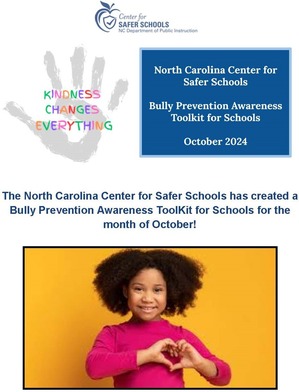
The Center for Safer Schools has developed a Bully Awareness Toolkit for public school units. The toolkit offers user-friendly resources to help schools foster a safe and supportive environment.
Key components of the toolkit include:
- Join us for the CFSS Kindness Challenge: Encourages students to practice kindness and create a positive school culture using the CFSS Kindness Changes Everything Calendar.
- Bully Prevention Checklist/Flow Chart: A practical guide to identify and address bullying incidents effectively.
- Bully Prevention Scenarios: Engaging scenarios for staff discussions to enhance understanding and response strategies.
- N.C. Bullying Laws: Links for N.C. Bullying Legislation.
- CFSS Bully Awareness Brochure: Informative material to raise awareness among students and parents.
- Engagement Lesson Plan: Activities designed for Bully Prevention Awareness Week to promote student involvement.
- Start With Hello Resources: Tools to help students connect and reduce isolation.
- Unity Day: Wear orange to show solidarity during National Bullying Prevention Month.
- Students Against Violence Everywhere (SAVE) Promise Clubs: Empower students to advocate against violence and bullying.
- Say Something Anonymous Reporting System: A confidential way for students to report bullying and seek help.
Click here for the Bully Awareness Toolkit. Let’s take a stand against bullying and create a safe school environment for all.
|
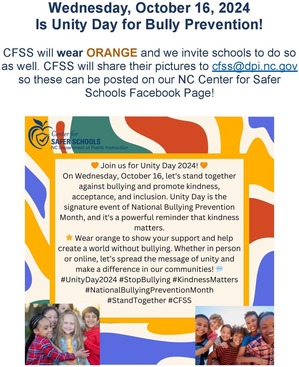
Unity Day
The signature event of National Bullying Prevention Month is Unity Day, which is held on the third Wednesday of October. This year, it is Wednesday, October 16.
Unity Day is a call to action that we are united for kindness, acceptance and inclusion.
The Center for Safer Schools invites public school units to share photos of students and staff wearing orange, the color to acknowledge bullying awareness. If you’d like us to share your Unity Day photos on our social media channels, please email them to cfss@dpi.nc.gov.
For more information on National Bullying Prevention Month and Unity Day, visit Pacer.org and StopBullying.gov.
|
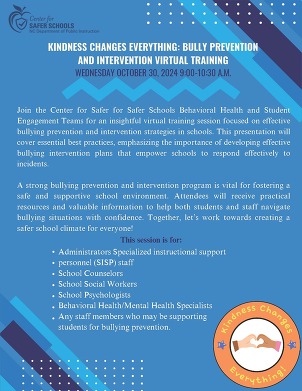
The Center for Safer Schools Behavioral Health and Student Engagement teams on Wednesday, Oct. 30 from 9-10:30 a.m. will hold a virtual training session on effective bullying prevention and intervention strategies in schools.
Kindness Changes Everything: Bully Prevention and Intervention will cover essential best practices, emphasizing the importance of developing effective bullying intervention plans that empower schools to respond effectively to incidents. A strong bullying prevention and intervention program is vital for fostering a safe and supportive school environment.
Attendees will receive practical resources and valuable information to help both students and staff navigate bullying situations with confidence. This session is intended for administrators, specialized instructional support personnel (SISP) staff (school counselors, school social workers, school psychologists, behavioral health/mental health specialists) and other staff members who might support students for bullying prevention.
Kindness Changes Everything will be led by CFSS Assistant Director-Behavioral Health Dr. Stephanie Ellis, Student Engagement Manager Chelsea King and Student Engagement Coordinator Mya Batts. Click here to register.
|
The Center for Safer Schools is providing public school units with a Training Calendar for the months of October, November and December. Both virtual and in-person sessions are available, including Gang Psychology, Behavioral Threat Assessment and Management, School Risk Management Plan, I Love U Guys Standard Response Protocol/Reunification, Youth Mental Health First Aid, Bully Prevention and Intervention, Active Assailant and BTAM Office Hours.
Each PSU attendee will need to register individually using the link located on the Training Calendar. Click here to view the calendar. If you have questions, send an email to cfss@dpi.nc.gov.
The Center for Safer Schools will hold an in-person Active Assailant Simulation Training on Thursday, Nov. 7 from 8:30 a.m.-3:30 p.m. at the CFSS Training Center in Moore County.
This course – for school resource officers and law enforcement – provides a simulation of active-shooter incidents. This course teaches best practices to prevent, recognize, plan and react to an active-assailant incident. Strategies are provided that can be applied in a facility’s Emergency Action Plan, including tactics on how to escape, hide and fight against an assailant attack.
Click here to register. For more information, send an email to CFSS School Safety Training Coordinator Jeff Branch.
The Center for Safer Schools will hold Gang Psychology and Awareness training on Wednesday, Nov. 6 from 10:00 a.m.-12:30 p.m. at the Education Building in Raleigh.
Participants will have the opportunity to expand their knowledge around gangs in the school and community setting. Focus areas of this presentation include gang awareness, gang psychology and the impacts to the school environment. Participants will be given information to identify, assess and address gang activity in the school setting, as well as best practices around policy, effective collaborations and intervention.
Click here to register. For more information, send an email to CFSS Social Work Consultant Michelle Guarino.
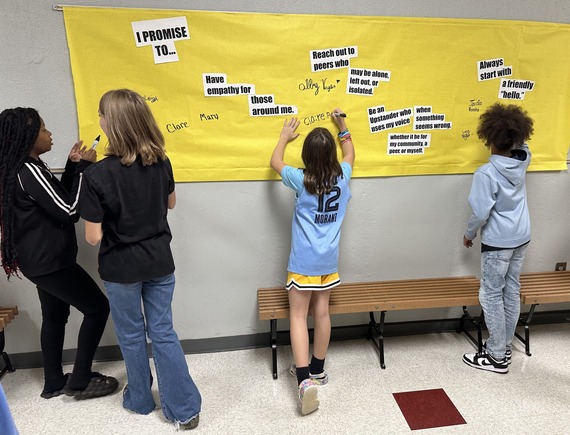 Grandview Middle School students sign a banner on Sept. 18 during Start With Hello Week. (CFSS photos)

Center for Safer Schools staff members visited Grandview Middle School in Hickory and Robert L. Patton High School in Morganton on Wednesday, Sept. 18 in support of Start With Hello Week.
Start With Hello Week, which was observed Sept. 16-20, is dedicated to making new social connections and creating a sense of belonging among youth. The Start With Hello program from Sandy Hook Promise teaches students to be more socially inclusive and connected to one another and empowers them to end social isolation.
Icebreaker questions were posted on tables during lunch at Grandview Middle. Outside the cafeteria, students and staff could sign a banner reinforcing the Start With Hello pledge.
Patton High’s SAVE Promise Club served lemonade from a stand during lunch periods. Club members also set up a table that included encouraging messages and sticky notes that students and staff could sign (left).
Patton High SAVE advisor Traci Rigsbee said those and other activities were planned to promote kindness and inclusion.
“Every day, we want students to be at school and see what a happy place it is,” she said.
If your public school unit is interested in having the CFSS Student Engagement Team support a SAVE Promise Club event, send an email to CFSS Student Engagement Manager Chelsea King.
|
Safe Schools Week, which this year will be held Oct. 20-26, addresses school violence and educates everyone about how schools can be made safer. The week is an opportunity for everyone to take steps to ensure that schools offer students and teachers an environment in which they can perform to the best of their abilities.
National SAVE Day will be held Wednesday, Oct. 23. The observance raises awareness of SAVE Promise Club, the youth leadership initiative of Sandy Hook Promise.
Click here for more information on Safe Schools Week and National SAVE Day.
North Carolina Emergency Management invites school districts across the state to participate in the 2024 Great Southeast ShakeOut on Thursday, Oct. 17 at 10:17 a.m. The ShakeOut is an annual public earthquake drill in which millions of people in schools, organizations and homes simultaneously practice “Drop, Cover and Hold On,” which is the recommended action for people to take during an earthquake to reduce the risk of injury.
Although Oct. 17 is the official ShakeOut date this year, school districts and individual schools can choose their own date (or multiple dates) to accommodate as many people and schedules as possible. The drill can be completed together in-person or at home via videoconferencing and offers your schools and community an opportunity to consider how they would respond to an earthquake while identifying potential refinements to your district’s emergency response plan.
Click here to register for the Great Southeast ShakeOut. If you have questions, contact Diana Thomas with N.C. Emergency Management at Diana.Thomas@ncdps.gov.
Center for Safer Schools Programs staff and Regional School Safety Specialists are certified to teach Youth Mental Health First Aid in North Carolina public school units.
Youth Mental Health First Aid teaches adults who regularly interact with youth how to identify, understand and respond to signs of mental health and substance use challenges among children and adolescents ages 12-18. Certified instructors are authorized to teach YMHFA both in-person and online. Those trained can include school staff and administrators, law enforcement, mental health professionals and social workers.
To request Youth Mental Health First Aid Training facilitated by a CFSS staff member, send an email to cfss@dpi.nc.gov.
The Center for Safer Schools announces dates for Behavioral Threat Assessment and Management Training during the fall semester. Please see the dates below and visit the CFSS Training Calendar to sign up for both BTAM Training and BTAM Office Hours.
Also, make sure your public-school unit has reviewed and utilizes the Best Practice Guidance Document provided in March 2024. In addition, please view the BTAM At a Glance document.
BTAM full-day training is an updated training based on Session Law 2023-78/House Bill 605 for PSUs to review legislative requirements and best practice in implementation and development of BTAM teams.
Training will include Building a required BTAM implementation and monitoring team (as required in HB 605), Understanding Behavioral Threats, Risk Factors and Warning Signs, Assessment Protocols, Team Approach and Requirements, Intervention and Monitoring, Legal and Ethical Considerations, and Safety & Intervention Planning. The training will also discuss the implementation and monitoring of the fidelity of behavioral threat assessments.
A scenario-based approach will be discussed and shared to help understand the overall BTAM process and monitoring with fidelity. Each team will need to bring an existing behavioral threat assessment case on their PSU protocol (if they have one developed). We will review fidelity and protocol development and monitoring at this training.
If teams already have a BTAM protocol, they are encouraged to bring this with them to review. If PSUs do not have a current protocol, a best practice protocol example and example case will be provided. We will review fidelity and protocol development and monitoring at this training.
BTAM Office Hours are provided to PSUs to help provide technical assistance, consultation and support. Each BTAM Office Hours session begins with an implementation strategy for BTAM, and then PSUs are able to ask implementation questions and receive consultation and support.
Click the links below to register for BTAM Training. For virtual trainings, note that you must attend Part 1 prior to Part 2. Also, Parts 1 and 2 must be attended completely to receive credit.
For more information on Behavioral Threat Assessment and Management Training, send an email to CFSS Assistant Director-Behavioral Health Dr. Stephanie Ellis.
Virtual Training
- Thursday, Oct. 24 (Part 1); 8:30 a.m.-12:30 p.m.: Register
- Friday, Oct. 25 (Part 2); 8:30 a.m.-12:30 p.m.: Register
- Thursday, Nov. 7 (Part 1); 8:30 a.m.-12:30 p.m.: Register
- Friday, Nov. 8 (Part 2); 8:30 a.m.-12:30 p.m.: Register
- Wednesday, Nov. 20 (Part 1); 8:30 a.m.-12:30 p.m.: Register
- Friday, Nov. 22 (Part 2); 8:30 a.m.-12:30 p.m.: Register
- Thursday, Dec. 5 (Part 1); 8:30 a.m.-12:30 p.m.: Register
- Friday, Dec. 6 (Part 2); 8:30 a.m.-12:30 p.m.: Register
In-Person Training
- Monday, Oct. 28 (Western Region); 8 a.m.-4 p.m.; Franklin, N.C.: Register
- Wednesday, Nov. 13 (Northeast Region); 8 a.m.-4 p.m.; Elizabeth City, N.C.: Register
Office Hours
- Thursday, Oct. 31, 9-10:30 a.m.: Register
- Thursday, Nov. 21, 1-2:30 p.m.: Register
- Thursday, Dec. 12, 9-10:30 a.m.: Register
The Center for Safer Schools has released a companion document to the Peer-to-Peer Guidance Document issued in August 2024. Peer-to-Peer Resource Hub provides a best practice checklist for public school units to use when selecting peer-to-peer support programs. In addition, the document includes information, resources and links to peer-to-peer support programs.
The Center for Safer Schools announces dates for in-person and online School Risk Management Plan trainings during the 2024-2025 fall semester. Please see the dates below and visit the CFSS Training Calendar to register.
After completing SRMP training, attendees will be able to:
- Input site-based school data to develop a comprehensive schematic diagram and plans into the SRMP portal.
- Both identify and discuss vulnerabilities and training gaps in their individual plans.
- At least once annually initiate a full schoolwide tabletop exercise on the procedures documented in the SRMP portal.
To obtain the most beneficial training within the SRMP system, charter school personnel should ensure that their school has been loaded into the SRMP and that they have an active NCID and are able to log into SRMP. LEA personnel should make sure they can log into SRMP using their NCID.
If you are not able to log in, click here to try to reset your NCID password first.
Attendees are encouraged to bring a laptop, as they will receive technical guidance to ensure their plans meet the necessary state requirements. All sessions are the same.
For more information on SRMP training, send an email to CFSS Assistant Director-Operations Karen Everett.
Virtual Training
- Tuesday, Oct. 22; 1:00-3:00 p.m.: Register
- Monday, Nov. 18; 2:00-4:00 p.m.: Register
- Tuesday, Nov. 19; 1:00-3:00 p.m.: Register
- Tuesday, Dec. 3; 1:00-3:00 p.m.: Register
In-Person Training
- Wednesday, Nov. 20; 2:00-4:00 p.m.; Fayetteville, N.C.: Register
Receiving a high score for funding from the School Safety Grant Program (contingent upon the passage of appropriations from the General Assembly) for public-school units is based in part on meeting legislative requirements, including having a complete and updated School Risk Management Plan, anonymous reporting system and panic alarm (hardwired or app). For more information, send an email to schoolsafetygrants@dpi.nc.gov.
Center for Safer Schools Executive Director Karen W. Fairley is touring North Carolina school districts and charter schools and would like to see anything they want to showcase regarding school safety. For school districts, this includes stops at an elementary school, a middle school and a high school. She also would like to take time to talk with a small group of students.
To schedule a tour, send an email to cfss@dpi.nc.gov. Thank you for your patience as she does what she can to get to as many public school units as possible.
Virtual BTAM Training
- Thursday, Oct. 24 (Part 1); 8:30 a.m.-12:30 p.m.: Register
- Friday, Oct. 25 (Part 2); 8:30 a.m.-12:30 p.m.: Register
- Thursday, Nov. 7 (Part 1); 8:30 a.m.-12:30 p.m.: Register
- Friday, Nov. 8 (Part 2); 8:30 a.m.-12:30 p.m.: Register
- Wednesday, Nov. 20 (Part 1); 8:30 a.m.-12:30 p.m.: Register
- Friday, Nov. 22 (Part 2); 8:30 a.m.-12:30 p.m.: Register
- Thursday, Dec. 5 (Part 1); 8:30 a.m.-12:30 p.m.: Register
- Friday, Dec. 6 (Part 2); 8:30 a.m.-12:30 p.m.: Register
In-Person BTAM Training
- Monday, Oct. 28 (Western Region); 8 a.m.-4 p.m.; Franklin, N.C.: Register
- Wednesday, Nov. 13 (Northeast Region); 8 a.m.-4 p.m.; Elizabeth City, N.C.: Register
BTAM Office Hours
- Thursday, Oct. 31, 9-10:30 a.m.: Register
- Thursday, Nov. 21, 1-2:30 p.m.: Register
- Thursday, Dec. 12, 9-10:30 a.m.: Register
Great Southeast ShakeOut
School Safety Grants Training
- Friday, Oct. 18, 11 a.m.-12:30 p.m.: Register
Virtual SRMP Training
- Tuesday, Oct. 22; 1:00-3:00 p.m.: Register
- Monday, Nov. 18; 2:00-4:00 p.m.: Register
- Tuesday, Nov. 19; 1:00-3:00 p.m.: Register
- Tuesday, Dec. 3; 1:00-3:00 p.m.: Register
In-Person SRMP Training
- Wednesday, Nov. 20; 2:00-4:00 p.m.; Fayetteville, N.C.: Register
Kindness Changes Everything
- Wednesday. Oct. 30, 9-10:30 a.m.: Register
Gang Psychology and Awareness
- Wednesday, Nov. 6; 10:00 a.m.-12:30 p.m.; Education Building, Raleigh, N.C.: Register
Active Assailant Simulation Training
- Thursday, Nov. 7; 8:30 a.m.-3:30 p.m.; Center for Safer Schools Training Center, Moore County, N.C.: Register
The Center for Safer Schools welcomes newsletter submissions about school safety events from school districts and charter schools across North Carolina. Email your information and photos to CFSS Public Relations Specialist Charles Kinnin.
|