North Carolina Public Schools - School Social Work August Update
North Carolina Public Schools sent this bulletin at 08/13/2024 09:30 AM EDT
|
 |
Lead With Relationships
The focus for school social workers this school year is to lead with relationships. Relationships are important. People are important, and we need healthy relationships to foster a positive school community.
School social workers serve as leaders and consultants to facilitate an understanding of factors in the home, school, and community that affect students’ educational experiences. We provide training and engage parents, school personnel, other professionals and community members in the removal of barriers to learning. School social workers also provide leadership and collaboration in the implementation of comprehensive school-based and school-linked programs that promote student well-being and positive academic outcomes. NASW
Strong student and family relationships allow for the effectiveness of services. We need avenues of trust, understanding, and empathy. The power of a trusted relationship cannot be underrated in fueling a student's success. We also know that the student is not our only 'client', as students have varying environments that impact their success and wellness. Building relationships within these environments is what will help catapult our service delivery and ultimately create positive academic outcomes for our students. School social workers are masters at the person-in-environment theory for meeting needs, and this year I hope to take that to the next level by us setting the example to lead with relationships. I propose that we not only serve as leaders within our school communities, but also set intentional goals to increase our reach and focus on the very basic task of connecting with another human, and then another, and another... Until our communities are connected and in a position to help foster a safe, supportive, and positive school climate.
I challenge you to start/or continue to do a few things this year.
- Try Relationship Mapping. For students, a positive connection to at least one school adult – whether a teacher, counselor, sports coach, or other school staff member – can have tremendous benefits that include reduced bullying, lower drop-out rates, and improved social-emotional capacities.
- Increase community partnerships. We need our community partners, and they are looking for ways to support us. Consider drafting a list of needs that would best serve your school community, and then approach your local organizations with that list. Often it is easier for them to adapt their services to meet our needs, rather than just approaching them with the question of what do they do.
- Be visible and assessable. I know this one can be tough, especially since school social workers serve anywhere from 3 to 6 schools; but I want to ensure that you aren't hiding in the shadow of help, as I like to call it. This is that place where everyone sees that something gets done but has no idea how it came to be. Take a few intentional moments this year to step out of the shadow and talk about all the wonderful things you are doing for the school community. Make the staff meetings, connect with the PTA, visit teacher PLCs, attend sporting events, and host office hours. Students, families, and staff need to know that you are there and what amazing services you have to offer.
Most of all, I want you to have a year full of positive connections and healthy relationships. This way forward ensures that we are in the best possible position to create buy-in for a school community that promotes comprehensive wellness, safety, and academic success.
Sincerely,
Pachovia
pachovia.lovett@dpi.nc.gov

Year Four PSU Q&A
- Yes, you will be required to report to DPI by September 15th, 2024. The reporting portal opened on May 13th 2024, and only one contact per PSU will have access to the reporting portal. You will answer the reporting questions as part of the Healthy Active Children's Report, the same as last year (charters bypass the HAC portions and only complete the SMH report). You will also upload a copy of your SMH plan.
- Traditional LEAs have received an invitation to the portal by Les Spell and charters received a notice from the Office of Charters. For reporting access, you can contact Les.Spell@dpi.nc.gov.
Has anything changed about what we are required to do?
- There are no major changes.
- Your plans do not have to change. You can upload the same plan with up-to-date modifications, as long as it is still what you plan to use. You also can make any adjustments and changes to your plan before submitting. You must include your detailed training plan and suicide risk protocol and ensure it is up-to-date.
- You will see the requirements for abuse and neglect resources that are now included in the School Mental Health Policy. These materials must be distributed/posted at the beginning of each school year. You will report on compliance. The newly added student video has not yet been made available through the Center For Safer Schools.
What does the 2-hour subsequent training have to include?
- The 2-hr refresher addresses at least 2 of 6 MH training program areas, and on even-numbered years, 2 hours of sex trafficking and child sex abuse content must be provided.
- The 6-hr initial training (for new employees) must address all 6 areas, regardless of year.
Where do I find all the SMH Policy materials?
- All resources and materials can be found on the NC Healthy Schools webpage and on the SMH Policy Compliance page.
- Questions can be sent to pachovia.lovett@dpi.nc.gov.
NEW: Specialized Instructional Support Annual Report
In anticipation of the revised School Mental Health Policy, beginning with the 2025 school mental health plan reporting, all PSUs will be required to submit data for the SISP annual report. This is a new requirement and report on quantitative instances of student contacts for referrals, interventions, and services provided by specialized instructional support personnel, related to mental health and overall student wellness, as reported in the NC Student Information System. This annual report is on the number of instances, and the data collected will not include any student information.
The data for this report can be recorded in PowerSchool currently and will be available soon in Infinite Campus. During this transition to Infinite Campus, PSUs have 2 ways you may collect this data.
-
To record the instances in the behavioral support/health section of PowerSchool that was released last school year. This option will eventually run a report with all the required matrics in it for you to upload into the SMH reporting portal in 2025.
-
To use a copy of the required metrics and self-record by a different method and upload the data from that method into the SMH reporting portal in 2025.
The official start date for recording data this school year will be September 30th, 2024 through June 30th, 2024.
ALL PSUs MUST REPORT THIS INFORMATION FOR THEIR 2025 SCHOOL MENTAL HEALTH PLAN.
More information can be found on our Reporting webpage in the SMH Policy materials.
| New Year, New Goals | 
|
As you start to think about what your program/professional goals will be and what data to collect, use this Sample Student & Program Outcomes list to help you organize.
This is also a great list to help you write a data story using the previous year's data, creating a narrative to use during advocacy.
Tips For The New School Social Worker
Are you a brand-new school social worker? Well, welcome to one of the best careers on the planet! The document below has been created to give you the very best foot forward into this new journey. Please review the tips and explore the resources provided. Also, forward this to the new social workers on your team and encourage them to join the DPI School Social Work mailing list to continue to receive updates.
Tips for the NC New School Social Worker
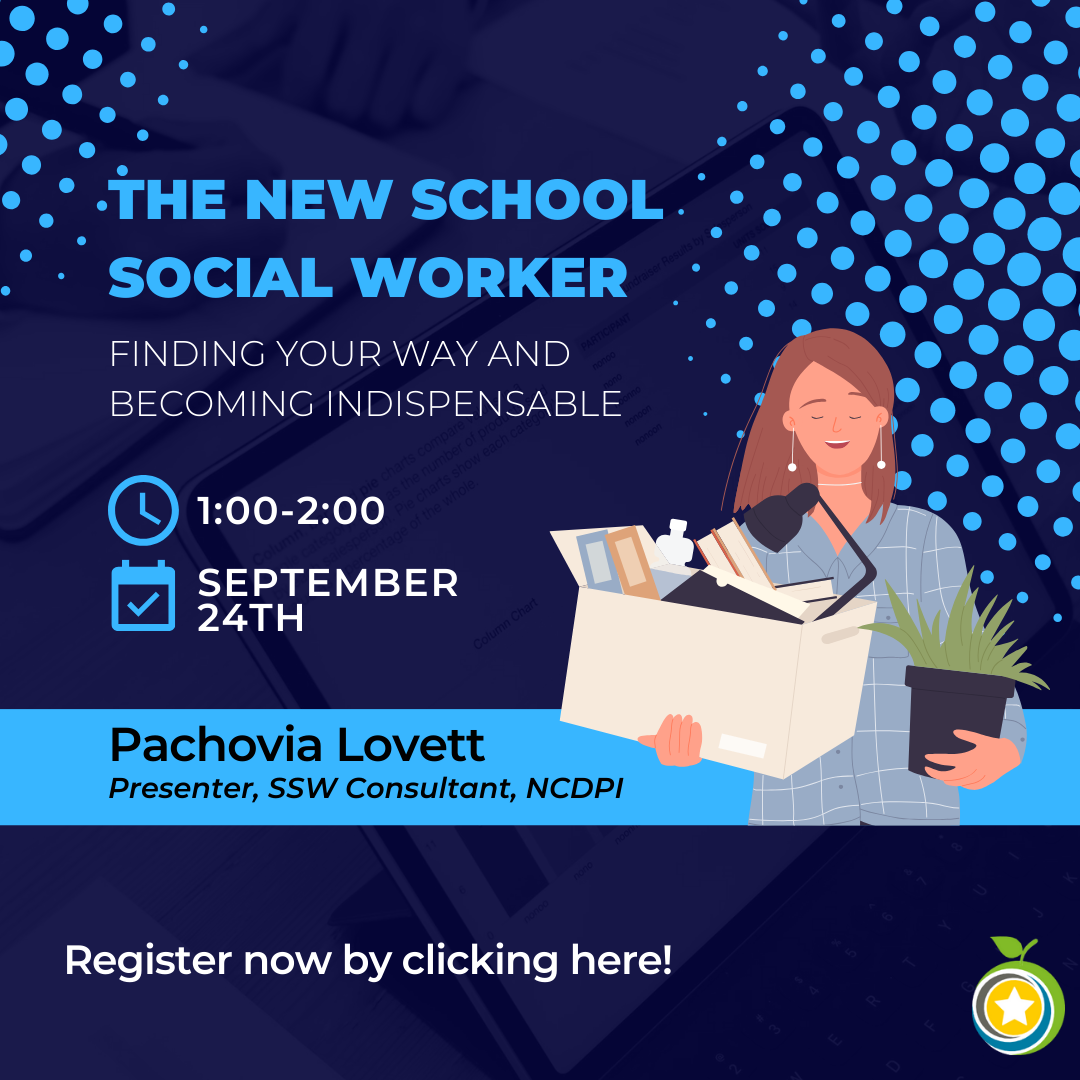 |
Registration Is Open! This webinar is open to all school social workers who are within their first 3 years of practice in NC public schools. We will discuss what to know about working in a school setting, the collaborations with SISP and other school staff, evidence-based practices and data collection, and becoming indispensable. We will also share and connect resources to practice. *Participants will receive a certificate of completion of one contact hour |
Are you a Director of Student Services?
There is a job-alike group for directors of student services and equivalent titles. This is a field-led, and organized group that allows for networking, information sharing, and troubleshooting. They meet once a month. This group is not open to lead positions or SISP. While this is not a DPI-led group, DPI representatives typically attend meetings to share important updates.
National Immunization Awareness Month
August is National Immunization Awareness Month (NIAM). This annual observance highlights the importance of getting recommended vaccines throughout your life. You have the power to protect yourself and your family against serious diseases [like whooping cough, cancers caused by HPV, pneumonia, and COVID-19] through on-time vaccination.
This NC School Vaccine Fact Sheet is a great resource to keep on hand during the start of this school year.
School social workers should work collaboratively to prevent student exclusions after the 30-day grace period. Please see the insert below, taken from the Avoiding Exclusions DPI Memo:
The valuable contribution of childhood vaccines to the health of students has long been recognized. Assuring vaccine compliance is not simply a ‘ticket’ to be in school, it is an investment in the health of the school and community. The obligation to ensure that no student is excluded from learning during the pandemic does not solely lie with our school nurses. We must work collaboratively to address the barriers that prohibit families from obtaining the required immunizations and health assessments. All school staff and stakeholders can play a part in assisting this effort and preventing student exclusions.
Some suggestions include:
-
Under FERPA, school officials are tasked with determining what school personnel have a ‘need to know’ confidential student information. In mobilizing a collaborative effort to avoid student exclusion, it may be necessary to share that information with a variety of staff who directly work with student families. This might include student support and related service personnel being aware of the students in their caseload who are out of compliance with the requirements in anticipation of engagement with families.
-
Encourage these staff members to be intentional about including dialog about immunizations and health assessments in all interactions with families. Ask parents/guardians about compliance and/or what barriers exist. Ask that barrier issues be reported back to administration for referral to directed assistance.
-
Post reminders around the school and community establishments. Add taglines to signatures of emails and remote communications. Provide a point of contact accessible to families if assistance is needed.
-
Explore options with local providers to organize clinics and/or be partners in ensuring that they communicate reminders of immunizations and health assessments when seeing students for other issues. Our local health departments and physicians are valuable resources on this front. They can promote messaging that encourages families to be compliant and offer convenient ways to address barriers in the community.
-
Organize a phone tree and engage school staff who have the capacity to make calls and communicate immunization and health assessment information. Refer any issues with communication and barriers to the appropriate resource. Ensure that communication with non-English speakers is available and offer to help coordinate services and referrals.
-
Cross-reference with exceptional children caseloads to examine intersections of healthcare needs and combine messaging.
-
Engage food and nutrition services to expand the message. Include reminder tags with delivered lunches, or have an information table at grab and go meal sites.
-
Utilize social media. Post reminders to social media outlets and provide a link for more information. Consider kicking off a campaign following Thanksgiving break that expresses the importance of immunizations and health assessments. Create a clever hashtag (examples-#ZeroOut, #AllPresent, #NoExclusions) to encourage engagement with the campaign.
SchoolSafety.gov
SchoolSafety.gov launched its 2024 Back-to-School Campaign, a month-long initiative that highlights resources and guidance K-12 school leaders, educators, staff, and parents and caregivers can use to help prepare for a safe return to school. SchoolSafety.gov serves as a comprehensive school safety resource library, housing actionable guidance, tailored information, and practical tools to help K-12 communities create and sustain safe and supportive learning environments for students and educators.
As part of the campaign, SchoolSafety.gov is releasing two new infographics to support schools in their back-to-school preparations:
- The SchoolSafety.gov Back-to-School Checklist outlines seven school safety actions that K-12 school leaders and personnel can consider leading up to and throughout the new school year. These actions can help support comprehensive school safety programs and include activities such as exercising emergency operations plans, enhancing staff mental health literacy, and increasing awareness of school safety reporting options.
- The SchoolSafety.gov Back-to-School Reading List offers ten resources that provide guidance and insights on timely school safety issues. These resources can help inform school safety plans and initiatives and cover topics such as bullying prevention, student mental health, cybersecurity, and school climate.
Legislative Updates
 |
View the K-12 Education Office of Government and Community Affairs Update from Friday, August 8, 2024. |
ICYMI: Supporting Students Experiencing Homelessness Through Career and Technical Education
Career and Technical Education (CTE) provides valuable pathways for supporting students experiencing homelessness by offering accessible programming in both secondary and postsecondary settings. CTE focuses on equipping these individuals with the necessary skills and knowledge to secure a living wage employment and complete meaningful credentials. Through practical, hands-on learning and a curriculum tailored to real-world job markets, CTE helps break barriers to employment and fosters long-term economic stability and independence for some of the most vulnerable youth. This NCHE webinar, co-hosted with the U.S. Department of Education’s Office of Career, Technical, and Adult Education, is tailored for school district staff that work with students experiencing homelessness.
View the resources
Attendance Tools
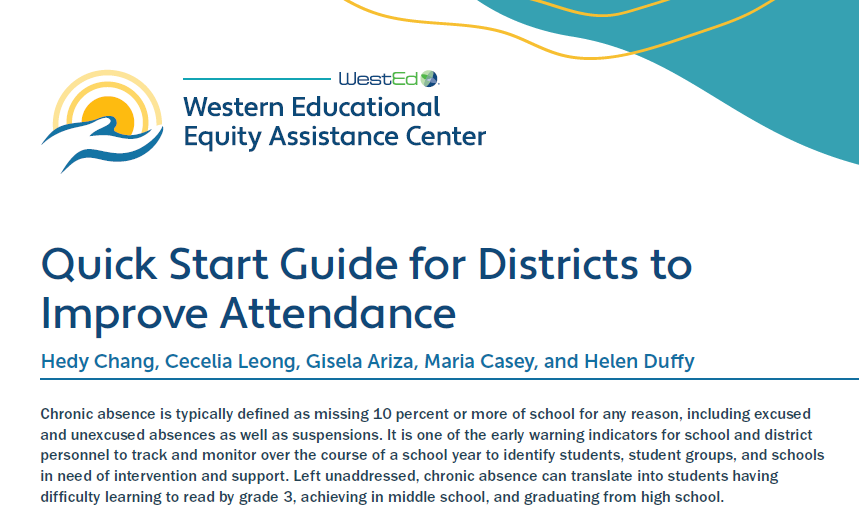 |
Download a new quick start guide. Attendance Works collaborated with the Western Educational Equity Assistance Center on a resource with six actionable steps that district, tribal, state, and other leaders can take to improve student attendance, reduce chronic absence, and close gaps in access to education. |
Learn more about why students are missing school, or what can motivate them to show up every day, using free qualitative data collection strategies such as an empathy interview, 2 by 10 relationship building, or surveys.
Reducing Student Absenteeism
The EdResearch for Action Overview Series summarizes the research on key topics to provide K-12 education decision-makers and advocates with an evidence-based base to ground discussions about how to best serve students. Authors – leading experts from across the field of education research – are charged with highlighting key findings from research that provide concrete, strategic insight on persistent challenges sourced from district and state leaders.
What are evidence-based practices that schools can implement to reduce student absenteeism?
---
School Attendance and Student Accounting (SASA) Manual
The SASA Manual was amended to implement pertinent legislation, funding in arrears, and the new Student Information System (SIS). Revisions include the admission of out-of-state and foreign exchange students to charter schools, withdrawing students from school, coding attendance on individual student make-up days, the class size waiver request process, guidance about eligibility for use of a modified school calendar, retention of digitized student records, and assignment of Student User Identification numbers. Information about the addition of Pre-K ADM to the K–13 ADM for purposes of school principal salary calculation was added as well; changes to the Principal Salary Schedule are effective January 2025 and will be brought before the Board in the fall for final approval.
Please also take time to review the NC SASA Manual to stay current on attendance legislation, policy, and procedures.
 |
General Statute HB 1168 Title Protection for Social WorkersHB 1168 became law during the 2009 Session. It prohibits an individual from using the title “Social Worker” if the individual is not certified, licensed, or provisionally licensed as a social worker, does not hold a bachelor’s or master’s degree in social work from a college or university which is accredited by the Council of Social Work Education, or has a not received a doctorate in social work. |
This is not new. Please ensure that all positions using the social worker title, hold a social work degree. This protection is for the benefit of the profession, the employee, and the community at large.
Receiving this as a forward?
Subscribe to this NCDPI School Social Work newsletter here.
Enter your email, then advance to the next screen that will give you a list of subjects and scroll down to find School Social Work.
The links on this page will bring you to third party websites, owned and operated by independent parties, over which NCDPI has no control. Any link you make to or from these 3rd Party Websites will be at your own risk. Any use of these 3rd Party Websites and any information you provide will be subject to and governed by the terms of the 3rd Party Website, including those relating to confidentiality, data privacy, and security.
Unless otherwise expressly agreed in writing, NCDPI is not in any way associated with the owner or operator of any of the 3rd Party Websites or responsible or liable for the goods and services offered by them or for anything in connection with such 3rd Party Websites. NCDPI does not endorse and makes no warranties, representations, or undertakings relating to the content of any 3rd Party Website.
|
Stay Connected with North Carolina Public Schools: |
|||||||
 |
 |
 |
 |
 |
|||
|
|
|||||||