Exploring the ELD Standards and English Language Arts
This school year marks districts and schools' initial implementation of the NC ELD Standard Course of Study. The NCDPI ML/Title III Team, in collaboration with the NCDPI ELA Team, is offering state-wide professional learning with a focus on integrating the ELD Standards into ELA. Both ELA educators and language educators are encouraged to attend. Read more about this series and the other content area sessions: bit.ly/SupportPD22-23
Save-the-Dates for the following Synchronous Sessions:
- English Language Arts (January 17, 2023)
Missed the mathematics, social studies, or science sessions? View the archives.
Join us for the 52nd Annual NC Reading Conference
Your Voice Matters: Celebrating Literacy
March 26 – 28, 2023 / Winston-Salem, NC
Geared to K-12 teachers and administrators, the 52nd annual Reading & Literacy Conference will be held at the Benton Convention Center, Winston-Salem, March 26-28th. Educators can earn up to 2.0 literacy CEUs attending sessions by NC DPI staff, nationally recognized professional speakers & authors, college professors, classroom teachers and specialists.
Seven 2-hour Sunday institutes are being offered as well as over 85 Monday & Tuesday breakout sessions.
For online registration and detailed conference information & schedule, go to: ncreading.org/2023-conference. For conference questions, email ncra.execassist@gmail.com or call Jean House at 919-606-3806.
|
Accountability Updates
How are test specifications developed?
- When new standards are adopted or a new assessment is created, NCDPI assembles a team of educators from across the state to collaborate on making a recommendation of what should appear on the new assessment.
- At a test specifications workshop, NC educators consider the following:
- Which standards can be assessed on a standardized assessment? Not all standards in our North Carolina Standard Course of Study for reading or mathematics and North Carolina Essential Standards for science can be assessed on a standardized test. Some standards are best suited to in-class exploration and assessment.
- Which standards should be prioritized?
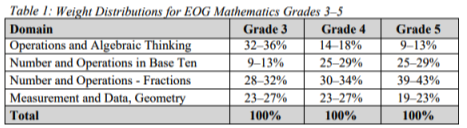
- How should the strands (for reading and science) and domains (for mathematics) be weighted? Here is an example from the math test specifications workshop for grades 3–5
- Which item types (multiple-choice, constructed response, technology-enhanced, numeric entry) are appropriate for each standard?
o What is the appropriate level of cognitive complexity for these standards? For reading and mathematics, NC assessments use Webb’s Depth of Knowledge (DOK); for science, NC assessments use Revised Bloom’s Taxonomy (RBT).
- More information about DOK
- More information about RBT
- For reading, how many literature, informational text, and poetry selections should be included?
- For math, how many calculator inactive vs. calculator active items on each assessment? Standards that are computation-based are likely better suited to the calculator inactive section.
- Once a committee of teachers agree on recommended test specifications, NCDPI content specialists and psychometricians review, make small adjustments if needed, and then finalize the specifications. Test specifications are released and posted to the specific assessment webpage.
DEADLINE EXTENSION
In August, the North Carolina Department of Public Instruction (NCDPI) Office of Academic Standards’ team kicked off the review phase for K-12 Arts, K-12 Guidance, and K-12 World Language Standards. This cohort of standards will follow the NC Standard Course of Study Manual in terms of process and timeline.
Per the Internal Procedures Manual, the review phase consists of data collection and analysis, as well as research. The NCDPI team is seeking input on the current K-12 Arts, K-12 Guidance, and K-12 World Language standards from educators, administrators, parents, students, institutions of higher education, business/industry representatives, national organizations, and other education agencies.
These surveys are being shared to gather thoughtful input and comments from stakeholders familiar with the Arts, Guidance, and/or World Language Standard Course of Study in order to inform revision decisions, which may include changes, clarifications, additions, deletions, or replacements to the current standards.
Any individual who wishes to provide input on the Standard Course of Study may complete this survey. This survey is estimated to take about 10 to 20 minutes to complete, depending on how many grades or courses you choose to review.
We thank you for your time and input. Your feedback is extremely valuable to the standards review and revision process.
Arts Education Team School Counseling Team
Dr. Lori Major Carlin, Section Chief Dr. Ellen Essick, Section Chief
Brandon Roeder, Arts Education Consultant Dr. Kisha Bryant, School Counseling Consultant
Sayward Grindley, Arts Education Consultant
World Languages Team Office Leadership
Dr. Stacy Daniel, Section Chief Dr. Kristi Day, Director
Dr. Ann Marie Gunter, World Languages Consultant
|