In This Edition:
- North Carolina Portrait of a Graduate
- PAEMST 2022-23 Nominations
-
Professional Learning Opportunities:
-
Accountability Information
-
K -12 Science Standards Revision Updates
- ICYMI
- October K12 Math Virtual Office Hour
|
North Carolina Portrait of a Graduate
Grassroots Developed, the Portrait provides a more balanced measure to determine what student success should look like
An initiative led by the N.C Department of Public Instruction (DPI) to define the skills and mindsets students need for success after high school has been unfolding since March. Now, with the help of 1,200 North Carolinians across the state, this grassroots-informed Portrait of a Graduate has been finalized.
The Portrait of a Graduate aims to ensure that North Carolina students are well equipped for the broadest range of postsecondary opportunities. Aligning with State Superintendent of Public Instruction’s Catherine Truitt’s 2022 focus on the “Year of the Workforce,” the Portrait can be adopted by schools and districts to better prepare the state’s 1.5 million students for civic life, career or college.
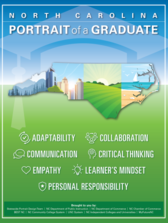
As determined by the design teams that were part of the initiative, the statewide Portrait identifies seven competencies that students should possess upon graduation from high school to help them thrive in the 21st century. These include:
-
Adaptability
- Collaboration
- Communication
- Critical Thinking
- Empathy
- Learner’s Mindset
- Personal Responsibility
To learn more about the Portrait and competencies, click here.
|
Nominations for Presidential Awards for Excellence in STEM Teaching Now Open!
The National Science Foundation (NSF) administers Presidential Awards for Excellence in Mathematics and Science Teaching (PAEMST), created by Congress in 1983, on behalf of the White House Office of Science and Technology Policy (OSTP). The awards are the nation’s highest honors for teachers of STEM, including Computer Science. This year's (2022-2023) awards will honor science, technology, engineering, or mathematics teachers working in grades 7-12. Recipients of the award receive the following:
- A certificate signed by the President of the United States.
- A paid trip to Washington, D.C., to attend a series of recognition events and professional development opportunities.
- A $10,000 award from the National Science Foundation.
- An opportunity to build lasting partnerships with colleagues across the nation.
Nominations close on January 9, 2023. Applications must be completed by February 6, 2023.
If you have any questions or would like to know more about the North Carolina Presidential Awards Program, please contact the State Coordinators for PAESMT:
Joseph Reaper, at joseph.reaper@dpi.nc.gov
Alexis Wood at kathryn.wood@dpi.nc.gov
|
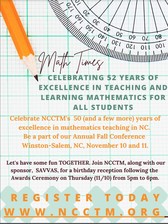
2022 NCCTM State Math Conference
November 9: Leadership Seminar
November 10-11: Conference Sessions
The conference will be held at the Benton Convention Center in Winston-Salem.
The theme for this year's conference focuses on celebrating 50+ years of NCCTM as well as the fact that all of us are learners of mathematics and support ALL students' learning of mathematics.
Conference Schedule [download flyer]
Wednesday, November 9: Leadership Seminar, 9:30 am - 4:30 pm
Thursday, November 10
- 8:30 - 11:15 am Concurrent Sessions
- 11:30 - 1:00 pm Vendor Hall Focus Hours
- 1:00 - 3:45 pm Concurrent Sessions
- 4:00 - 5:00 pm Celebrating NCCTM's 50+ Years and Honoring our Members (Awards)
Friday, November 11: 8:30 am - 3:00 pm Concurrent Sessions
REGISTER NOW!
Book Hotel Now!
|
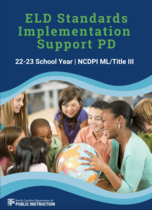
ESL/Title III ELD Standards Implementation: Support PD
This school year marks PSUs' initial implementation of the NC ELD Standard Course of Study. Our team is offering state-wide professional learning with a focus on integrating the ELD Standards into Mathematics, Social Studies, Science, and ELA for the 22-23 school year. Both content area educators and language educators are encouraged to attend.
Register for the following sessions at
bit.ly/SupportPD22-23
- Science (November 16, 2022)
- ELA (January 16, 2023)
To request professional learning specific to your region and/or PSU, please also contact your Regional Director. Should you have any standards questions or need technical assistance, please email ESLTitleIII@dpi.nc.gov.
|
LIS LEARNING SERIES
Throughout the 2022-2023 school year, there will be a series of professional learning involving multiple content areas. The LIS are to be used by all teachers in every content area for core instruction. This
series will focus on integrating the Literacy Instruction Standards (LIS) into standards-aligned content area instruction. These sessions are open to K-12 educators.
- Literacy in ELA: November 30, 2022
- Literacy in Science: December 15, 2022
- Literacy in Math: January 25, 2023
- Literacy in Social Studies: April 27, 2023
- Literacy in ELD: May 11, 2023
Bonus LIS Learning Series Sessions Added!
- LIS for PK-5: February 7, 2023
- Integrating LIS: Content Area Literacy: February 14, 2023
- Writing Strategies for K-5: February 21, 2023
- Improving Reading for Secondary Students: February 28, 2023
To learn more about the LIS, view the DPI LIS webpage.
To view LIS resources, visit the LIS Toolkit (LIST).
What makes up an End-of Grade, an End-of-Course, or an NCEXTEND1 assessment?
- Federal law requires states to administer all students annual statewide assessments in reading/language arts and mathematics in grades 3-8 and once in high school as well as assessments once in each grade span in science. In NC, we develop and administer End-of-Grade (EOG) and NCEXTEND1 assessments for reading and mathematics in grades 3 through 8 and in science at grades 5 and 8; End-of-Course (EOC) and NCEXTEND1 assessments for Biology, English II, and NC Math 1; and End-of-Course (EOC) assessments for NC Math 3.
- Chances are you have administered or proctored one of these assessments. Each assessment follows a set of test specifications and a blueprint, which together mandate the specifics of each assessment. They account for characteristics such as number of items, item types, and the weight of strands (for reading and science) and domains (for mathematics). This is critical to ensure that although each student in a room may have a different form of the assessment, all forms are built to the same specifications.
- Test specifications set the number of operational items for each form. Operational items are those that will count for each student. However, EOGs and EOCs contain more than just operational items. NC also includes some embedded field test items on each EOG or EOC, which do not count for the student. The purpose of field tests is to try out items before they count for students to ensure that each item is fair, reliable, and valid. NC does not administer stand-alone field tests but instead adds a few embedded field test items onto each EOG or EOC. Since these items are mixed in with operational items, students are more likely to try their best to answer the question. Psychometricians then review the performance of these embedded field test items. Items that are fair, valid, and reliable and do not show bias can be included later as operational items on future forms.
- When most people think of a standardized test, they think of four-choice multiple-choice items. In addition to multiple-choice items, NC includes other item types.
- For mathematics, students have numeric entry items online and gridded response items on paper. For these items, students are given a text box and must provide a numeric answer without having a list of possible answers to choose from.
- For reading, mathematics, and science, several different technology-enhanced items are also used. Technology-enhanced items can take many forms:
- Sometimes, technology-enhanced items require students to choose multiple correct answers from a list.
- Other times, students drag and drop correct answers into a chart or table.
- For reading and science, students will sometimes be asked to replace a string of text with a different phrase or word.
- For mathematics, students sometimes are asked to build expressions and equations, choosing from one list of possible answers to build the first part of an expression or equation and from a different list of possible answers for the second part.
- All items used on state-developed assessments (EOGs, EOCs, NCEXTEND1s, and NC Check-Ins) go through the same rigorous process.
- As new assessments are constructed, new item types are developed and tested out with students through cognitive labs. If students can successfully manipulate the new item types and are able to show what they know, then the new item type may end up on a state-developed assessment.
Want to find out more?
Ready to become a part of the process?
K-12 Science Standards Revision Updates
Completed Actions:
✓ Data Review Committee (DRC) Report completed and shared with the Standard Writing Team
✓ Standards Writing Team (SWT) orientation and work session (mid October)
✓ Standards review updates are being sent through Science, Math and STEM newsletters and listservs, and posted on the website
Next Steps:
- SWT completing the first draft of the revised standards
- DPI will release the first draft of revisions (tentatively) in mid-November for 30 days for both public and PSU standard-by-standard survey feedback
- Communication is being, and will continue to be sent, preparing the public and PSUs
- After the 30 day window, the survey data will be sent to the Office of Learning Recovery & Acceleration
Stay tuned for Science Standards Revision updates by signing up via the NCDPI listservs.

NCDPI K-12 Mathematics Virtual Office Hours
On October 18, 2022, the NCDPI K-12 Mathematics team, with special guests, NCDPI Test Measurement Specialists, Beth Nash and Michael Mahoney, and NCDPI Exceptional Children Education Consultant, Matthew Martinez, held an office hour for NC math school and district leaders. This office hour featured Testing and Accountability information along with information and a request for assistance in developing the Extended Standards Unpacking Documents.
Click here for the agenda, presentation, and recording.
|
NC DPI Math Consultants
Denise Schulz
K-5 Mathematics Consultant
919-807-3758
Denise.Schulz@dpi.nc.gov
Tammy Lackey
K-8 Mathematics Consultant
919-807-3931
Tammy.Lackey@dpi.nc.gov
Lisa Ashe
6-12 Mathematics Consultant
919-807-3856
Lisa.Ashe@dpi.nc.gov
Joseph Reaper
6-12 Mathematics Consultant
919-807-3820
Joseph.Reaper@dpi.nc.gov
Dr. Charles Aiken
Math, Science, and STEM Section Chief
Charles.Aiken@dpi.nc.gov
984-236-2837
Marilyn Johns
Administrative Specialist
Marilyn.Johns@dpi.nc.gov
919-807-3266
Disclaimer Statement: Any links on this newsletter that bring you to third party websites, owned and operated by independent parties over which NCDPI has no control. Any link you make to or from these 3rd Party Websites will be at your own risk. Any use of these 3rd Party Websites and any information you provide will be subject to and governed by the terms of the 3rd Party Website, including those relating to confidentiality, data privacy, and security.
Unless otherwise expressly agreed in writing, NCDPI is not in any way associated with the owner or operator of any of the 3rd Party Websites or responsible or liable for the goods and services offered by them or for anything in connection with such 3rd Party Websites. NCDPI does not endorse and makes no warranties, representations or undertakings relating to the content of any 3rd Party Website.
|