The National Dual Language Education Teacher Preparation Standards: A Call to Action
by Dr. Joan Lachance
 |
|
The Standards: A Call to Action
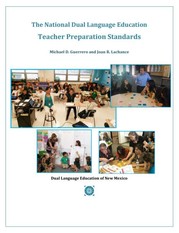
Dual language/immersion programs continue to expand nation-wide. From the North Carolina perspective, we have experienced a tremendous increase in programs in just under a decade, a relatively short period of time. Proudly, at the time this article was written, NC hosted 201 Dual Language/Immersion (DL/I) programs with eight partner languages—serving both English learners and native speakers of English to foster a culture of multilingualism. To this end, at the state and national level, many groups of stakeholders made numerous considerations regarding said expansions. One pressing topic is the national shortage of well-prepared dual language teachers. The urgency of the shortage resulted in years of engaged scholarship addressing the critical call for action regarding high quality, consistent dual language teacher preparation. The call to action sparked Dual Language Education of New Mexico’s (DLeNM) publication of the National Dual Language Education Teacher Preparation Standards (NDLETPS).
|
DLeNM and the co-authors, Drs. Michael Guerrero from the University of Texas at Rio Grande Valley and Joan Lachance from the University of North Carolina at Charlotte, acknowledged the need for a set of standards that provide guidance to educator preparation programs while also creating a critically needed means that could result in program accreditation. The NDLETPS are strengthened by their anchoring in current and empirical literature, indicating that well-implemented dual language education programs increasingly and consistently close the achievement gap between minoritized populations of emergent bilingual children and their monolingual English-speaking peers. The demand for consistently well-prepared dual language/immersion education teachers warranted the national standards given that teacher preparation programs continue to struggle to keep up with the pleas for dual language teachers. Likewise, there are unique pedagogical and linguistic qualities of dual language teachers that are often glazed over or simply not addressed in various teacher preparation programs. The NDLETPS aim to alleviate said void.
|
The six standards are:
1) Bilingualism and Biliteracy
2) Sociocultural Competence
3) Dual Language Instructional Practices and Pedagogy
4) Authentic Assessment in Dual Language
5) Professionalism, Advocacy, and Agency
6) Program Design and Curricular Leadership
The reader should note that the format for framing the six standards necessitated certain characteristics that are anchored to the Council for the Accreditation of Educator Preparation (CAEP). Aligning the standards to CAEP was strategic and intentional in order to leverage the accrediting entity, from a supportive stance for the greater distinction of dual language education.
|
|
 |
From this standpoint, the prospect of having access to external examiner teams that are dual language education experts to provide feedback on the design, development, and evaluation of educator preparation programs across the U.S. has significant potential for moving the profession forward. Ultimately, we aim to better serve all multilingual teachers and their learners.
 |
|
Highlights: 2019 La Cosecha Conference |
La Cosecha hosted a pre-conference workshop devoted to providing current progress on the NDLETPS. A focal point in the workshop was CAEP’s recent acceptance with conditions of the NDLETPS to serve as the foundation for a newly formed Specialized Professional Association, The National Consortium for Dual Language Education. A significant point from the pre-conference workshop was its participants who represented stakeholders from institutions of higher education, state education agencies, district-level dual language educators [including representation from the Eastern band of Cherokee from Western, North Carolina], and most-importantly, practicing dual language classroom teachers. Additionally, the Board Members from the National Association of English Learner Administrators (NAELPA) and leadership from the Multistate Association for Bilingual Education, Northeast (MABE) attended to give an organizational perspective for future collaboration.
Guided conversations explored the formation of the National Consortium with a core leadership team as well as other potential uses for the NDLETPS as an anchor document. One crucial example is state education agencies’ development of policies and guidance regarding dual language teachers, following the Massachusetts Department of Education’s citation of the Standards in their current guidance on the recently passed legislation, the LOOK Act. Discussions also revealed ways for the Standards to be used as an anchor for the creation of high-quality professional development for current dual language teachers, for human resources and administrative teams responsible for hiring dual language educators, as well as for other policy-makers.
Another pivotal portion of the conference was a professional panel that included Mr. David Rogers, Executive Director of DLeNM, Drs. Joan Lachance from the University of North Carolina at Charlotte and Michael Guerrero from the University of Texas at Rio Grande Valley (the NDLETPS co-authors), Dr. Elizabeth Howard from the University of Connecticut, Dr. Barbara Kennedy (formerly of the Texas Education Agency), and Mariana Castro from WIDA. Panelists commented on the NDLETPS benefits to the field as well as pertinent questions.
Benefits:
1) Importance of having a mechanism for program accreditation and licensure given the states’ variations in parameters
2) Generation of recognition for dual language within the larger context of teacher education
3) Value of having a field-based consensus for dual language teachers’ necessary knowledge, skills, and dispositions
4) Promotion of communication between IHEs and SEAs/LEAs regarding the expectations and demands of dual language teachers, and the additional support they would need for success
5) Standards provide potential for improved dual language teachers’ clinical experiences.
Questions:
1) How will the standards serve to shape bilingual/TESOL/teachers of ELs, etc. to broadly define educator preparation programs that have specific and varying needs? For example, dual language teacher preparation coursework in the Texas Borderland region will have unique needs versus dual language teacher preparation in up-state Washington, or up-state Maine.1) Will the standards serve to shape bilingual/TESOL/teachers of ELs, etc. in programs more broadly define?
2) To what degree will new teachers versus veteran teachers be able to demonstrate competencies in all six standards?
3) How might the standards be used differently in initial licensure programs versus add-on programs?
The panel and participants agreed that these are vital questions for consideration as we continue the forward momentum for the betterment of dual language/immersion teacher preparation.
In conclusion, the next steps include the formation of the national consortium, specifically delineating what membership will oblige and, the logistical timeline for supporting programs with the accreditation and educator preparation program evaluation processes.
What do the DL/I Teacher Preparation Standards Mean for NC?
The publication of the National Dual Language Education Teacher Preparation Standards (NDLETPS) may impact NC in a number of ways, including:
- Development of DL/I Teacher Preparation Courses
- The University of NC, Charlotte (UNCC), under the guidance of Dr. Joan Lachance is developing an online DL/I teacher preparation program.
- The University of NC, Greensboro (UNCG), under the guidance of Dr. Jane He, currently offers ESL add-on licensure with a DL/I concentration via the EnACTeD program. Long term plans include offering a DL/I teacher preparation program.
- Development and approval of NC DL/I add-on licensure
- The NCDPI has explored DL/I licensure before via the 2005-2009 federal FLAP grant, which built infrastructure for DL/I programs across NC.
- Requests from NC Universities, such as UNCC and UNCG, substantiate the desire for DL/I add-on licensure in NC.
- The publication of the NDLETPS is a compilation of research based standards for preparing DL/I teachers, which can be included in the application for NC DL/I add-on licensure.

About Dr. Joan Lachance
Dr. Lachance is an Associate Professor and serves as the Director of the TESL Graduate Certificate and TESL Minor programs. She teaches graduate and undergraduate courses focused on TESL Teaching Methods, Multiligualism and Language Development as well as Authentic Assessment with English Learners. Her research agenda focuses on dual language teacher preparation, academic language development, and authentic assessment with current studies on dual language pedagogies, edTPA systems of support, as well as co-teaching and ESL teacher collaboration. She also has an extensive service agenda that includes connections with the North Carolina Department of Public Instruction Title III/ESL Department to support school districts' language assistance programs. She is also an active member of AERA and the Bilingual Education Special Interest Group.
|
|