|
You may remember reading about the ECU DL/I Administration Certificate program in previous messages. We are sharing about the program and its benefits in this message through the eyes of a student and leadership program administrator.
In the Sociocultural Competence article, you will learn how course assignments/projects can turn into valuable programmatic tools. The tool is shared for you to explore and adapt for your own DL/I program.
In the DL/I Leadership Program article, you will learn about a networking opportunity which grew out of the desire of the first ECU DL/I Certificate Program cohort to continue working together and supporting each other on the DL/I journey. Read about networking opportunities, site visits to successful DL/I programs, and how YOU can get involved!
NC DL/I Discourse Article: Sociocultural Competence, an ECU DL/I Certificate Project & Product
by Helen "Lannie" Simpson
When you began DL/I programming in your school, you probably used the Guiding Principles for Dual Language Education to help design your program, which is originally from the Center for Applied Linguistics (CAL). Do you also use the Guiding Principles for program reflection and amelioration?
Consider this question:
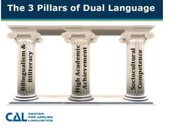
How aligned is your DL/I program with your mission and goals, particularly considering the three pillars of DL/I programs?
|
You would probably answer that you have at least partial, if not full, alignment with the first pillar of bilingualism and biliteracy. The second pillar, grade level academic achievement, is likely clearly articulated in standards-based expectations for English and the DL/I program language. However, when you, as a DL/I administrator or teacher, reflect on the third pillar of sociocultural competence, you may see room for improvement. The pillar of sociocultural competence may be somewhat neglected.
What exactly is sociocultural competence?
CAL describes it as “a term encompassing identity development, cross-cultural competence, and multicultural appreciation—for all students.” The Guiding Principles publication further cites that effective DL/I staff “use multiethnic curricular materials, integrate students’ cultural values into the classroom,” and are grounded in sociocultural understanding.
(Howard, E. R., Lindholm-Leary, K. J., Rogers, D., Olague, N., Medina, J., Kennedy, D., Sugarman, J., & Christian, D., 2018).
|
Research demonstrates that socioemotional learning is directly correlated to success in all academic areas (Durlak, Weissberg, Dymnicki, Taylor, & Schellinger, 2011). Therefore, positive self-identities, respecting and valuing multiple cultures, languages, and heritages are critical to the development of sociocultural competence. CAL cites components of sociocultural competence such as “identity development, cross-cultural awareness, multicultural appreciation, and conflict-resolution.” Some strategies to develop these components of sociocultural competence include conflict resolution strategies via what-if scenarios, perspective-taking role plays, empathy development activities, cross-grade buddies, and cross-country class partners (Howard, E. R., Lindholm-Leary, K. J. , Rogers, D., Olague, N., Medina, J., Kennedy, D., Sugarman, J., & Christian, D., 2018).
Moreover, literature in a DL/I program must reflect the diversity of languages and cultures specific to your own program and community. Rudine Sims Bishop, Professor Emerita of The Ohio University, describes literature as mirrors, reflecting children’s lives: “But books can also be mirrors. When books reflect back to us our own experiences, when scenes and sentences strike us as so true they are anchors mooring us to the text, it tells readers their lives and experiences are valued. When children do not see themselves in books, the message is just as clear (“Mirrors for My Daughter’s Bookshelf; Sara Ackerman, The New York Times, Feb. 3, 2017). Thus, in a DL/I program, it is critical for diverse students to see themselves in the literature to develop positive self-identities and cross-cultural understanding. CAL postulates that “this area of sociocultural development is as critical as language development in dual language programs” (Howard, E. R., Lindholm-Leary, K. J., Rogers, D., Olague, N., Medina, J., Kennedy, D., Sugarman, J., & Christian, D., 2018). The message is loud and clear: sociocultural competence is of critical importance to dual language programming.
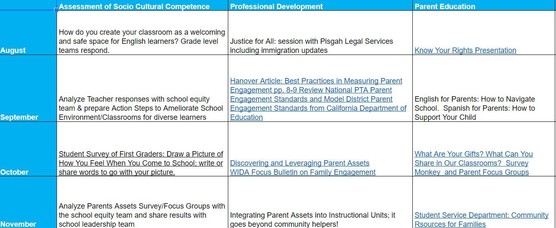
After utilizing the self-evaluation tool contained in the Guiding Principles, I developed a year-long calendar of activities to assess sociocultural competence, provide professional development in sociocultural competence, as well as parent education. This calendar of activities began as an assignment for ECU's Dual Language Administrator's course, Leading Cross-Cultural Competence in DLI Programs. I have since augmented the calendar with resources from the 2019 La Cosecha Conference.
The calendar has become a useful tool in my work as a DL/I administrator in Burke County Public Schools. We are not fully implemented yet, but this calendar and menu of resources that we have developed may be helpful to you in your journey to effectively implement, evaluate, and improve your DL/I program with regard to the third pillar of sociocultural competence.
Dual Language/Immersion Leadership Program (DL/ILP):
An ECU and Southeast Education Alliance Partnership
by Helga Fasciano
East Carolina University (ECU) has taken the lead in preparing principals to lead schools that educate using DL/I by establishing the online DL/I Administration Certificate program for building and central office administrators. In addition, ECU has developed a collaboration with the Southeast Education Alliance to provide ongoing support for current administrators of these programs and to mentor those that are exploring implementation.
One of the goals of this annual program is to experience current programs and interact with leaders currently hosting successful DL/I programs. Each cohort has the opportunity to participate in four school visits, and here are the ones for 2019 - 2020:
For the first site visit, DL/ILP cohort administrators were hosted by Speas Global Elementary Principal, Robert "Bobby" Ash. The October 24, 2019, visit began with an overview of DL/I program history and current practices, followed by classroom visits. A Q&A session, including teachers and administrators, was offered at the end of the visit.
One of the cohort administrators reflected, “It doesn’t matter what you already know going into one of these site visits; it is what you learn from each unique program and setting.”
The DL/ILP member administrators shared their site visit reflections at a cohort webinar in November, and a photo essay is also available on the NC DL/I Program Spotlights page.
|
For details about the DL/ILP, contact:
Ms. Helga Fasciano, 2019-2020 DLI/LP Coordinator at DLIAdmin@ecu.edu and/or
Dr. Kathy Spencer, Southeast Education Alliance at sealliance15@gmail.com
Want to apply to the DL/I Administration Certificate Program?
The DL/I Administration Certificate provides school leaders with the knowledge and skills necessary to implement successful DL/I programs. The program is offered 100% online and completed in 1 year (4 classes). Tuition is approximately $3,000 for the program or $750 per semester for North Carolina Residents.
The ECU DL/I Administration Certificate program application is online and due April 15.
NC DL/I Discourse Magazine
The DL/I Discourse Magazine has taken on a new format. Articles will be shared via the listserv several times per month, loaded to the DL/I Discourse Magazine page on the DL/I Website, and then compiled into the DL/I Discourse Magazine format, similar to the Fall of 2019 (PDF), at the end of the season.
Watch for information about topics such as DL/I:
- Spotlights on students and programs
- Standards
- Instruction
- Leadership
- Principal's Blog
- DL/I Quarterly Webinars
- Of Interest including resources, conferences and more!
|
|