|
This update contains the latest announcements and current news impacting K-12 Social Studies in North Carolina public schools. As always, we encourage those of you who receive the updates to please share this issue with others who are not currently subscribed to our listserv. To receive Social Studies Updates please sign up using the following link: Social Studies Listerv Update and Remind or follow us on Facebook and Twitter .
If you would like to share any upcoming events, professional learning opportunities, instructional resources, or award/grant opportunities with the NCDPI Social Studies Listserv, please send a brief explanation or description, image, and any pertinent additional information by the 4th of each month to
Phylisha.Sanders@dpi.nc.gov
Update includes:
PROFESSIONAL LEARNING OPPORTUNITIES
- Money Smart Week Resources
- Economics for Educators Summer Institute for K-12 Teachers
- Center for Smart Financial Choices Event
INSTRUCTIONAL RESOURCES
- Free Spirit Publishing Financial Literacy Resources
- Read Aloud Books for Financial Literacy
- K-12 Financial Literacy Resources from The Federal Reserve Bank of Richmond
Don't Forget to Scroll Down for More Great Information!!
PROFESSIONAL LEARNING
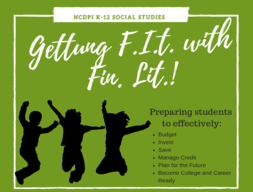 The last week of April has been recognized as Money Smart Week
Money
Smart Week (MSW) is held during the last week of April. It aims to help individuals to better manage
their personal finances.
Click
for more information about Money Smart Week:
Visit
the K-12 Social Studies Wiki to
access Financial Literacy Resources.
For additional instructional resources for
personal financial
literacy, be sure to register for the PFL Webinar Series featuring:
- an encore presentation from the North Carolina Council on Economic Education with Sandy Wheat : April 24th from 3:30 pm-4:30 pm click HERE
-
The Office of the Secretary of State with John Maron: April 25th from 3:00 pm-4:00 pm click HERE
Click to see the 2018 Proclamation of Financial Literacy Month from Governor Roy Cooper.
|
Don't Forget to Scroll Down for More Great Information!!
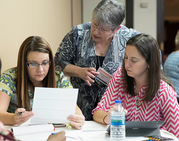 Economics for Educators Summer Institute for K-12 Teachers
August 6 – 10, 2018
Campbell University
Cost: Free of charge
Grounded in research-based instructional best-practices, this professional development program teaches the economics content in North Carolina’s Essential Standards in a way that makes economics accessible, empowering, and relevant to students’ lives. Mindful of adult learning theories, all of the economics content will be taught by modeling field-tested lessons, so there is no traditional lecturing.
Teachers attending this institute will be able to:
- Attend free-of-charge
- Experience learning economics content in similar ways that their students do
- Receive a wealth of classroom-ready, student-centered resources
- Receive differentiated instruction based on the grade levels and subjects represented
- Have an inclusive breakfast and lunch
- Earn 40 hours of professional development (or have the option to pay tuition and earn 3 credit hours)
TO REGISTER:
EMAIL: Your Name School Division and Name Grades/Subjects to Dr. Mostashari Campbell University Mostashari@campbell.edu
Limited to 25 teachers on a first come, first serve basis
REGISTRATION DEADLINE: June 1, 2018
|
 |
|
Center for Smart Financial Choices: Wish I Learned that in School Event
Tuesday, April 24th
6pm - 8pm at Footnote Cafe
634 W. 4th Street Winston-Salem
So far this year, the Center for Smart Financial Choices has brought the basics of money management to over 1500 students in Forsyth and Guilford County schools. You are invited come and celebrate the vital work that is being done to cultivate youth for financial success!
- Recognize 2018 scholarship winners
- Experience what it's like to be an "Adult for a Day"
- View video by WSSU students involved in Operation Money Talks
- Hear from youth whose lives have been impacted by CFSFC
- Food, drinks and a raffle
Register today!
|
INSTRUCTIONAL RESOURCES
 Financial Literacy Resources from Free Spirit Publishing
The Survival Guide for Money Smarts
Earn, Save, Spend, Give
This lively survival guide introduces the basics of financial literacy and money management to kids. Readers will find humorous illustrations and engaging examples that bring to life ideas for setting money goals, delaying gratification, being thrifty, giving to charity, and making socially responsible spending and donating decisions. The authors also offer friendly insight into how choices about money and finances connect to character development and social-emotional well-being.
Learn more and download a free leader's guide.
Fun with Finance: Classroom Activities for Financial Literacy Month
Help students establish a foundation of money smarts that will help them now and in the future.
Read the full article. >
Helping Students Set SMART Goals for Financial Literacy
Setting financial goals can be a fun and inspiring activity for students of any age. And when you keep the focus on the end goal of using money to achieve the lifestyle students want, it can be easier to engage them.
Read the full article. >
|
Don't Forget to Scroll Down for More Great Information!!
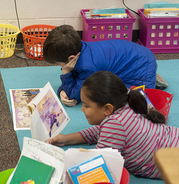
Great Read Aloud Books for Financial Literacy Month
Berenstain Bears: Trouble With Money
F&P Level L
First Grade thru Third Grade students hear a story about two little bears whose parents use several figures of speech relating to money. Students draw a picture of a bank and write a caption explaining their illustration. Students follow along with the story by listening for additional figures of speech and how they relate to the concepts of banks and interest. The students also construct a story map of an event in the story relating to why people choose to keep their money in banks.
There is even a lesson plan ready to go from the Federal Reserve Bank of St. Louis!
https://www.stlouisfed.org/education/the-berenstain-bears-trouble-with-money
Uncle Jed's Barbershop
F&P Level S
Sarah Jean's Uncle Jed was the only black barber in the county. He had a kind heart and a warm smile. And he had a dream. Living in the segregated South of the 1920's, where most people were sharecroppers. Uncle Jed had to travel all over the county to cut his customers' hair. He lived for the day when he could open his very own barbershop. But it was a long time, and many setbacks, from five-year-old Sarah Jean's emergency operation to the bank failures of the Great Depression, before the joyful day when Uncle Jed opened his shiny new shop — and twirled a now grown-up Sarah Jean around in the barber chair. With James Ransome's richly colored paintings brimming with life, this is a stirring story of dreams long deferred and finally realized.
Here is a great lesson plan to support the book too!
https://www.philadelphiafed.org/-/media/education/teachers/lesson-plans/UncleJedsBarbershop.pdf
A Chair for My Mother
Students
read A
Chair for My Mother,
about a little girl and her family who save money to buy a chair after their
furniture is destroyed in a fire. Students learn that characters in the book
are human resources who save part of the income they earn. Students identify
other human resources, discuss how their work allows them to earn income and
name strategies that will help them reach a savings goal.
There is a lesson plan that support this book, too!
https://www.stlouisfed.org/education/the-berenstain-bears-trouble-with-money
|
 Instructional Resources from The Federal Reserve Bank of Richmond
Middle and High
Invest in What’s Next: Life After High School: Help your students navigate their first major financial decision – what path to pursue after high school. Through online, self-directed lessons, students build personal finance knowledge and skills to help implement a plan that’s right for them.
Photo Essay of MaggieL. Walker: illustrates the life of a visionary leader in the African-American community
Economic Concepts Posters: Find hands-on ideas for teaching economic concepts by using these award-winning, student created illustrations.
Dollars and Sense :Dollars and Sense is a budgeting game for middle and high school students. Students select a lifestyle and budget for expenses and unexpected events.
PSAs in the Classroom: Engage your students with short PSA videos, paired with easy-to-implement classroom activities, to demonstrate economic and personal finance concepts.
Deficit and Debt Direction Connection : Predict the effect of changes in the economy and other events on tax revenue, government spending, the federal budget and the national debt to determine the connection between deficit and debt.
Fed Centennial Lessons Combined: Conduct a readers' theater, interactive card sort, human timeline activity, and more to learn about the Fed’s history and functions, and how its role has evolved over the last 100 years.
Region Focus: Check out selected issues and articles from Region Focus, now titled Econ Focus, and links to related lessons, resources and activities.
The Monetary and Fiscal Policy Two Step: Examine quotes from news sources to distinguish the differences between monetary and fiscal policy.
Elementary
Economic Concepts Posters: Find hands-on ideas for teaching economic concepts by using these award-winning, student created illustrations.
Photo Essay of MaggieL. Walker: illustrates the life of a visionary leader in the African-American community
My Money: Explore lessons such as What Is Money?, Money Equivalents, and Jobs, Money, Goods and Services in this educational package for elementary school students.
Lemonade for Sale: Use the book Lemonade for Sale to discuss and classify productive resources. Hands on activities are a key part of this lesson and extension activities integrate mathematics and language arts into the exercise.
Historical Figure Bookmarks: Discover fun facts, activities and brief biographies that highlight historical figures on coins, and the history of economics, banking and the Federal Reserve System.
To access more resources and information, please visit: https://www.richmondfed.org/education
For
information on presentations, tours, and TCC in Charlotte:
Yolanda
Ferguson
Yolanda.Ferguson@rich.frb.org
For
information on resources shared:
Kevin Woodcox
Kevin.Woodcox@rich.frb.org
Sarah Gunn
Sarah.Gunn@rich.frb.org
|
 |
K-12 Social Studies Resources
K-12 Social Studies Essential Standards Wiki
NCDPI's K-12 Social Studies Essential Standards Wiki website is a resource designed especially for educators to assist in the preparation of moving to the K-12 Social Studies Essential Standards. The North Carolina K-12 Social Studies Essential Standards are available, along with a number of other resources such as the Instructional Toolkit components and professional development material.
Follow Us on Social Media
Facebook and Twitter
AND...
Sign-Up for Remind Today!!
NCDPI- Social Studies is proud to announce that we are able to communicate with social studies educators through http://www.remind.com.
What is Remind?
- A FREE web and app based communication tool that can connect North Carolina educators to the NCDPI- Social Studies Team
- Fast, easy, convenient and effective way for NCDPI- Social Studies Team to communicate the most recent social studies related legislative updates, resources, events, announcements, webinars, opportunities, etc.
- NCDPI- Social Studies Team can send or receive messages via text or email to help update, remind,
connect, and/or communicate last minute changes
- Flip phone, IOS, or Android compatible
- Won’t clog inboxes
- Everyone’s contact information stays private because cell number and/or email address are not shown to users
- Joining only takes seconds: Text @bc8e8c to the number 81010 OR CLICK here
|