|
For immediate release
Nov. 15, 2016
Federal Grants Support School Improvement Efforts
Aid Helps 19 Schools Across North Carolina
Nineteen of
North Carolina’s lowest performing "priority schools" will share in nearly $40.3
million in federal grant funds during the next five years aimed at improving
student achievement through various school turnaround strategies.
The schools (listed below) represent the fourth and final round of recipients of federal School
Improvement Grants (SIG) awarded by the N.C. Department of Public Instruction
through a competitive federal application process. The 19 schools, in eight
districts, will benefit from SIG funds North Carolina has received for the last
three years – allowing for five years of support instead of three years
provided for previous cohorts of schools. North Carolina received approximately
$13.9 million in 2014, $14.1 million in 2015, and recently awarded $12.2
million for 2016.
The grant
competition was open to Title I or Title I-eligible schools that previously had
not been awarded the grant and, based on the most recent data available, had
been identified as "priority schools," or the lowest performing 5 percent of schools in the state,
determined by state end-of-grade or end-of-course tests.
The schools that
submitted official “letters of intent to apply” by a summer 2016 deadline and that
completed the full application process by September represented 44 of 69
possible traditional schools from 17 of a possible 29 school districts, and two
of a possible eight charter schools. In
all, 77 schools were eligible, and a combined 46 traditional and charter
schools submitted the letter of intent and completed the competition requirements
for the five-year awards.
Since 2010 in
North Carolina, 61 schools in three previous rounds of School Improvement
Grants – in 2010, 2011 and 2013 – have received a total of nearly $144 million
in federal funding to pursue three-year efforts to boost student performance
through aggressive turnaround approaches. Some schools received as much as $2
million for each of the three years of participation though others received
less than $1 million total depending on need and student population.
The grant
program is intended to achieve significant gains for schools struggling with
low student performance by adopting one of several turnaround models prescribed
by the federal government but chosen by the school. These have included
converting to a charter, replacing the principal and at least half the staff, outright
closure and a transformation approach that involves replacing the principal and
taking a series of steps to increase teacher effectiveness, overhaul
instructional strategies and increase parent involvement, among others.
Schools in the
latest round of grants will get two additional years of grant support – for a
total of five years – and have two additional turnaround options from which to
choose – for elementary schools, one that focuses on improving early learning,
and for all schools, a “whole-school” reform approach allowing schools to adopt
a model for which research shows evidence of success.
The federal School Improvement Grants
(SIG) program awards grants to states to provide competitive sub grants to
local school districts for providing assistance for school improvement. States
must award sub grants of at least 95 percent of the funds it receives to districts
for school improvement activities. States
must give priority to the districts with the lowest-achieving schools that
demonstrate the greatest need for such funds and the strongest commitment to
ensuring that the funds are used to support the lowest-achieving schools to
meet improvement goals. The federal requirements for the grants define school
districts with the “greatest need” for SIG funds and the “strongest commitment”
to ensure that the funds are used to substantially raise student achievement in
the persistently lowest-achieving schools in the state.
States are also given flexibility
to develop their own intervention model that focuses on whole-school reform and
is designed to improve student achievement. In schools that have received funds
under this program in the past, up to 80 percent of students are from
low-income families – 28 percentage points higher than the average school. In
North Carolina, some schools that have benefitted from the grants have
enrollments where nearly 100 percent of the students are from low-income
families.
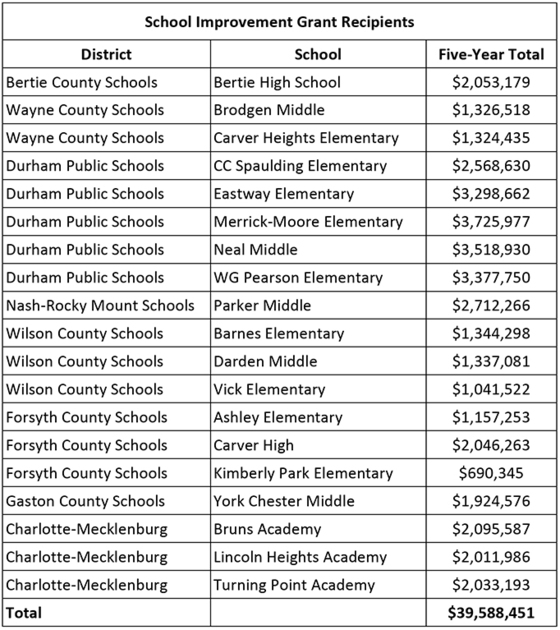
Funding projections in the table below showing awarded schools are based on actual (FY 14, FY 15) and estimated (FY 16) funding from the U.S. Department of Education. Each school's actual award amount will be finalized prior to Jan. 1, 2017.
###
|