|
For immediate release
Sept, 1, 2016
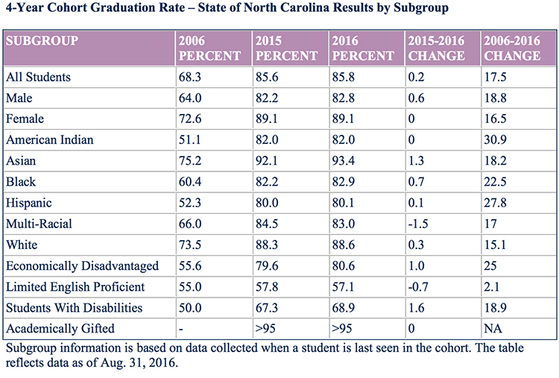
Gaps Narrowing as NC Graduation Rate Climbs
North Carolina’s four-year cohort high school graduation
rate ticked up to 85.8 percent with the class of 2016, adding an 11th
year of consecutive gains on a critical measure of student success. The
four-year rate has climbed 17.5 percentage points since 2006, the first year
North Carolina reported a cohort rate.
Gains among a number of student groups
outpaced the state’s overall increase last year, continuing a trend in the
state that has seen gaps closing for minority and economically disadvantaged
students against the rate for white students and the state’s total overall. Except
for students with disabilities and those with limited English proficiency, the
four-year graduation rate for all groups exceeded 80 percent for the first time
in 2016.
State Superintendent June Atkinson said North
Carolina’s steady improvement in graduation outcomes means that more students
from all backgrounds are now finishing high school better positioned for
college and careers.
“This is good news for our state, and
especially good news for students who will have more opportunities available to
them because they have completed high school,” Atkinson said.
“I’ve highlighted high school graduation rates
as one of my major priorities since becoming state superintendent, and I’m especially
pleased to see these numbers improve for our diverse student population at the
same time that we’ve raised graduation requirements and expectations for
students.”
The four-year cohort graduation rate for
students from low-income families increased by 1 percentage point from 2015,
reaching 80.6 percent, while the rate for black students increased by 0.7
points, to 82.9 percent. The gain for both the state overall and for white
students was 0.3 percent from 2015 to 2016.
The latest increases for student groups that
have been underrepresented as high school graduates and in postsecondary
education add to 10 years of strong gains in graduation outcomes that have exceeded
the state’s overall growth.
Compared to the 17.5-point increase for all
students combined since 2006, the four-year cohort graduation rate for American
Indian students has increased by 30.9 percentage points; for Hispanic students,
27.8 points; for economically disadvantaged students, 25 points; and for black
students, 22.5 percent.
As a result of those improvements, persistent
gaps evident in 2006 have narrowed significantly. The gap between white and
black students, for example, has closed by more than half, from 13.1 points in
2006 to 5.7 points in 2016; a similar trend is seen between students from
low-income families and the state as a whole, closing from 12.7 points in 2006
to 5.2 points in 2016.
The gains in recent years have been achieved along
with more demanding graduation requirements. Since 2009, high school students
have been required to earn a minimum of 22 course credits, up from 20
previously, and they are expected to complete mathematics through Math 3 as a
minimum.
For more detailed information, see the 2015-16 Executive Summary – Cohort Graduation Rate on the Accountability and Testing Results page on the NCDPI website. Questions regarding the
state’s cohort graduation rate may be directed to NCDPI Communications at
919.807.3450.
###
|