The
State Board of Education has begun looking forward to the new biennial budget
that will set priorities and address needs in the 2017-19 biennium for public
schools and other activities supported by state government.
I want
to thank you for your participation in the three regional meetings that Chief
Financial Officer Philip Price and his team in Financial and Business Services
held recently with you. Your feedback made a significant difference in the
priority list that the Board members reviewed at their August meeting.
For
example, we highlighted the social and emotional needs of students and the need
for funding to address students at risk in these areas. Other items that were
provided to the Board include: funding to address the impact of new legislated
changes that will require class sizes to match class size allotments;
professional development for teachers; more digital content; master’s degree
pay; more competitive salaries for assistant principals and principals; more
assistant principals; resources to handle social and emotional issues related
to students; more adults to support teachers and students (teacher assistants
and instructional facilitators); funding for students with special needs; funds
to address the impact of losing “lower cost” students to charter schools;
reducing allotment categories; removing restrictions on flexibility with
teacher assistants, children with special needs and CTE; and a desire to return
to school-based awards versus individual pay differentials.
The
General Assembly will return to Raleigh for its long session in January,
so we will continue to involve you and keep you updated about budget priorities
that will have a direct effect on your work and ours.
|

State Board of Education Meeting Highlights
The State
Board of Education last Thursday approved eight new charter schools to open in
2017, opened interscholastic sports to sixth graders (see item below), adjusted
state policy for issuing continuing licenses to teaching applicants from out of
state, and approved five applications for Reform Models: two schools in Chatham
County, two in Edgecombe County and one in Winston-Salem/Forsyth.
The board
also heard updates on the state’s planning for the federal Every Student
Succeeds Act (ESSA) and development of the Achievement School District set by
the legislature to improve five of the lowest-performing schools in the state.
The
complete list of this month’s Board actions is available on the Board’s website. The
Board’s August agenda as well as supporting executive summaries are available online by
clicking on the SBE Meetings tab.
|
 Interscholastic Athletics Policy Updated
At
last Thursday’s State Board of Education meeting, members revised the Interscholastic Athletics Policy (HRS-D-001 click on NCSBE Policy Manual Table of Contents link). The new policy changes the
grade level at which students may participate in interscholastic competition
from grades 7-12 to grades 6-12. As part of this change, 6th
grade students may participate in all interscholastic sports with the exception
of football.
The
policy allows each LEA or charter school to determine whether or not 6th
graders may participate in interscholastic athletics, with the exception of
football.
If you have any questions, please contact NCDPI Healthful Living
Consultant Burt Jenkins.
|

NC Math 1, 2, and 3 Resources Update
NC Math 1, 2, and 3 resources continue to be posted for teachers, coaches, principals
and coming soon ... for parents.
Tomorrow
morning (Aug. 9), the newest resources available include OPTIONAL pacing
guides for each course. These pacing guides are part of a statewide
effort by educators in the field. More than 20 districts and 50 math teachers
and leaders gathered and worked on creating an OPTIONAL statewide pacing guide.
Many of those educators agreed to share their district guides as well.
The
virtual "Just in Time" weekly support sessions for NC Math 1, 2, and 3 teachers will
address topics in the courses according to the OPTIONAL pacing guides and recorded
for viewing at any time. More information on support sessions will be coming
soon.
Should
you have any questions about the resources, please contact NCDPI Secondary Math
Consultants Joseph Reaper or Lisa Ashe or K-12 Mathematics
Section Chief Jennifer Curtis.
|
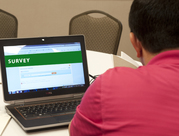 Survey to Identify Priority Issues
NCDPI Exceptional Children Division Director Bill
Hussey was asked by the US Department of Education to serve on the Southeast
Regional Advisory Committee (SERAC). This committee is responsible for
assessing the education needs of the region.
Bill today sent a five-question survey to
principals that will provide feedback to SERAC on priority issues. This survey
is being sent to all states included in the SERAC’s region to various populations
including teachers, principals, superintendents and others. The information
collected will help SERAC align its resources to support the identified needs.
Your principals’ participation will be very much appreciated.
Questions regarding the survey may be directed to
Exceptional Children Director Bill Hussey.
|

NC Textbook Commission to Meet
Aug. 15-16
The North Carolina
Textbook Commission will meet Monday and Tuesday, Aug. 15-16, beginning at 8
a.m. each day, at the Embassy Suites, 204 Centreport Drive, Greensboro.
Commission members will formulate a
list of textbooks for recommendation to the State Board of Education after the
deliberations and reconsideration process.
Questions regarding
this meeting may be directed to Judy Blount with NCDPI Textbook
Services.
|
Promising
Neighborhoods Grant Competition
On
July 11, Secretary King announced the 2016 Promise
Neighborhoods grant competition, which will award $30 million to
up to five organizations to provide their communities with a coordinated,
comprehensive suite of services and school supports aimed at improving outcomes
for students and their families.
This
year’s competition is the fourth and final round of funding for the program
under the Obama Administration. New grantees will build on a portfolio of 58
prior Promise Neighborhood grants in 48 communities across the nation,
representing an overall federal investment of nearly $300 million. Potential
applicants include non-profit organizations, institutions of higher education,
and Indian tribes.
Applications are due Sept.
6.
Special Olympics Unified Strategy for Schools
(formerly known as “Project UNIFY”)
As the honorary chair of the Unified Champion
Schools program for the past eight years, State Superintendent Atkinson
encourages superintendents to read the following message.
Special Olympics Unified Champion Schools is a strategy that offers a unique
combination of sports, education and leadership activities to equip students
with and without intellectual disabilities with tools and training to create
sports, and classroom and school climates of acceptance and inclusion.
This past school
year, more than 260 NC public schools used the whole-school approach of the
Unified Champion Schools program to:
* reduce bullying and exclusion;
* increase healthy activity and interactions
between students with and without intellectual disabilities;
* eliminate hurtful language in schools; and
* engage students in service-learning activities
that lead to personal growth.
Districts are invited to join our efforts to involve more schools during
the 2016-17 year! Special Olympics of NC (SONC) is able to provide training and
financial support to all registered Unified Champion Schools thanks to funding
from private donors and the US Department of Education’s IDEAs that Work
program.
For more information
and to learn how to register schools in your district, visit the SONC
Unified Champion Schools website. To learn more about how district-level
integration of the Unified Strategy for Schools can positively impact all grade
levels, contact Graham County Public Schools’ Superintendent Angela Knight.
|