If you were able to
join the superintendents’ meeting last week, you know that everyone loves a
story. Andy Goodman reminded us of their power to capture the attention of
audiences we know are critical – whether those are other educators, parents or
community leaders – and to affirm the value of public education or to persuade
those who might think otherwise.
Here are a few
messages from his workshop I found especially compelling:
· Andy told us that while data can be illuminating, stories are what
people remember. Story and data provide a “one-two punch.”
· Give people a more powerful story to change the stories they may
already have in their minds. (I think this advice is powerful for our work.)
Change the story. Talk about things that people really care about.
· Use the elements of good storytelling: characters with names, a
beginning and ending, tension or barriers to overcome, and resolution. His
framework of “three acts” – from introducing the character, to the pursuit of
the goal to resolution – is simple and easy to remember.
· As leaders, we should think about following the approach from Marshall
Ganz that Andy recommends for telling stories that resonate with others and
compel them to action. What’s our story or why have we been called to our work?
What values do we share as a community? What’s the challenge to those values
and how should we move together now?
Finally, I was inspired
by the wonderful stories that a number of you shared. They reminded me why our
work is so important and how fortunate North Carolina is to benefit from your
commitment and leadership. As we look ahead to the new school year, let’s be
thinking of the stories that will remind people of the essential importance of
public education.
As a reminder, all
materials shared during this meeting will be posted on the Superintendent’s
web page later this week. This includes the slides shared by Andy Goodman.
To view one superintendent’s compelling story click here.
|

 School
Calendar Flexibility Survey
Watch
your email for a survey from the General Assembly’s Program Evaluation Division
on School Calendar Flexibility. It is due Aug.
5. We need 100 percent participation.
|
ESSA Local
Workgroup Reminder
NCDPI
staff have been pleased to notice that many local districts have formed Every
Student Succeeds Act (ESSA) teams and have been engaging parents and other
stakeholders. As we consider feedback from your communities and you in forming
the state plan for implementing ESSA, we will be looking at practical concerns
about scaling ideas to a state level.
We look
forward to having a draft plan online later this summer/early fall so that all
can see how our state plan is shaping up. Based on questions and feedback we
have heard from you, we are no longer requesting that each LEA submit a local
version of a total accountability model to us by Sept. 30 as previously
requested. We periodically will be sending you specific options to consider and
discuss with your teams to let us know your preferences. The first of these
should be available within the next week. We hope this will make the work of
your teams more targeted and manageable.

Follow-up Webinar to
Superintendents’ Quarterly
State Superintendent
June Atkinson has scheduled a webinar for Monday, Aug. 1, at 10:30 a.m., to address topics discussed at the July 21
Superintendents’ Quarterly meeting including Teacher Compensation Models and
Advanced Teaching Roles RFP (due to DPI by Oct.
15), Achievement School Districts, UNC System Lab Schools’ and budgetary
items. Additionally, we will answer your questions at the scheduled September
RESA meetings. A link to register for this webinar will be sent later this week.
|
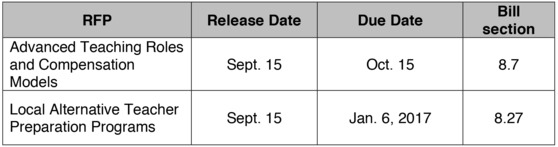
Legislated Requests for Proposals (RFPs) Coming Sept. 15
The State Budget Bill (HB 1030) recently passed by the General Assembly and signed by the Governor directs the State Board of Education to release two requests for proposals (RFPs) by Sept. 15 for two separate pilot local programs related to teacher preparation, roles and compensation.
NCDPI staff have begun developing the RFPs, sticking tightly to the language specified in legislation, and planning for how to provide technical assistance to support local boards of education interested in applying. If you think you might be interested, please use the link above to review the legislation (specific sections listed below) that is associated with each RFP.
NCDPI
staff will provide more detailed information about the application process at
the time of RFP release. Until then, if you have questions about these upcoming
opportunities, please contact NCDPI Chief Performance Officer Adam Levinson.
 Curriculum Leaders Collaborative
District
curriculum and instruction directors will soon receive an application for the
first annual Curriculum Leaders Collaborative hosted by NCDPI staff. The
purpose of this optional four-day Curriculum Leaders Collaborative will be to
provide school district central office administrators who are responsible for
the district implementation of content standards (NC Standard Course of Study) a process for discussing how
professional development, technical assistance/coaching,
communication/visibility and research/evaluation support quality implementation
that can be sustained and monitored for fidelity. There will be a cohort for
the east and the west.
NCDPI
is requesting that interested school districts develop a representative team of
two-three central office administrators who can commit to attending all four
days (taking place every other month) for the cohort and be led by the Chief
Academic Officer, the Assistant Superintendent for Curriculum &
Instruction, the Executive Director of Curriculum and Instruction or any other
central office administrator who is responsible for implementing new content
standards.
Questions
regarding this collaborative may be directed to Academic and Digital Learning
Special Projects Manager Hunter
Huffman.
|
NC Committee of
Practitioners Meets Aug. 4
The North Carolina
Committee of Practitioners (COP) will meet Thursday, Aug. 4, from 1-3 p.m., in the 7th Floor Board Room,
Education Building, Raleigh.
The draft agenda
includes an overview of programs administered under the Every Student Succeeds
Act (ESSA), the timeline and development status of the state plan for ESSA, and
proposed changes to the 21st Century Community Learning Centers
competitive grants.
COP members serve as
advisors to the State Board of Education on rules or regulations related to
ESSA, which reauthorizes the Elementary and Secondary Education Act of 1965
(ESEA).
The meeting will be audio streamed for those who
cannot attend. Questions regarding the meeting may be directed to NCDPI
Communications at 919.807.3450.
 Schoolnet Workshop for Administrators
The Schoolnet
Administrator Workshop is a one-day session for novice Schoolnet
users who are part of the leadership staff at their school or district.
The
workshop (locations/dates below) includes setting up user accounts,
roles and permissions, creating and administering tests, accessing benchmark
items, and data and reporting. This session will run from 9 a.m. – 4 p.m., with
lunch on your own. Space is limited so
register early! PLEASE bring your own device.
* East: Aug. 2
Teachers Memorial in
Lenoir County, 500 Marcella Drive, Kinston
Register here
* West: Aug. 9
Burke County Public
Schools Resource Center, 509 W. Concord Street, Morganton
Register here
If you have any
questions, please contact Yanisha Mann.
|
 North Carolina Virtual
Public School’s LEAD Ed
Leaders of Excellence
and Advancement of Digital Education (LEAD Ed) is an initiative of NCVPS’s
Professional Learning Division. LEAD Ed’s mission is to provide a pathway to
authentic, engaging, and relevant online learning and leadership to K-12
teachers and administrators and postsecondary faculty and pre-service teachers.
LEAD Ed helps
educators become innovative leaders and change agents in a quickly evolving
online and blended world. LEAD Ed is a road map for schools, districts,
teachers, and administrators to follow as they further the growth and
development of students and instructional and professional practice.
Visit the NCVPS website and explore all of
LEAD Ed’s learning opportunities.
|
September is
Attendance Awareness Month
Missing as little as
two-three days every month is considered chronic absence and can translate into
third graders unable to master reading, sixth graders failing courses and
ultimately, teens dropping out of high school.
Join the Attendance
Awareness Campaign. A toolkit and other free resources are available online.
|