Tuesday
is the deadline to register for the Monday, June 20, Superintendents’ Quarterly
meeting in Asheville. Please send in your registration to Communications if you
have not already responded. I look forward to our conversation there.
Also,
most of you have decided to opt-in for the full Home Base suite of digital
tools for your classroom teachers and students. As of Friday, 103 districts
have opted in. Let’s have 100 percent making this important decision. Last
week, we sent you FAQs to assist you in your discussions.
We
continue to watch legislation closely. As you know, the House did not agree
with the Senate budget, so we expect major deliberations to occur in
conference. With that in mind, please remember that your voice is important.
Please let lawmakers know what your district’s and schools’ needs are and how
they can help.
|

 Information
Sessions Scheduled on Revised High School Math Standards
The
State Board of Education at its June meeting unanimously approved revised high
school mathematics standards for NC Math 1, 2 and 3 – the key high
school-level math courses required of all students. These new standards will go
into effect this fall.
As part
of the support and implementation plan, NCDPI mathematics staff will provide
regional summer information sessions. This information was shared with
curriculum and instructional leaders earlier this week. Please make sure your
district is registered.
|
2016 Summer
Information Sessions’ Details
Districts
are asked to register a team of five-seven educators (ex. math lead teachers,
district curriculum leaders, math coaches, math coordinators, etc.). The
morning’s agenda is devoted to both general and specific changes in standards
and courses along with the new resources that are available to aid in the
implementation of revised standards. The afternoon agenda focuses on high
school math content specific.
Please
click on the region hotlink to register. The times and specific locations are
located on the Eventbrite registration page.
Northeast Region:
Tuesday, July 26, Plymouth
Southeast Region:
Thursday, June 30, Jacksonville
North Central Region:
Monday, June 27, Raleigh
Sandhills Region:
Tuesday, June 28, Bladenboro
Piedmont-Triad Region:
Tuesday, June 21, Asheboro
Southwest Region:
Monday, June 20, Charlotte
Northwest Region:
Tuesday, July 19, Morganton
Western Region: Tuesday, July
12, Waynesville
Please contact Susan Hart with any questions.
 School Connectivity
Funding Update
School connectivity
funding was expanded in the biennial budget passed during the 2015 long
session. The school connectivity expansion includes $12M in recurring
funding beginning in FY 2016-17 to support the procurement, installation and
configuration of internal school network infrastructure and related services.
Based on the
requirements of the expanded connectivity funding, the department has worked
diligently with public schools during FY 2015-16 to identify and specify the
needs, to establish contracts and purchase orders, and to file E-rate funding
requests. All told, North Carolina public schools have established contracts
valued at over $55 million and requested over $41million in E-rate funding,
leaving nearly $14 million in local funding requirements — all of the local
funding was budgeted for payment using school connectivity funds.
The recently passed
Senate Budget reduced Connectivity funding by $10 million. The House did not
adjust the funding in its budget, which means the final decision on funding
will be decided in the upcoming Conference Budget discussions.
We are working
closely with members of the General Assembly to provide information related to the
E-rate process and how any changes would impact North Carolina public schools moving
forward. We believe that this information will lead to a positive result in the
Conference Budget. We will keep you informed as the budget process progresses.
|
 NC Digital
Learning Competencies Training Scheduled for July
State
Board of Education members approved the Digital Learning Competencies for
Classroom Teachers and School Administrators on June 2. These competencies will
go into effect July 1, 2017. Throughout the 2016-17 school year, NCDPI staff will
be piloting the competencies and providing professional learning opportunities
across the state.
The
intent of the competencies is for teachers to improve their practice as they
integrate digital tools and resources to drive student learning within their
classrooms. The four focus areas, within the teacher competencies, have been
aligned to the Professional Teaching Standards and the Digital Learning Plan with
a subset of competencies that help to explain and ‘unpack’ each area. For more
information about the Digital Learning Competencies, please visit bit.ly/NCDLCs.
To
provide districts leaders and teachers with an initial insight and support for
these competencies, NCDPI Digital Teaching and Learning staff will be providing
professional learning sessions in July for district teams. Staff are partnering
with various Institutes of Higher Education across the state to host these
sessions. Together, we will dive deep into the competencies focusing on the
scope of the competencies, exploring professional learning resources, and
crafting a plan for district implementation.
Each
district will need to select a lead member from their team to be the point of
contact, attend the session, and facilitate the development of an implementation
plan for their district. Staff recommend that a district team be comprised of five-eight members. Members of the team might include a professional learning
coordinator, an administrator, an instructional technology facilitator, a
school library media coordinator, or an instructional coach, along with teacher
leaders.
Between
now and Wednesday (June 15), staff
request each district to identify and submit contact information for their lead
team member and their first and second location choices by completing this
online form. We will contact and provide follow up information
to the lead team member to confirm the session date and location as well as
register the rest of their district’s team.
For
any questions, please contact Jill
Darrough.
|
 July 1 is Last Day to Drop North Carolina Virtual
Public School Summer Students
The last day to
drop NCVPS summer session students is Friday, July 1. Some districts are on an
abbreviated summer schedule for staff by this date. Be sure your NCVPS summer
students know whom to contact in the district if they want to be dropped. NCVPS
cannot drop students.
July 1 also is the
last day districts and schools can drop students with no penalty for the
student and no cost to the district. After July 1, all enrolled students will
receive a grade, and the enrollment will count in the district’s allotment
totals.
|
Multi-Tiered System of Support:
Data Evaluation for Implementation
One of the six critical
components of a MTSS framework is Data Evaluation. While student assessment
data tell us about student behavior, implementation data tell us how the
adults are implementing the critical parts of the Multi-Tiered System of
Support.
Traditionally, School
Improvement Plans focus on student assessment data, rather than implementation
data. As teams plan for implementation of a Multi-Tiered System of Support, a
shift in focus should occur, with implementation data becoming even more
important.
We cannot change student
outcomes without changing how adults support students to get the outcomes. And,
we cannot attribute a change in student outcomes without the implementation
data. An example of how the DPI MTSS team is providing targeted assistance to
support district and school teams to be intentional about collecting and using
implementation data may be found in this online video housed in the NCEES modules.
If you have additional questions, please contact Amy Jablonski.
|
Implementation Science Frameworks:
Implementation Stages
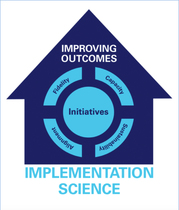
Implementation is a process that occurs in
discernible stages through common components (Drivers) of successfully
implemented programs. Understanding the stages of implementation provides
improved planning and decreases frustration with the challenging work of
systems change.
There are four functional Implementation Stages:
• Exploration. Taking the time to consider change
by exploring what to do, how to do it, and who will do it, saves time and money
and improves chances for success.
• Installation. Activities during this stage
create the infrastructure and make instrumental changes necessary to begin
implementation.
• Initial Implementation. When the new program is
first being put to use, practitioners attempt to use new skills during a season
of change. This is the most fragile stage.
• Full Implementation. This level of
implementation is reached when 50 percent or more of the staff or team members
are using the program with fidelity and good outcomes, and the new way of
providing services is now the standard way of work.
Please visit the NCDPI State Implementation
Team’s wikispace to learn more about Implementation Science.
|
Happening
Now
- LEAs and
charter schools across the state are currently in the Exploration Stage in the
use of the LEA Self Assessment to improve services and programs for Exceptional
Children.
-
Chatham County has used Implementation Stages to develop the work of a District
Implementation Team. This team has
reached the Installation Stage to support systemwide programs.
-
The work of
building a Multi-Tiered System of Support in Wake County is in the Initial Implementation Stage. Current work is
devoted to building teaming structures, cohorts for training and coaching
support, and plans for data evaluation and communication protocols. The MTSS team will begin supporting Cohort 3
schools in the 2016-17 school year.
-
Cleveland County has reached the Full Implementation Stage with
its Behavior and Mental Health Support Framework. This framework includes
school-based mental health supports through vetted outside agencies, as well as
in-school behavior liaisons and interventionists.
Revised Middle
School Athletic Manual Available Online
The
Middle School Athletic Manual has been updated and may be accessed online.
The most significant change comes from the rule addressing physicals.
Following
the NC High School Athletic Association, the 365 rule has been extended to 395
days. This 30-day grace period will allow students more flexibility in
acquiring their physicals. All physicals acquired after May 3, 2016 will be
subject to the new rule.
Questions
may be directed to Ellen
Essick, section chief for Healthy Schools.

Global
Education Workshops Scheduled for this Summer
NCDPI
staff, in partnership with three of the Regional Education Service Alliances
(RESAs), will offer two Global Education Professional Development Workshops
this summer.
The
Global Educator Digital Badge Capstone Project Workshop is for educators
enrolled in the process of attaining the digital badge and also for school and
district personnel leading the local evaluation of these projects before
submission for state-level review.
The Global-Ready
School and/or Global-Ready District Applicant Workshop is for those
intending to submit or exploring submission of an application to NCDPI.
For
more information and registration, please click here or
contact Special Assistant for Global Education Helga Fasciano.
|
|