I want to be one of the first to say thank you to North
Carolina’s public school teachers, just a few days away from the 2016 Teacher
Appreciation Week that begins on May 2. I am sure that your students and their
families thank you for your service and dedication in many ways each year, but
as they do, I hope that the appreciation never becomes routine.
While you have taught many students in your careers,
your students have not had so many teachers. They know that your dedication to
them, your expertise and your interest in learning make a difference in their
lives. You open doors to reading, to the universal language of mathematics, to
history and connections across time, to the expressive permission of art, and to
the skills of the workplace. You prepare our next generation to be good,
thoughtful and productive people. So, thank you!
I hope your desk is covered in notes, pictures, flowers
and treats next week. Happy Teacher Appreciation Week!
|


State Board of Education
Meets Next Week
The State Board of
Education will hold its May monthly meeting next week, May 4-5, in the 7th
Floor Board Room, Education Building, Raleigh.
Action items include
final approval of School Reform Models, FY 2015-16 Final Allotment adjustments,
and a host of consent agenda items including the Middle School Athletics Manual
update. Discussion items include Digital Learning Competencies/Digital Learning
Plan, Math I, II and III Draft Standards Revisions, and Career and Technical
Education Licensure revisions. On Thursday, Board members will receive special
presentations on The Military and Education Connection, Give Five – Read Five,
and a Parent/Teacher Involvement program.
The complete agenda as well as supporting executive
summaries are available online by clicking on the Meetings tab. The meeting is audio
streamed for those who cannot attend. To listen, please visit the above link
and click on the live audio streams link to the right.
|

Greetings from 2016 North Carolina
Teacher of the Year
From the moment Dr. Atkinson said my name on that stage,
there has been a feeling I just couldn’t place always at the back of my mind.
This feeling has driven every interview I have given, every word I have written
since. It was not until this week that I was able to place the feeling. I am
certain now that the feeling I cannot escape is a deep and overwhelming sense
of debt.
From my very first teacher, Mrs. Gardener, at Wines
Elementary who made me taste green eggs and ham, to my fifth grade history
teacher, Mr. Reynolds, whose review game I used last week in my own class, to
Dr. Kirk Melnikoff at The University of North Carolina at Charlotte whose
graduate class in sonnets changed the way I taught poetry, the debt I owe to
the teachers of my past has come for a reckoning.
I have benefitted immensely in life from great teachers and
great schools. I am thankful for this, but I also recognize the debt I owe
because of it. I believe it is the debt of those of us who were given so many
opportunities to work diligently to ensure that all children are offered,
equally, those same opportunities for generations to come.
As North Carolina Teacher of the Year, I feel I am finally
in the position to be able to repay my debt to my teachers. I am grateful to
everyone at the Department of Public Instruction for giving me the means to do
so. I want to represent teachers well this year because I owe it to Mrs.
Gardner and all the hard working teachers of my past to give them the chance to
touch the future, just as I hope my own students will carry my voice into their
future.
I am so grateful that I
will get to speak for teachers across North Carolina, but more than speaking
for teachers, I hope to listen to teachers this year. I do not pretend to know
all that concerns every teacher, from the kindergarten teacher in Waynesville,
to the AP Science teacher in Emerald Isle. I hope that by listening to teachers
this year, I can become their voice in Raleigh. Whatever the next year brings,
above all else, I hope I make my teachers proud.
|
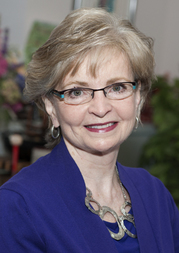
Bobbie Cavnar, 2016-17 Burroughs Wellcome Fund North
Carolina Teacher of the Year
 Digital Learning Update
A goal of the State
Board of Education is for very student in North Carolina to have a personalized
education. The Department’s NC Digital
Learning Plan addresses this goal; and the State Board of Education’s
2016-17 supplemental budget recommendation includes substantial support for
digital learning.
Some highlights of
staff accomplishments to date include the recent release of the new Digital Learning and Media Inventory,
the development of an RFP to establish contracts that districts may use to
procure devices such as Chromebooks, and the development of Digital Learning
Competencies for School Administrators and Classroom Teachers. Where the
competencies are concerned, staff are soliciting teacher
feedback:
• Draft
Digital Learning Competencies for Classroom Teachers. Feedback
Form
If you have specific
questions about moving digital learning forward in your school, please feel
free to reach out to the Department’s Director for Digital Teaching and
Learning Verna Lalbeharie.
Verna and her staff are available to provide guidance and support.
|
Multi-Tiered System of Support:
Examining Core Beliefs
Our
beliefs impact the selection and implementation of practices and systems. Practices are the things we do to support our
students. The systems in place support our staff members. Belief work is
challenging, incredibly rewarding and critical to implementing a Multi-Tiered
System of Support.
To
empower you in this work, we need to acknowledge our beliefs about student
learning, and what student learning looks like within the framework of MTSS. North Carolina MTSS has
identified these four fundamental beliefs:
* All subgroups can reach proficiency with
current academic and behavior standards.
* Core Instruction (Tier I) in reading, math,
and behavior can be effective for the majority of our students.
* Supplemental instruction (Tier II) can ensure
students achieve grade level benchmarks.
* Intensive instruction (Tier III) can ensure
students are growing toward achieving grade level benchmarks.
How
do existing beliefs in your school align with these fundamental beliefs? If you have additional questions, please contact Amy Jablonski.
|
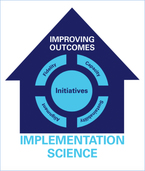
Implementation Science:
The Formula for Success
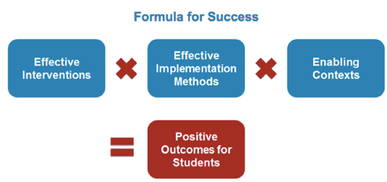
The formula for
success, illustrated below, highlights the components necessary to create
positive outcomes for students.
* Effective
innovation/intervention helps us to know “what it
is” we are implementing.
* Effective
implementation methods are the infrastructure and the “how” of the
equation for success.
* Enabling
contexts
within the organization includes ensuring a “hospitable environment” through building competency, organizing the
system, and supportive leadership.
|
Opportunities to deepen
your understanding about the implementation drivers needed for this Formula for
Success can be found in this online module.
NCDPI Requests Waivers to Tydings Amendment
The NCDPI is submitting
a request for a waiver of section 421(b) of the General Education Provisions
Act (GEPA) (the “Tydings Amendment”) as it affects the authority of the
Department and its sub-recipients to obligate fiscal year FY 2015 and FY 2016
School Improvement Grant (SIG) 1003(g) funds after Sept. 30, 2017 (FY15 Funds)
and Sept. 30, 2018 (FYI 16 Funds).
Specifically, NCDPI is
requesting that the authority to obligate funds for the state-administered
Elementary and Secondary Education Act CFDA 84.377A School Improvement Grants
program be extended to Sept. 30, 2021.
The public is invited
to review and comment on the waivers being requested by May 20. To read more, please visit the NCDPI Public Notices website.
NC Listens to Its Educators:
2016 NC TWCS
Concludes
Thanks to all North Carolina educators who participated in the 2016
Teacher Working Conditions Survey (NC TWCS). The survey window closed April 4.
The official statewide response rate was 85.4 percent representing
feedback from over 101,800 educators. Approximately 8,600 more educators
participated in 2016 than 2014. Congratulations also to the 1,076 schools who
achieved the goal of a 100 percent response rate! These schools will be
eligible for incentives sponsored by BB&T, California Casualty, Blue Cross
Blue Shield, Duke Energy, Lenovo and NCAE. Winners will be selected beginning
May 23.
The NC TWCS results will be presented to State Board of Education
members in June, and available for school districts soon afterward. For more
information, please contact Yvette
Stewart.
|
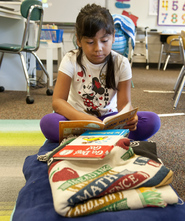
Give Five – Read Five Free
Online Literacy Tool
As part of the 2016 Give Five - Read Five campaign
and through a partnership with myON, a division of Capstone, DPI is offering
every student in the state access to the personalized literacy tool myON
Reader. If your school has elected to participate, now is the time to ensure
that students know how to access the online tool on their device. (Contact your
principal to see if your school is participating and to get instructions for using
the myON Reader.)
Many schools and districts also are beginning to wrap
up Give Five – Read Five book drives and organizing books for
distribution to students (program ends May 31). Please share what your school
is doing to promote the campaign and summer reading with Diane Dulaney. And don’t forget to
report your school’s final book collection total by June 17 by completing this three-minute online survey. The school with the
overall highest total of books collected and schools that collect the most books
in three size categories will receive a free one-year school-wide license to
one of three outstanding online literacy tools.
Visit the NCDPI Give Five – Read Five website
to see if your school is included on our final book collection total list!
|
 Professional Development
News
New Literacy Modules
NCDPI
Educator Effectiveness staff have heard your requests for more courses that
carry literacy credit. After careful review, two additional courses within the
Home Base Professional Development System catalog have been added that meet the
statutory description (115c-296(b)(1)b) of a literacy credit:
* Supporting
English Language Learners (ELLs) in the Classroom: Action Research from the
GTN; and
* The
Reading and Writing Connection: Action Research from the GTN Project.
These literacy
modules were produced by the Governor’s Teacher Network action research
project.
For a detailed description of the course,
please visit http://www.rt3nc.org/. For
support on issues related to online professional development, please contact Geetanjali Soni.
|
 Governor’s Teacher Network
Action Research Projects Available
Have you ever wondered how professional development is
done in districts other than yours? Are you looking for ideas that have been
tested in North Carolina classrooms? Look no further. Over 200 action research
projects created by members of the Governor’s Teacher Network Action are
available for review. Many of these projects examined different types of
professional development activities.
Brittany Guy, an action researcher in
Winston-Salem/Forsyth County Schools, investigated a year-long personalized,
blended professional development model for implementing technology in the
classroom.
If you are interested in learning more about this model
or finding Ms. Guy’s action research results, please visit the Online Professional
Development Catalog and click on the Action Research tab.
|
|