Upcoming Programs & Events
 |
|
Wednesdays 3 - 6pm through 10/28/2020
The Moore Square Market wraps up for the season on October 28th, but there’s still time to stop by for delicious fruits and veggies, fresh bakery goods, meats and more! The Market runs every Wednesday 3-6pm at Moore Square until Oct. 28th.
|
 |
|
Saturday, October 3, 9 am - 12 pm
Create your own scarecrow to be put on display at Pullen Park Amusements! Bring clothes, accessories and a head. Stuffing and support structure will be provided. RecLink Barcode: 259399.
Pre-registration is required.
*All participants must wear a mask and practice social distancing*
|
 |
|
Saturday, October 3, 12pm - 2pm
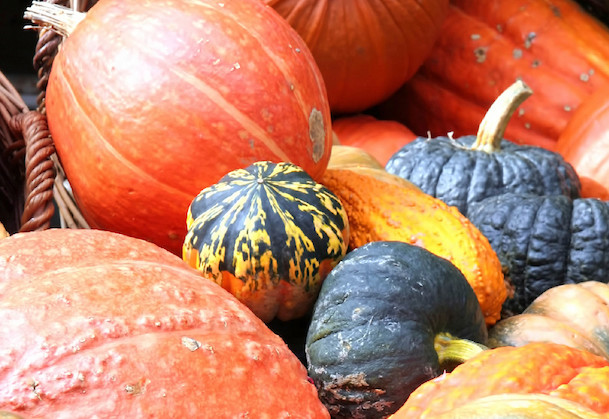
Purchase a pumpkin at the Pullen Park Pumpkin Patch Bash! You can decorate it and take it home or choose to put it on display at the park! Stick around for the foam punkin-chunkin contest at 1 pm. $5 per pumpkin. RecLink Barcode: 259400. Pre-registration is required.
*All participants must wear a mask and practice social distancing*
|
Hidden Histories
Did You Know?
The Moore Square Visitor Center is housed in the Norwood House at 226 E. Martin Street. This was once the home J.M. Norwood who served as the Chief of the Raleigh Police Department for much of the late 19th century.
|
|
 |
Collection Corner
The Historic Resources and Museum (HRM) Program manages more than 21,000 decorative art objects pertaining to local history and material culture. The collection includes but is not limited to furniture, ceramics, silver, fine art, photographs, archives, amusements, glass, and textiles dating from the 17th century to the present day.
Many of the objects furnish more than 25 rooms, galleries, or spaces in and around our historic sites. The HRM Program aims to research and present the most authentic settings, exhibits, and programs possible, from the wealthy landowner, to the African American doctor, to the amusements that have been enjoyed by generations.
Each month, in Collection Corner, we feature a few items that might pique your interest!
 |
|
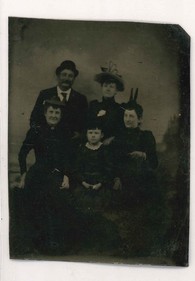
A tintype photograph featuring five people. The man in the back row may be Henry Little and the woman in the front right is Martha “Patty” Mordecai. It was taken October 20th, 1892 at the North Carolina State Fair.
Image courtesy of Capital Area Preservation, Inc.
|
 |
|
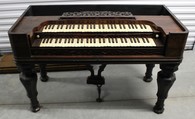
Double-manual melodeon made of dark wood with ivory keys. There is an attached music sheet holder and the top part of the instrument appears to be missing. Inside the melodeon is the number 9710 and a note that reads, "On the interior of the windchest is the following inscription Sam Jay Crockett #1940 Sept. 27, 1859". On the building frame is, "Boston, October 1922 1859". There is one foot pedal remaining. |
 |
|
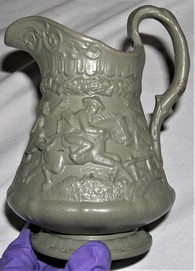
This small ceramic pitcher features a variety of scenes including a tavern scene and a Native American riding a horse. Makers' mark stamped under foot shows leaf and reads "[illegible] by w. Ridgeway & co./ [illegible], October 1, 1885".
Image courtesy of Capital Area Preservation, Inc.
|
HRM Program Curator of Collections
Ainsley Powell
Learn More About the Raleigh HRMProgram Collection >
 Preserving to Persevere
By Celeste Sherer
The leaves are turning autumn colors and the air is turning crisp. It is the time of year to start the transition. The transition is not only from the warmer months to the cooler months, but in food preparations. This is the ideal time to harvest and preserve food for the upcoming winter. How would one prepare perishables and store meat on an antebellum plantation? One walk around Mordecai Historic Park and the clues of the preserving past are revealed: from the smokehouse to food hanging in the Allen Kitchen.
Corn was the primary crop raised on the Mordecai plantation by 1850. Multiple methods were used to preserve corn. It could be kept in structures called “cribs” while still on the cob. It could also be shelled or ground into cornmeal. What else was great about dried corn? Making popcorn! This tasty treats dates back centuries. Today, heirloom corn is grown in the Ellen Mordecai Garden. The harvest is used for demonstrations onsite.
The plantation kitchen located behind the Mordecai house currently has a bountiful amount of corn, as well as peppers, strung inside to dry. Once the vegetables are properly dehydrated they can last many months.
Why did they hang food back then? Food was hung for space reasons and so no critters could reach the goods. Vegetables were not the only items that were dried and hung. Herbs were also utilized in their dried states. Today we use dried herbs on a regular basis. However, this method could also be applied to fruits as well. Apples are also ideal for this method. In fact there are accounts of dried apple pie.
If dried fruits and vegetables do not sound appealing, don’t worry you can reconstitute them. Reconstituting is when moisture is added back to the dried fruits or vegetables.
Similarly, meat was often cured in a smokehouse. The Mordecai’s original c. 1830s smokehouse still sits on in its original location adjacent to the kitchen site. In her memoir entitled Gleanings from Long Ago, Ellen Mordecai recalled pork being salted, smoked and hung on the plantation. Salt is an excellent preservative. Salt will remove all the moisture from the meat, so it will not rot or spoil. The salt will also keep the bugs away! Salt even kept eggs from going bad in the days before refrigeration. Salt and water mixtures have been used for centuries to preserve. We call it pickling today. We invite you to come explore Mordecai Historic Park and take a walk into the past. See how people “back then” would have cleverly stored and prepared food. Aren’t you glad that you can put your food in a refrigerator now instead of: salting, smoking, pickling, and curing all your food?
Learn More About Mordecai Historic Park >
In July 2012, Raleigh City Council created the Historic Resources and Museum Program with the express purpose of protecting and programming identified cultural, museum, and historic resources within the City of Raleigh.
The HRM Program manages operations and programs at Borden Building and Stone Circle at Fletcher Park, City of Raleigh Museum, Fred Fletcher Amphitheater at Fletcher Park, John Chavis Memorial Park Historic Attractions, Latta University Historic Park, Moore Square, Mordecai Historic Park, Pope House Museum, Pullen Park Historic Attractions, Raleigh Trolleys, and the Tucker House.
History Happenings informs citizens of news, events and programs at HRM Program sites.
Learn More at
parks.raleighnc.gov
|




 |
|  |
|  |
|  |
|  |
|