In the trenches: What it means to be a heavy equipment operator for the N.C. Forest Service
Many Americans recently witnessed the Indiana Hoosiers complete their ascent to the college football pinnacle with a perfect season (16-0), capped by a win over the Miami Hurricanes for the program’s first ever national title. All season the Hoosiers featured strong defensive prowess paired with offensive playmaking from their backs and receivers, led by Heisman Trophy winning quarterback Fernando Mendoza. While the aforementioned received the bulk of praise and attention, perhaps the Hoosier’s best asset belongs to the most overlooked, underappreciated position in football: the offensive line. The buffet-busters up front consistently won the battle in the trenches, clearing lanes for Indiana’s high-level rushing success while holding a clean pocket for Mendoza, who only had to endure 20 sacks across the entire season.
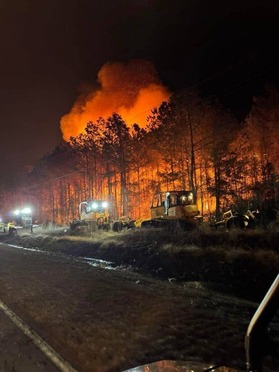
Oftentimes, the offensive line is hidden in plain sight, going unnoticed until receiving notoriety for all the wrong reasons. Football’s grittiest and dirtiest job dictates the flow of success for every offensive attack. Similar comparisons can be drawn to a heavy equipment operator’s role with the N.C. Forest Service (NCFS). While responsible for the maintenance and operation of a bulldozer, hauling unit and other heavy equipment used in wildland fire suppression and prescribed fire operations, a forest fire equipment operator’s (FFEO) job can be summarized in three words: plowing fire line.
“I enjoy all aspects of the job, but there’s just something about being in the seat of that tractor in the woods,” said Stewart Niemyer, NCFS Richmond County FFEO. “Don’t get me wrong, it’s all business but there just seems to be a higher sense of comradery on a fire. Especially a large fire with multiple tractors and resources.”
|
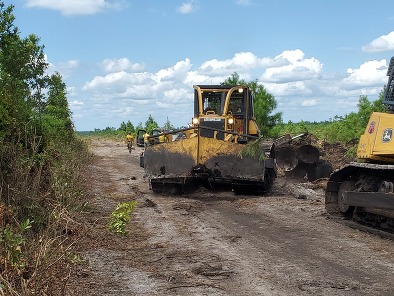
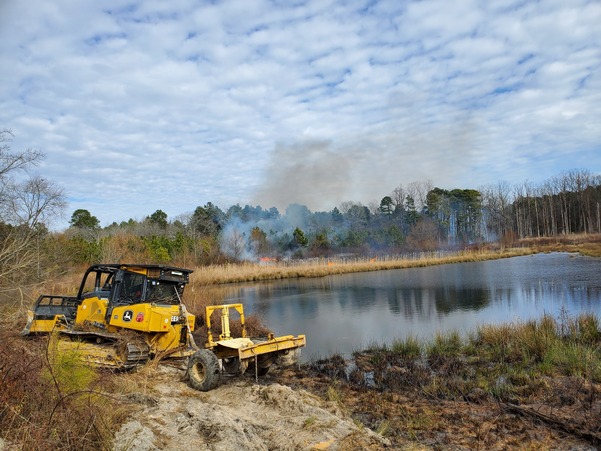
Bulldozers and tractor plow units are deployed by the NCFS -- as part of the agency’s responsibility to suppress the more than 4,500 wildfires that burn across North Carolina each year -- to install fire lines and construct fuel breaks around wildfires to stop further spread. Fire lines are a critical necessity not only for containing wildfire spread but as a safeguarding mechanism when implementing the beneficial use of prescribed fire to achieve specific forest management objectives. As the O-line establishes a clean pocket protecting the quarterback from a pursuing pass rush, fire lines halt encroaching wildfire, protecting lives, homes and other property. While the line of scrimmage maintains a grip on their blocks providing time for the play to develop, fire lines allow low intensity prescribed fire to operate within the planned area to enhance forest health. Guards and tackles create running lanes for backs and receivers to slip through and get loose in open field, fire lines become an access road for additional equipment, resources and firefighting personnel to navigate the area.
|
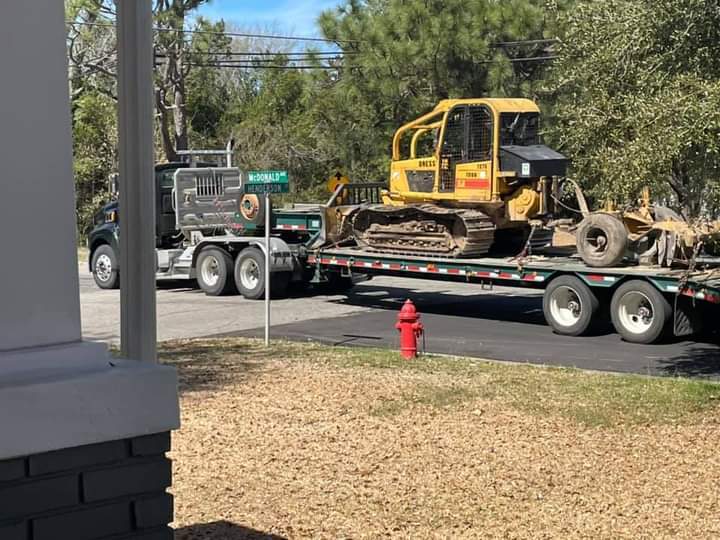
“When that hauling unit pulled up and the tractor went into the woods, I can always remember thinking, ‘that’s got to be the coolest job; operating heavy equipment and fighting fire,’” Niemyer explained referring to his childhood. “I knew at that point that being an FFEO for the N.C. Forest Service is where I wanted to be. What child didn’t like bulldozers, big trucks and Smokey Bear?”
Niemyer’s father worked for the NCFS and retired as one of the agency’s law enforcement (LE) officers. However, Niemyer’s father spent many years as the FFEO in Richmond County, the same position Stewart currently holds, inevitably providing him with a front row seat to the many programs and services offered by the NCFS.
"As a child, I can remember my father bringing home the hauling unit and parking it in front of the house on weekends during fire season when he was on call,” recalled Niemyer. “When he pulled off to respond to a wildfire, I would count the gears as he was shifting until he was out of sight or out of ear shot. I still see things every day that I know he was a part of and I try to keep things going that I know were important to him.”
|
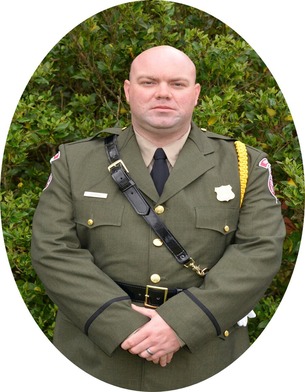 |
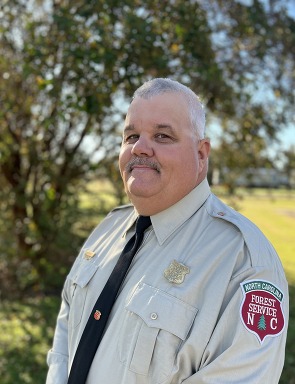
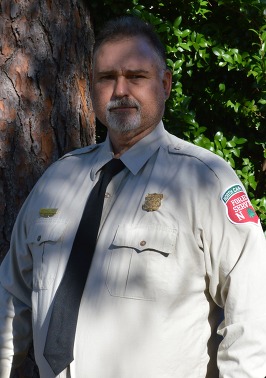
Stewart Niemyer, NCFS Richmond County FFEO
NCFS FFEOs, along with rangers and smokechasers, compile the initial attack resources who respond to wildfires that burn on state-and privately-owned land. Through early detection and rapid response, these folks are the first boots on the ground to fend off wildfires, holding most to just a couple acres or less. This of course comes with a cost for those who gear up. NCFS personnel endure long hours, on-call responsibility, emergency response incidents that may require days, if not weeks away from home, and at times, grueling conditions that come with the territory of working among the outdoor elements. This may cause some to wonder why anyone would sign up for this.
“It’s about being a part of something bigger,” explained Neimyer. “The N.C. Forest Service is known as a leader in fire control and management. I’ve been on wildfires with folks from all across the U.S. and I’ve had several tell me, ‘when those guys and gals in the dark green trucks show up, the fire goes out.’”
Heavy equipment has its place in Western North Carolina, but it also has its limitations in the steep and mountainous terrain. Like most NCFS personnel, FFEOs may be dispatched anywhere in the state in response to wildfires, hurricanes and winter storms, but most positions are designated to the Piedmont and Coastal Plain.
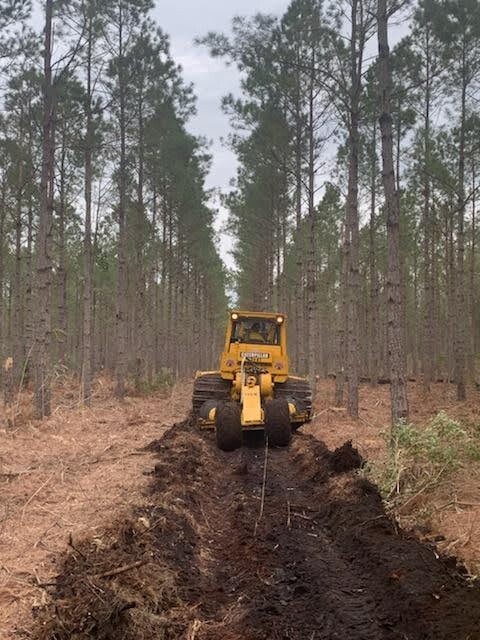
“Working with wildland fire, the ability to dispatch to the various places that we’re frequently called to and the people we meet along the way, whether in-state or out-of-state,” Chris Holyfield stated when asked what he enjoyed most about his job as an NCFS FFEO.
Known universally as “Biggin” amongst his peers, Holyfield has served Tyrrell County for 19 years with more than 18 of those years spent behind the gears in the dozer cabin, chugging down the line. Before putting on the patch in January 2007, Holyfield worked in the logging industry for 15 years, learning to handle almost every type of heavy machinery found in the trade. In other words, been there, dug that.
“I wanted a job working for the state because of the benefit package and retirement offerings. Those perks paired with being able to work with wildfire and heavy equipment is what made me want to join the N.C. Forest Service,” Holyfield added.
|
Niemyer and Holyfield had a similar pathway to the NCFS having previously owned, or prior experience operating heavy equipment such as bulldozers, fire plows, backhoes, skid steers and various farming equipment among other machines. Each began their NCFS careers as smokechasers in their respective counties before becoming full-time equipment operators. They arrived knowing how to maneuver heavy equipment and, through NCFS training programs and available qualification pathways, they learned to fight wildfire with it.
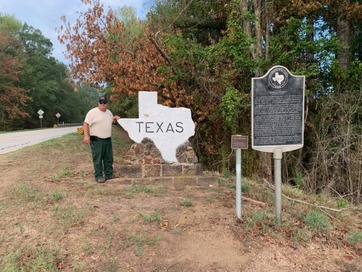
“You learn by being in that seat and doing it,” Holyfield points out.
Not every job and career pathway offered by the NCFS requires pursuit of higher education. A broad blend of education, knowledge and experience levels are found throughout the division with opportunities to expand skillsets, qualifications and capabilities offered at every turn. Skillsets that will be highly sought after as wildfire demands are expected to increase as the state’s population continues to grow. To uphold its mission to protect, manage and promote the forest resources for the citizens of North Carolina, the NCFS is equipped with more than 90 FFEOs across the state and the need for more will always be there.
|
Chris "Biggin" Holyfield, NCFS Tyrrell County FFEO.
During a four-year span (2021-2024), more than 1,160 wildfires burned nearly 7,000 acres across Robeson County, the most wildfires for any county across the state each of those years. More than 4,500 (65%) of those acres were plowed by one man. A workhorse.
“I noticed from the beginning that he was fired up and ready to go to work,” said Jimmy McCall, NCFS Robeson County ranger. “He was always on ‘go’ when there was a job to do.”
James “Jamie” McMillan began working as an NCFS FFEO in Robeson County in 2018, and since 2021, he’d been the lone operator for a county that consistently ranks among the top for number of wildfires each year.
“One thing that always sticks out in my mind was the dedication that Jamie showed,” McCall added.
Whether it was wildfire response, chainsaw competitions, in-state dispatches or public outreach events, McMillan was usually one of the first to volunteer, more than willing to help and oftentimes putting his personal life on hold.
“He was an integral part of the forest service, especially in Robeson County,” said Robby Freeman, former Robeson County ranger and current LE ranger for NCFS District 8. “His dedication to the forest service is something to be admired.”
Several folks who worked closely alongside McMillan pointed to his willingness to help train new operators, even after he began displaying symptoms of cancer, knowing that he would one day rely on that person to assist with wildfire response and that someday he would not be around to do the job anymore. March 2025 was a rough month for widespread, intense wildfire activity throughout North Carolina. Yet McMillan continued to grind it out and worked hard, assisting wherever he could as his condition deteriorated. On Monday, Aug. 4, 2025, McMillan passed away.
“Running 647 wildfires the way we did in 2022, we could have used four tractors in Robeson County that year,” added McCall. “But there was only one; Jamie McMillan.”
James "Jamie" McMillan passed away on Aug. 4, 2025. McMillan served as FFEO for the NCFS in Robeson County since 2018.
These three men, while different but similar, represent an irreplaceable asset needed to protect lives, property and one of the state’s most valuable natural resources. Exemplifying integrity, leadership, professionalism, service and unity along with fortitude and sacrifice. Life on the fire line can be anything from a sweltering inferno to a frozen tundra and everything in between. Simple but not easy.
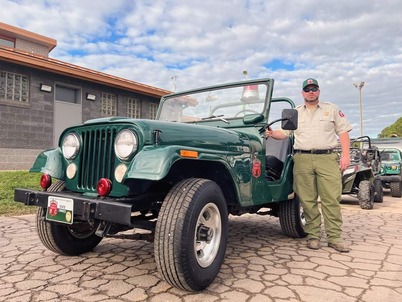
“The people, hands down,” concluded Niemyer. “I’ve worked with many great people across the state in different capacities on incidents ranging from hurricanes to wildfires and there is no doubt in my mind that these people are all here for the same reason: to protect the private and state lands of North Carolina while doing what is right for the landowners we serve. Those who are here are selfless, putting their family’s own personal needs aside to help someone else. Why would you not want to be a part of that?”
|
|