N.C. Forest Service finds laurel wilt in Pamlico County for the first time
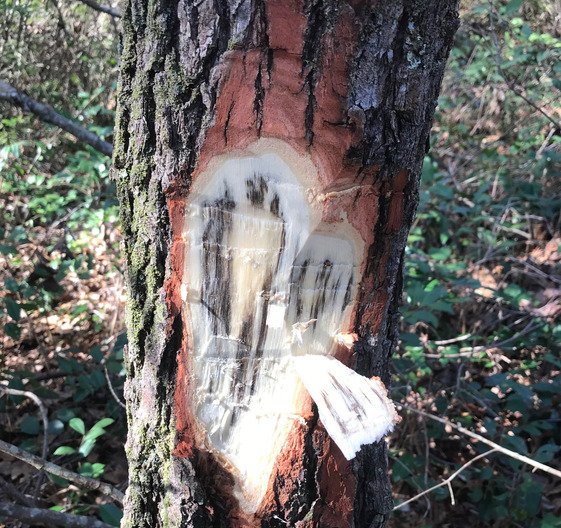
Black streaking found in the outer wood of a tree, which is a evidence of a redbay ambrosia beetle attack.
RALEIGH -- The N.C. Forest Service has confirmed that laurel wilt, a devastating disease of redbay and other plants in the laurel family, has been detected on private property in the southwestern corner of Pamlico County, bringing the number of counties where the tree-killing disease has been detected to 19. Laurel wilt was recently detected in nearby Pitt County in April.
Sassafras, redbay, swampbay, pondberry, pondspice and spicebush are in the laurel family and can be affected by this disease. Redbay trees infected with laurel wilt retain their leaves even after the tree has died allowing for easier detection during the winter months.
“We received a call from a private landowner who had observed several dead or dying redbay trees on his property,” said Daniel McCoy, Pamlico County ranger with the N.C. Forest Service. “Our service forester, one of our forest health specialists and I met with the landowner on-site where we located several dead redbay trees that were displaying symptoms such as wilted leaves, frass toothpicks and dark staining of the main stem below the bark.”
Trees are infected with the fungus that causes laurel wilt disease by the invasive redbay ambrosia beetle. Native to southeastern Asia, the beetle was first detected in the U.S. in 2004 near Savannah, Ga. It has since spread to 12 states, from Texas to Virginia. Redbay ambrosia beetles are known to cover short distances flying tree to tree but humans aid in spreading the pest over long distances when transported in firewood.
Redbay ambrosia beetles do not feed on the trees themselves but rather on the laurel wilt fungus. Female beetles bore into trees, carrying the fungus with them. Once inside the tree, she makes tunnels and lays eggs. Fungal spores begin to grow in these tunnels, blocking the movement of water and causing the tree to wilt and eventually die. Trees typically die within weeks or months of infection.
Symptoms of laurel wilt disease include drooping reddish-purple foliage. Evidence of a redbay ambrosia beetle attack may be found in the main stem; often threads of chewed wood, called frass toothpicks, can be seen sticking out of entry holes. Removal of tree bark reveals black streaking in the outer wood.
Laurel wilt has been found in the following North Carolina counties: Bladen, Brunswick, Carteret, Columbus, Craven, Cumberland, Duplin, Johnston, Jones, Lenoir, New Hanover, Onslow, Pamlico, Pender, Pitt, Robeson, Sampson, Scotland and Wayne.
Currently, there is not a reliable method of treating laurel wilt and insecticides have been ineffective at stopping beetle attacks. Fungicides may be used to prevent infection by the fungus, but they are costly and require reapplication. The best defense continues to be slowing the spread by using local or treated firewood and by notifying the local NCFS county ranger if laurel wilt is suspected.
Homeowners with dead redbay trees are encouraged to keep cut trees on their property. Dead trees should not be moved to a landfill or off-site. Proper disposal of redbay trees includes leaving wood on-site, cutting or chipping wood on-site, or burning wood on-site in compliance with local and state ordinances. You can obtain a burn permit at any authorized permitting agent or online at https://www.ncforestservice.gov/burnpermit.
The detection of laurel wilt in Pamlico County was confirmed by pathologists at N.C. State University’s Plant Disease and Insect Clinic.
The N.C. Forest Service Forest Health Branch monitors the spread of invasive pests. People who suspect there is an infected tree in an area near them should contact their county ranger. Contact information can be found online at www.ncforestservice.gov/contacts.
A map showing laurel wilt detections throughout North Carolina is available at www.ncforestservice.gov/forest_health/pdf/Map_LW_NCTracking.pdf.
For more information about laurel wilt, visit www.ncforestservice.gov and follow the links under the Forest Health section. To find contact information for your local NCFS county ranger, visit www.ncforestservice.gov/contacts.
-30-
|