|
Dare A250 Passport Program Highlight |
|
Dare A250 Passport Stop #8
Pea Island Cookhouse Museum
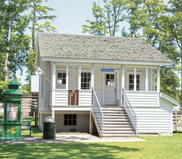
The Pea Island Cookhouse Museum, located in Manteo on historic Roanoke Island, preserves the original cookhouse from the Pea Island Lifesaving Station. The building stands as a rare surviving structure connected to the only all-African American lifesaving crew in U.S. history and serves as a powerful place to learn about the men who served from 1880 to 1947.
After its relocation to Sir Walter Raleigh Street and careful restoration, the Cookhouse Museum opened in 2008. Today, it offers visitors a close look at the lifesaving legacy shaped by Keeper Richard Etheridge and the generations of African American surfmen who followed him.
Location:
This site is located at 622 Sir Walter Raleigh Street in Manteo, NC. The A250 Passport Program QR code sign is located inside the Town of Manteo's green information kiosk, located beside the Pea Island Cookhouse and pictured above.
Pea Island Cookhouse Hours:
Tuesday, August 18, 2026, from 10 a.m. to 12 p.m.
Wednesday, August 19, 2026, from 10 a.m. to 12 p.m.
Thursday, August 20, 2026, from 1 p.m. to 3 p.m.
Tuesday, August 25, 2026, from 10 a.m. to 12 p.m.
Wednesday, August 26, 2026, from 10 a.m. to 12 p.m.
Thursday, August 27, 2026, from 1 p.m. to 3 p.m.
September through May
Saturdays from 11 a.m. to 3 p.m.
The Dare A250 Passport Program features 13 historic stops located throughout Dare County, each offering a meaningful introduction to local history through museums, cultural sites and natural landmarks. At each site, visitors can scan a QR code to collect a virtual stamp and submit their name and email through the digital form. As participants build their collection, they will become eligible to receive a certificate recognizing their engagement with Dare County’s historic landscape during the A250 celebration. The program is open through November 18, 2026.
|
|
|
Of the People, By the Sea |
|
This Month's Historic Highlight:
The Elizabethan Gardens
Write-up provided by members of the Dare A250 History Subcommittee.
The idea for the Elizabethan Gardens on Roanoke Island originated in 1950 after Sir Evelyn Wrench and Lady Wrench visited Fort Raleigh and watched The Lost Colony Outdoor Drama. Inspired by England’s first attempt at a permanent settlement in the New World, the Wrenches, along with their hosts Inglis Fletcher and Ruth C. Cannon, envisioned a garden that would memorialize the Lost Colony and add to the island’s identity. The idea was formally presented to the Garden Club of North Carolina in 1951 and adopted as a major project. After leasing 10 ½ acres from the Roanoke Island Historical Association, the garden club officially began work on June 2, 1953—the same day as Queen Elizabeth II’s coronation in London.
Originally envisioned as a modest two-acre garden representing what the colonists might have created had their settlement succeeded, the plans expanded dramatically when the garden club learned that the Honorable John Hay Whitney, U.S. Ambassador to the Court of St James, had a collection of European garden statuary in need of a new home. More than a dozen pieces valued at over $100,000—including an Italian fountain and pool, wellhead, sundial, birdbaths, stone steps and benches—were acquired, transforming the concept into an elaborate Elizabethan Pleasure Garden.
|
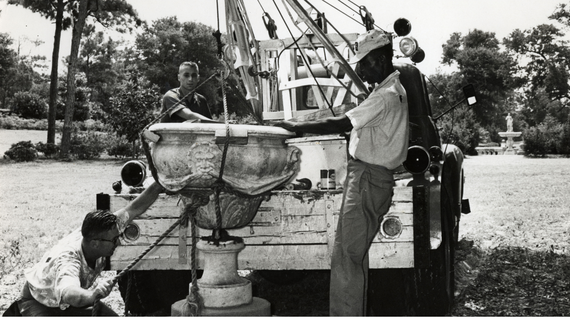 Elizabethan Garden being constructed on Roanoke Island by the Garden Club of North Carolina in 1953. (Credit: Outer Banks History Center)
Landscape architects Webel and Innocenti designed the gardens, E.W. Reinecke oversaw construction, and Albert Q. Bell served as nurseryman and supervisor. Plants from around the world arrived as gifts and donations, while local residents, the North Carolina Garden Club and the Roanoke Island Garden Club worked to bring the vision to life. The Elizabethan Gardens officially opened on August 18, 1960, the 373rd anniversary of the birth of Virginia Dare, the first child of English parentage born in the New World. In 1959, Louis Midgette came on as Garden Supervisor—the first permanent employee of the gardens.
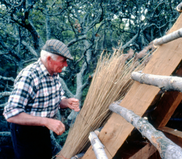
Over the past 66 years, the Elizabethan Gardens have continued to grow while incorporating features of historical significance, including roses from Windsor Castle gifted on behalf of Queen Elizabeth II; herbs sent by Princess Anne following her 1984 visit; iron gates once used at the French Embassy in Washington, D.C.; a gatehouse based on a 16th-century orangery; and an 1859 Virginia Dare sculpture that survived a shipwreck and fire before arriving on Roanoke Island. The Gardens also constructed a thatched-roof gazebo using 16th-century techniques and reeds sent from Norfolk, England.
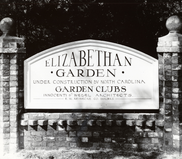
Today, the Elizabethan Gardens on Roanoke Island feature more than 500 plant species and are often considered one of the largest garden club projects completed in the United States. The gardens continue to delight visitors while honoring, as the entrance plaque reads, “the valiant men and women who founded the first English Colony in America.”
|
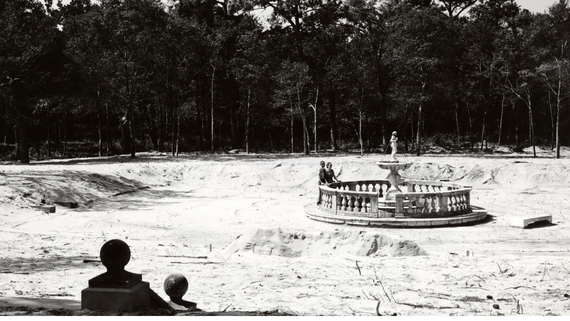 Elizabethan Gardens being constructed on Roanoke Island by the Garden Club of North Carolina in 1953. (Credit: Outer Banks History Center)
|
|
Highlighting A250 Educational Initiatives |
|
Dare A250 Teacher Grant Applications Now Open!

As we prepare for a new school year, the Dare A250 celebrations are still going strong, and so is the Dare A250 Education Subcommittee’s commitment to the teachers who are shaping the next generation of leaders. Earlier this year, the Dare A250 Education Subcommittee introduced Dare A250 grants for local educators and proudly recognized six outstanding teachers who brought creativity, innovation, and the spirit of Dare A250 into their classrooms and schools.
With additional funding available, the Dare A250 Education Subcommittee can support additional educators who go above and beyond for our community. The Dare A250 Committee and the Dare Education Foundation are teaming up to identify teachers and educational professionals who are creating curriculum, events, and special projects that highlight the history, people, and culture of America, North Carolina, and Dare County.
To make participation easier than ever, the Dare A250 Education Subcommittee has streamlined the application process so that all educators across Dare County—public, charter, private/independent, and homeschool—are encouraged to apply and share the incredible work being done.
All who teach or are part of the education team for students between K-12 in Dare County are eligible to apply for one of the Dare A250 grants. Please share the work you are doing to educate our students about America’s 250 anniversary, celebrating our community and people. The grant period is open through Saturday, October 31, 2026 or when the available money runs out. You will be notified no later than Sunday, November 15, 2026 if you are a grant recipient. If you have any questions or need additional information, contact Denise Fallon at fallonde@daretolearn.org or Brenda Shore at brenda.shore@darenc.gov.
|
|
|
Featured Video: Dare A250 Storytelling
The Families Who Stayed: The Working Coast of the Outer Banks with Nancy Gray
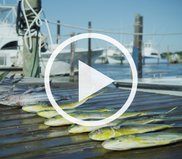
For centuries, fishing sustained life on these islands, first for Algonquin communities and later for early settlers and commercial watermen. This conversation with Nancy Gray examines the economic and cultural backbone of the Outer Banks. From whale oil shipments in the 1600s to modern-day bluefin tuna exports, fishing shapes both livelihood and identity. Infrastructure such as ice plants, roads, and bridges transformed the industry from subsistence to commerce, while tourism later reshaped the coastal economy. Nancy Gray's research offers a way into a larger conversation about resilience, adaptation, and the future of maritime communities.
This video was produced by CurrentTV during the Dare A250 Faire on April 18, 2026.
|
|
|
|
|
|