Watercraft Inspection Numbers
Montana inspectors have stopped 12 boats with
invasive mussels. The boats came from Arizona, Texas, California and the Great
Lakes area. Most of the boats were passing through Montana destined for Idaho,
Washington and Canada.
When a mussel boat is discovered, the
watercraft inspectors decontaminate the boat, lock the boat to the trailer and
notify the state or province where the boat is destined. Six of the boats had
been recently purchased from another owner.
Watercraft inspection stations will operate
through the summer months and close between Labor Day and the end of October,
depending on the location. See
CleanDrainDryMT.com for station times and dates of operation.
Watercraft Inspection Station Numbers
46: Inspection Stations in Montana
50,495: Boats inspected from January 1 to July 17
12: Boats with invasive mussel detected.
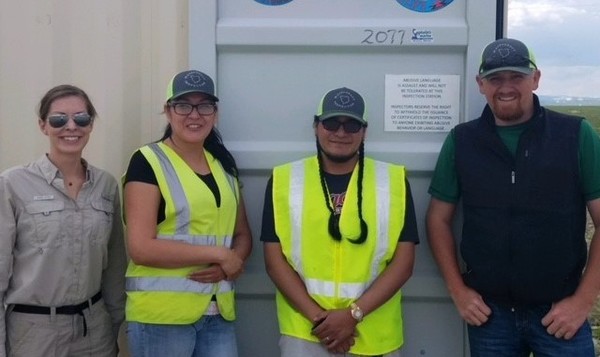
Inspectors at watercraft station operated by Blackfeet Nation.
Comment on Response Plan
FWP is seeking public comment on two documents that
would guide Montana’s response to the detection of invasive mussels.The public comment period for this public notice ends on Aug. 13.
Public comment can be submitted electronically or by mail
to Fish, Wildlife & Parks, Fisheries Division, PO Box 200701, Helena, MT
59620.
Panel Makes eDNA Recommendations
A panel of nationally recognized scientists in
the field of environmental DNA (eDNA) convened in April to make recommendations
that will guide the use and development of eDNA testing for the early detection
of invasive mussels.
The use of eDNA is a rapidly evolving
technology in need of standardized scientific
protocols for the sampling, analysis,
communication and verification of test results.
Information about the panel recommendations
can be found at the DNRC-MISC
web page.
AIS Laboratory
The AIS Laboratory analyzes water samples to
detect the presence of invasive quagga or zebra (dreissenid) mussel larva
called veliger. Because veligers are
microscopic in size the samples are viewed under a microscope using a process
called cross-polarized light microscopy.
FWP monitoring crews and other partner
organizations use a plankton tow net to collect water samples during the summer
months. Samples from high-priority areas can be processed within two weeks. If
the lab detects a dreissenid veliger, the water sample is shared with two
independent labs for verification.
AIS Lab Timeline
- 2005
- Lab in Helena established in cooperation with the Missouri River Basin Panel
and the U.S. Fish & Wildlife Service.
- 2005
– Processed 48 samples.
- 2015
– Processed 688 samples.
- 2016
– Processed 610 samples.
- 2016
– Mussel veligers detected in Tiber Reservoir and suspected in a sample from Canyon Ferry Reservoir.
- 2017
– Processed 1,670 samples. No mussels detected.
- 2018
– Processed 402 samples as of July 14. No mussels detected.
Monitoring for AIS
FWP monitors for all aquatic invasive species, including zebra and quagga mussels, Asian clams, New Zealand mudsnails, Eurasian watermilfoil, flowering rush, curlyleaf pondweed and other species not known to occur in Montana.
The monitoring and early detection efforts have increased steadily over the years but nearly tripled in 2017. Since there are a variety of aquatic invasive species, different sampling techniques are used to increase the likelihood of early detection. In 2017, a total of 260 waterbodies were inspected in Montana.
See the 2017 AIS Monitoring Report.
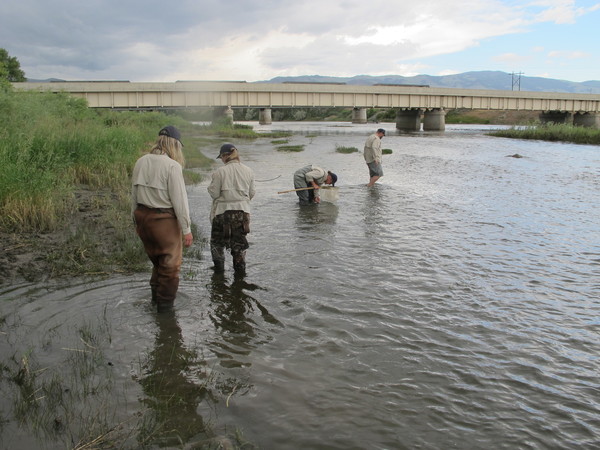 AIS Monitoring crew on the Missouri River near Townsend in 2017.
AIS Curriculumfor High Schools
The Watershed Education Network
(WEN) has developed a curriculum
for high school science classes called the Columbia
Headwaters Education Kit for AIS, or CHEK 4 AIS.
WEN constructed an education trunk that includes
all the supplies and gear needed to conduct the eight lessons. The curriculum
meets the Next
Generation Science Standards.
Learn more at montanawatershed.org.
Big Sky Watershed Crops
The Big Sky Watershed Corps is a Montana
Conservation Corps program that places young
professionals in Montana watershed communities to do research, project
planning, education and community outreach.
Casey Gallagher, Big Sky Watershed Corps member working with the Milk River
Watershed Alliance, had an information booth at the at SUPfest at
Bear Paw Lake near Havre. Stand up paddle
boards are classified as a “watercraft” and SUP owners must follow the same rules
as boaters, such as having a life jacket on board and stopping at watercraft inspection
stations. Casey also shared the Clean-Drain-Dry message at the Governors Cup Water Carnival near Fort Peck.
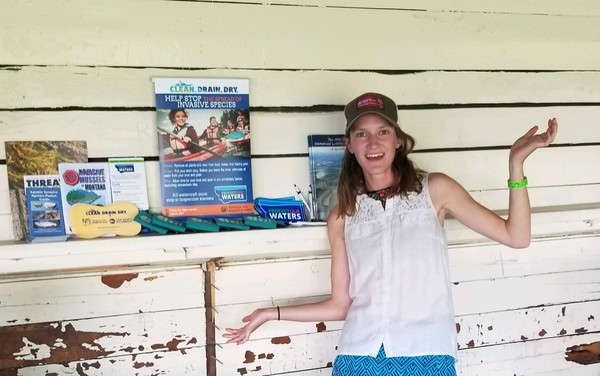 Casey Gallagher shares the Clean Drain Dry message at SUPfest.
Upper Columbia Conservation Commission
Created in the 2017 legislative session by House
Bill 622, UC3
was established to foster cooperation and coordination between international, federal, regional, state, tribal, and local
water resource managers for the development and implementation of comprehensive
Upper Columbia River Basin prevention and management measures to prevent the
introduction and/or further establishment of AIS.
The mission of the UC3
is to protect the aquatic environment in Montana tributaries to the Columbia
River from the threat of AIS in order to protect water resources, downstream
interests, and the economic and ecological vitality of the region.
The UC3
is comprised of 9 appointed members as well as ex-officio federal agencies;
they work closely with FWP and other AIS partners in Montana and throughout the
region. Focus areas include education and outreach, expansion of AIS
monitoring, and response preparedness The next UC3 meeting is September 26th
in Glacier National Park.
|