|
Emerald Ash Borer Awareness Week May 18-24
|
|
|
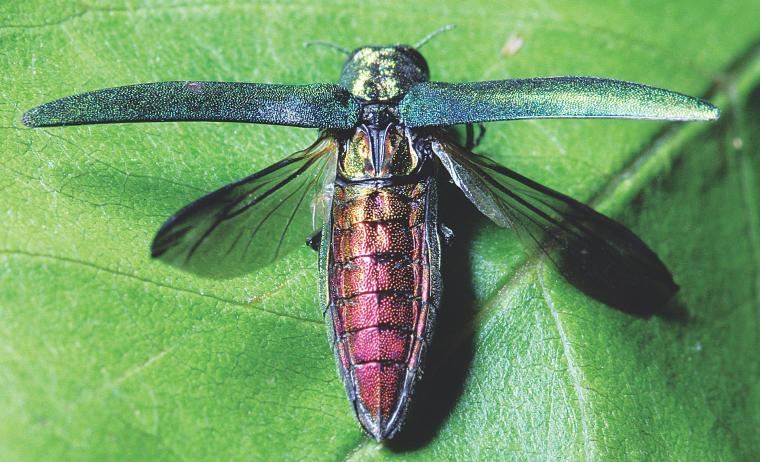
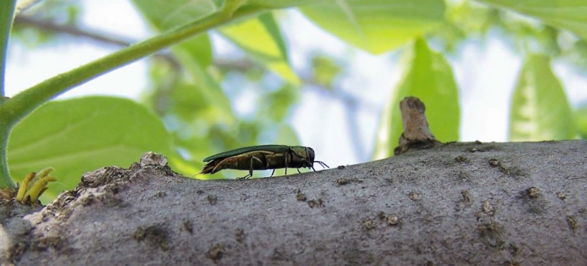
Emerald Ash Borers (Agrilus planipennis) are an invasive wood-boring beetle from Asia that can impact all 16 species of North American ash trees and are the primary cause of nationwide ash decline.
Emerald Ash Borers (EAB) are not currently found in Montana but have been detected in many central and eastern states including a detection in North Dakota in 2024 and a leap into Oregon in 2022.
EAB will have devasting impacts to eastern Montana's native green ash and to ash trees planted in urban areas. Green ash (Fraxinus pennsylvanica Marsh.) is the only native true ash species in Montana and comprises a significant component of riparian corridors in eastern Montana. It is also one of the most common trees planted in cities. Note that mountain ash (Sorbus scopulina) is not a member of the same tree family despite its common name; mountain ash is not infested nor affected by emerald ash borer.
The primary pathway EAB move is through firewood and wood products. Learn more about EAB and the Don't Move Firewood campaign.
Webinars:The Nature Conservancy and Don't Move Firewood
Register and learn more about these webinars at EAB Webinars
Monday - May 19 @ noon (mountain)
- Impacts and Management of Emerald Ash Borer
The emerald ash borer has killed billions of ash trees in cities and forests across the US and Canada. Several ash species in our region inhabit different types of forests and play important ecological roles. The results of 20 years of monitoring the impacts of emerald ash borer on ash populations and forest ecosystems show the ways this invasive pest has changed our forests. Management actions can be used in situation-specific combinations to mitigate the impacts of EAB, preserve ash species, and restore forest function.
Monday - May 19 @ 2 pm (mountain)
- Don’t Move Firewood Social Media Message Frame Testing: Emotional versus Objective Language
Effective communication on invasive species is crucial for generating awareness and reducing further anthropogenic spread of forest pest and pathogens like EAB. Message frames in invasion biology have evolved as outreach efforts shift away from using potentially problematic metaphors to more ethically conscious language. We at Don’t Move Firewood tested two types of socially responsible message frames on Facebook: one with values-based, emotional and protective language against one with objective, fact-based language to determine if there were any differences in engagement.
Tuesday - May 20 @ noon (mountain)
- Roots of Resilience: Fighting the EAB Impact on Wetlands
Emerald ash borer is causing widespread mortality of black ash (Fraxinus nigra) trees in the western Great Lakes region, threatening forest ecosystems and biodiversity. To assess the impacts, researchers studied black ash wetlands in northern Minnesota, documenting wildlife species, including birds, mammals, and amphibians. Experimental simulations of EAB-related tree loss revealed significant changes in forest structure and hydrology, influencing wildlife communities. Findings emphasize the need for management strategies that promote alternative tree species to maintain habitat complexity and support biodiversity. Integrating ecological, hydrological, and cultural perspectives will be key to conserving these vital ecosystems.
Thursday - May 22 @ noon (mountain)
- The Impacts of EAB and the Efforts to Preserve Black Ash
Examining the cultural impacts of EAB damage, and the efforts of the Saint Regis Mohawk Tribe to preserve black ash as a cultural resource.
More EAB Resources
Noxious Weed Awareness Week June 1-7
Join the Montana Department of Agriculture (MDA) in celebrating Montana’s Noxious Weed Awareness Week (MNWAW). This year, MNWAW will be celebrated Sunday, June 1, 2025, through Saturday, June 7, 2025.
In April of 2021, thanks to the help of legislators Marilyn Marler and Ken Walsh, Montana Noxious Weed Awareness Week was signed into state law. This official week occurs annually on the first full week of June to recognize the impact of terrestrial noxious weeds on our beautiful Montana landscape.
Read more. . .
Weed Pulls around the State
-
Tuesday May 13 – Weed pull at First Peoples Buffalo Jump State Park: Join park staff for a land improvement event from 6-7 p.m. to help remove noxious weeds that threaten the prairie landscape within the park. Gloves and water will be provided for volunteers, or bring your own, and wear closed-toe boots along with long pants and shirts. Call 406-866-2217 or email firstpeoplesbuffalojump@mt.gov to register. First Peoples Buffalo Jump State Park is three miles north of Ulm.
-
Tuesday May 27 - Poindexter Weed Pull: Join the Beaverhead Conservation District for a community weed pull! Poindexter slough is known as a community fishing site and a great spot to take your dogs but currently Hound’s tongue is taking over and we cannot fight it without your help. Hound’s tongue sticks to clothes and dogs making it a meness to society, spreading extremely fast.
-
Saturday May 31 – Weed pull at Tower Rock State Park: Tower Rock State Park is looking for volunteers to assist with a weed pull inside the area of the park which burned in 2024 to remove noxious weeds and help give the native plants room to grow and thrive. Gloves and water will be provided for volunteers, or bring your own, and wear closed-toe boots along with long pants and shirts. Call 406-866-2217 or email firstpeoplesbuffalojump@mt.gov to register. Tower Rock State Park is about 8 miles south of Cascade.
-
Monday June 9 - Hummocks & Uplands Community Weed Pull: Join Grow Wild, Big Sky Community Organization, and Lone Mountain Land Company for an afternoon of pulling weeds! Come any time between 3-6pm and stay as long or as short as you wish. Any help is appreciated!
-
Saturday June 14 - Gallatin River Weed Pull: Join Grow Wild and Madison-Gallatin Trout Unlimited for our 17th annual event! To date, 509 volunteers have removed 10,139 lbs of noxious weeds from the banks of the Gallatin River. Show your love for the canyon and dislike for noxious weeds by joining us!
- Saturday June 14 - Russell Gates FAS Weed Pull:
-
Tuesday June 17 - Big Sky Community Park Weed Pull: Join Grow Wild for a 13th annual weed pull event at the park! We'll rendezvous at the River Pavilion and then pull weeds around the park and along Little Willow Way. Stick around after for a delicious BBQ and volunteer raffle!
-
Friday June 27 - River Weed Pull Rodeo on Middle Fork of the Flathead River: During River Weed Rodeo private volunteers combine with commercial rafting outfitters, government organizations, non-profits and local businesses to hand pull weeds along the beautiful Middle Fork of the Flathead River corridor. Sponsored by the Flathead Rivers Alliance.
Montana Legislature Concludes
The 69th Montana Legislature adjourned on April 30th, the 85th day of the session. MISC tracked these bills during the session. See more information here.
| Bill # |
Short Title |
Status |
| HB 242 |
Revise fines related to AIS |
Signed by Governor 5/5/25 |
| HB 74 |
Revise private fish pond and commercial take laws |
Signed by Governor 4/3/25 |
| SB 167 |
Provide funding for noxious weed trust |
Vetoed by Governor |
| HB 932 |
Revise conservation financing laws |
Transmitted to Governor 5/7/25 |
| SB 409 |
Revise laws related to the department of commerce |
Transmitted to Governor 5/5/25 |
| SJ 42 |
Interim study of noxious weed control |
Transmitted to Governor 5/6/25 |
| HB 57 |
Designate quail as upland game bird |
Passed House. Senate indefinitely postponed. (DEAD) |
| HB 829 |
Revise laws related to AIS |
Tabled in committee (DEAD) |
| LC4294 |
Revise AIS laws |
Draft delivered to requester, not introduced |
|
|
 |
|
Warden intercepts mussel-fouled tugboat near Anaconda
Apr 28, 2025
Driver neglected to stop at inspection station
HELENA – A Montana Fish, Wildlife & Parks warden stopped a driver pulling a mussel-fouled tugboat after he drove past an aquatic invasive species (AIS) inspection station near Anaconda last week. The driver was traveling from Lake Michigan to the Puget Sound in Washington.
|
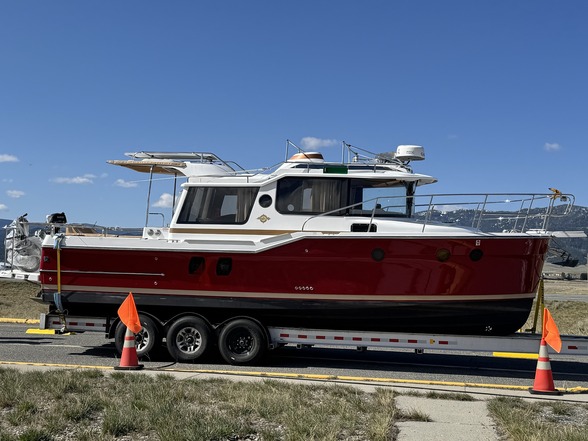 The warden had the driver return to the inspection station, where not only a great amount of mussels were found but also barnacles, indicating the boat was likely in salt water before it went to Lake Michigan. The boat was out of the water for two days, and it is possible that some of the mussels were still viable.
Everything was decontaminated except for the engine flush, due to the size of the vessel. The boat was locked to the trailer, and a follow-up inspection will be needed.
The driver also drove past inspection stations in Broadus and Hardin. The tugboat is the sixth boat this year detected with AIS.
This is a good reminder that it’s the law that anyone transporting watercraft (motorized and nonmotorized) must stop at all open inspection stations they encounter. Watercraft includes paddle boards, kayaks, canoes, rafts and pack rafts. Nonresidents and residents returning home must have their watercraft inspected before launching in Montana. Watercraft must also be drained of all water before transporting. Read more. . .
More AIS News

|
|
Spring 2025 MT EDRR Webinar: Waterhemp and Palmer Amaranth
May 19, 2025 - 8:00am
|
|
 |
Montana Dept of Ag is hosting North Dakota State University’s Dr. Joe Ikley for the Spring 2025 MT EDRR webinar. After a brief update from Josh Wagoner regarding the latest news on our high priority weeds, Dr. Ikley will share North Dakota’s experience with waterhemp and Palmer amaranth, two species of critical concern for Montana.
This will be a great opportunity to learn more about these invaders and refamiliarize yourself with them as we kick off the growing season. Montana pesticide applicator credits in several categories will be available for attendees. See attachment for more details, including the presentation overview, Dr. Ikley’s bio, available credits, and Zoom info. Please share this invite with your colleagues, employees, friends, family, etc.
Webinar link: https://mt-gov.zoom.us/j/89908636766
2025 Rural Resilience Webinar Series
In this webinar recording, learn how to manage weeds and stimulate native grass growth with goats!
Guest speakers:
- Lani Malmberg – Founder of Goat Green LLC, the longest-running professional prescription goat grazing operation in the U.S. With over 29 years of experience across 16 states, Lani specializes in land and watershed restoration, soil regeneration, and invasive species control using strategic mob browsing.
- Daniel Magalsky – A Montana rancher who transitioned his family’s operation to focus on meat goats as a primary enterprise. Daniel integrates holistic management to improve rangeland health, combat invasive weeds like leafy spurge, and build a resilient, adaptable goat herd.
What You'll Learn:
- How goats can control invasive weeds and improve native grasses
- Practical strategies for managing a goat herd in rangeland environments
- The economics and benefits of integrating goats into ranching operations
- Innovative fencing solutions for grazing management
NAISMA: Beyond Buckthorn: Innovative Strategies for Invasive Control and Habitat Restoration
May 21,2025
Invasive buckthorn continues to threaten native ecosystems, but new and creative management approaches are showing promising results.
|
|
 |
This webinar will explore cutting-edge strategies to control and replace buckthorn, including the Cover It Up program, which utilizes native plantings to suppress regrowth, targeted goat grazing, and the use of fungal pathogens to weaken buckthorn populations. Join experts as they share research-backed insights, real-world applications, and success stories from the field. Whether you’re a land manager, conservationist, or homeowner, this session will equip you with practical tools to restore habitat and reclaim invaded landscapes.
|
|
|
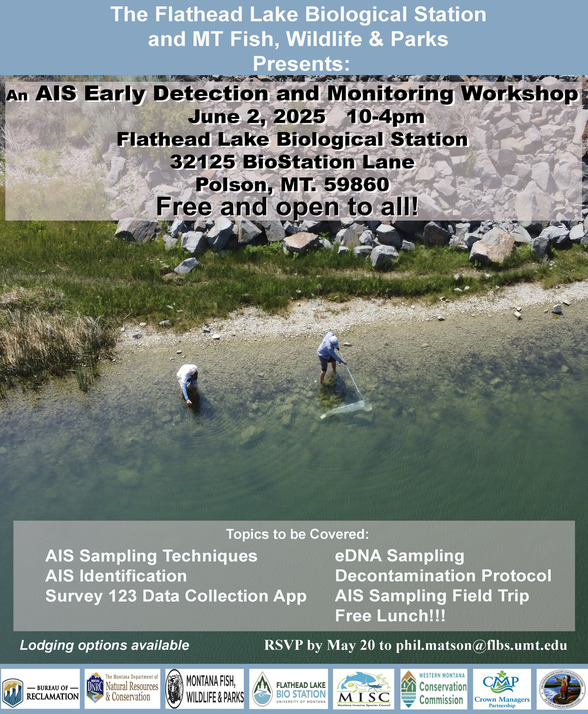
Join the Flathead Lake Biological Station and the Montana Fish, Wildlife & Parks for an aquatic invasive species training, June 2, 2025 at the Flathead Lake Biological Station. Topics covered will include AIS monitoring and identification, eDNA and decontamination protocol, and data upload using the Survey 123 data app. Open to all - lunch is provided! Lodging is available upon request. Contact phil.matson@flbs.umt.edu for more info.
Montana Weed Control Association Area Trainings
|
|
|
|
|