Should I Sell Carbon Credits?
A Decision Guide for Ranchers
Land-based carbon accumulation has long been considered an essential element of climate mitigation strategies and is increasingly viewed as a potential source of purchasable credits for those seeking to offset emissions. Ranch owners and managers need a framework to make the most effective decisions about if, and how, entering into a carbon credit contract fits their business operations.
The following resources discuss the foundational concepts of carbon trading, key considerations for managing the development of credits, risks associated with entering a carbon credit contract, and economic and market considerations. Our goal is to inform ranchers so the best decisions can be made in an emerging and uncertain enterprise
King Ranch Institute Webinar and White paper on carbon credits, click here.
Grass-Cast indicates for ranchers and other grassland managers whether productivity (pounds per acre) is likely to be above-normal, near-normal, or below-normal in the upcoming growing season relative to the 30+ year history of their local area (individual 6-mile x 6-mile grid cells). Grass-Cast is first published in the spring (typically beginning in late April) and then updated every two weeks with newly observed weather data. It therefore becomes more accurate as the growing season unfolds and should be consulted throughout the growing season.
Ranchers and rangeland managers will need to combine the information from Grass-Cast with their knowledge of local soils, plant communities, topography, grazing history, and other conditions as part of their decision-making process. Similarly, public land managers should not use Grass-Cast as a sole source of information for setting stocking rates, turnout dates, or other aspects of lease agreements, allotments, or permits.
Grass-Cast cannot tell the difference between desirable forage species and undesirable forage species. So, it is important for grassland managers to know what proportion of a pasture is occupied by weeds, and how well those weeds respond to rain (or lack of rain) compared to the desirable species. Monitor these different vegetation types to see if one is responding to the weather better than the other and adjust Grass-Cast’s productivity estimates accordingly.
For more information visit Grassland Production Forecast (unl.edu)
 |
|
During late summer and early fall it is normal for spiders to enter buildings and homes. This includes hobo spiders which have long been prevalent in Montana. Common misconceptions about the hobo spider often cause unnecessary concern.
For more information, please visit Hobo Spiders - MSU Extension IPM Program | Montana State University
|
Dirac Twidwell, associate professor of rangeland ecology at the University of Nebraska - Lincoln, will present "The Last Stand of North America's Grassland Biome" as the fourth installment of the Bair Ranch Foundation Seminar Series.
The IRS issued some news regarding the weather related sales of livestock tax rules
JC Hobbs, Oklahoma State University | Oct 17, 2022
Over the past several months I have received many calls from livestock producers wanting information concerning the application of the Weather Related Sales of Livestock Rules provided by the IRS.
Last week, the IRS released Notice 2022-43: Extension of Replacement Period for Livestock Sold on Account of Drought. It reports that livestock producers in all 77 Oklahoma counties qualify for the 4 year extended period for replacing breeding, dairy, and draft animals that were sold in excess of normal beginning September 1, 2021 and during 2022. The beginning of the replacement is the first 12 month drought free period (September 1 to August 31). Producers electing to replace animals will have until December 31 of the fourth year. More detailed information can be found by using Google and searching for IRS Notice 2022-43. Full story here.
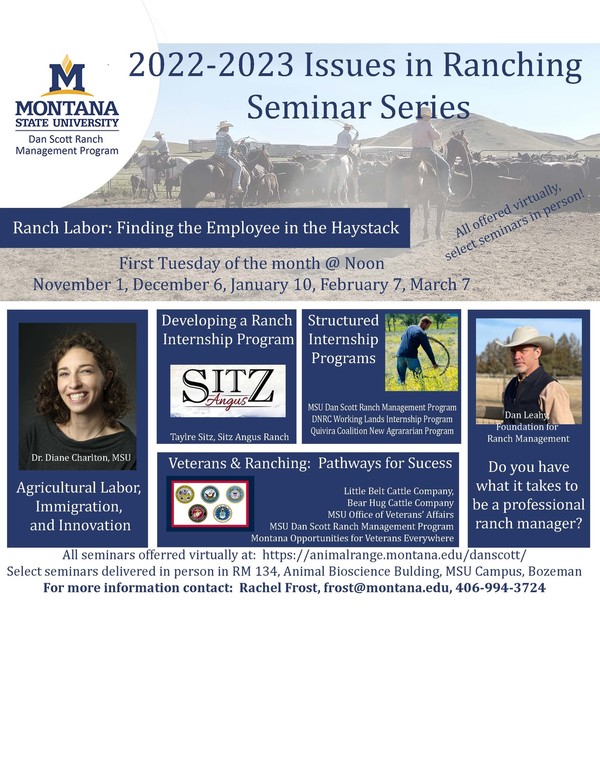
Grazing: Judge denies appeal of BLM bison grazing decision
Gianforte, Knudsen denied appeal of BLM decision on American Prairie’s bison [r20.rs6.net], Daily Montanan - A federal administrative law judge has denied appeals by both Montana Gov. Greg Gianforte and a separate one filed by Montana Attorney General Austin Knudsen that disagreed with a decision by the Bureau of Land Management to extend and add leasing acreage for American Prairie’s bison herd. The state, in several separate appeals, challenged the BLM’s decision to continue leases it currently holds with American Prairie, and one new leased parcel. Knudsen and Gianforte argued that fencing requirements were inappropriate, that bison could spread disease to cattle, and that allowing American Prairie would economically cripple the area, including Phillips County. However, Judge Veronica I. Larvie denied the appeal, saying that neither Gianforte nor Knudsen had presented specific evidence to support their claims. The appeal is another chapter in a long simmering battle with Gianforte and Knudsen opposing American Prairie’s vision of restoring prairie land by private land acquisition and leasing, as well as creating more public access to land and hunting, and adding bison herds. Gianforte and Knudsen have routinely opposed the organization’s plans, saying that it harms Montana’s agricultural community by taking land from commercial agriculture production and shifting it toward conservation.
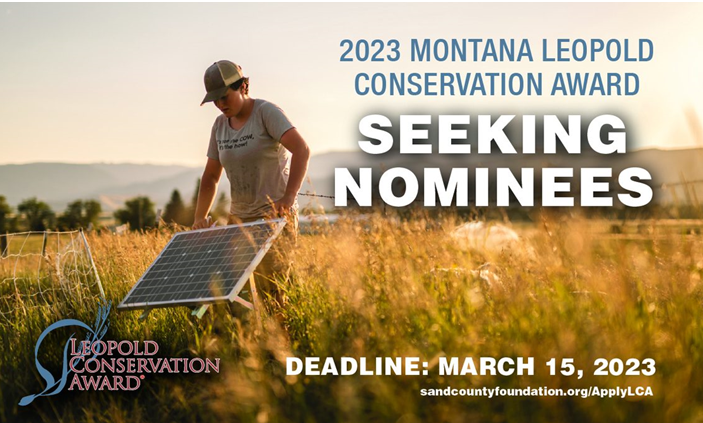
2023 Montana Leopold Conservation Award Seeks Applicants
|
|
Know a Montana rancher, farmer or forestland owner who goes above and beyond in the stewardship and management of natural resources? Nominate them for the 2023 Montana Leopold Conservation Award®.
The Montana Leopold Conservation Award was made possible through the generous support of the American Farmland Trust, Montana Department of Natural Resources and Conservation, Montana Rangeland Resources Committee, Sand County Foundation, Sibanye-Stillwater, TC Energy, Northwest Farm Credit Services, USDA-Natural Resources Conservation Service, Ducks Unlimited, Grazing Lands Conservation Initiative, McDonald’s, Montana Farm Bureau Federation, Ranchers Stewardship Alliance, Soil and Water Conservation Society, and World Wildlife Fund.
Sand County Foundation [sandcountyfoundation.us13.list-manage.com] and national sponsor American Farmland Trust [sandcountyfoundation.us13.list-manage.com] present the Leopold Conservation Award to private landowners in 24 states for extraordinary achievement in voluntary conservation. In Montana [sandcountyfoundation.us13.list-manage.com], the $10,000 award is presented with the Montana Department of Natural Resources and Conservation, and the Montana Rangeland Resources Committee.
Given in honor of renowned conservationist Aldo Leopold, the award recognizes landowners who inspire others with their dedication to land, water, and wildlife habitat management on private, working land. In his influential 1949 book, “A Sand County Almanac [sandcountyfoundation.us13.list-manage.com],” Leopold called for an ethical relationship between people and the land they own and manage.
Nominations may be submitted on behalf of a landowner, or landowners may nominate themselves. The application can be found at www.sandcountyfoundation.org/ApplyLCA [sandcountyfoundation.us13.list-manage.com].
The application [sandcountyfoundation.us13.list-manage.com] deadline is March 15, 2023. Applications can be emailed to sbarta@mt.gov or postmarked by March 15, 2023, and mailed to:
Leopold Conservation Award
c/o Rangeland Resources Program Coordinator
Dept. of Natural Resources & Conservation
P.O. Box 414
Clyde Park, MT 59018
Applications are reviewed by an independent panel of agricultural and conservation leaders.
“Landowner-driven conservation helps ensure that our natural resources provide benefits for present and future generations of Montanans. We are grateful for their dedication and thankful to partner with Sand County Foundation to recognize an outstanding agricultural landowner once again with the 2023 Leopold Conservation Award,” said Amanda Kaster, Montana Department of Natural Resources and Conservation Director.
The first Montana Leopold Conservation Award was presented in 2019 to Bill and Dana Milton [sandcountyfoundation.us13.list-manage.com] of Roundup. The 2020 recipients were Craig and Conni French [sandcountyfoundation.us13.list-manage.com] of Malta. The 2021 was Hidden Hollow Hideaway Cattle and Guest Ranch [sandcountyfoundation.us13.list-manage.com] of Townsend. Last year’s recipient was Barney Creek Livestock [sandcountyfoundation.us13.list-manage.com] of Livingston.
|
|
|
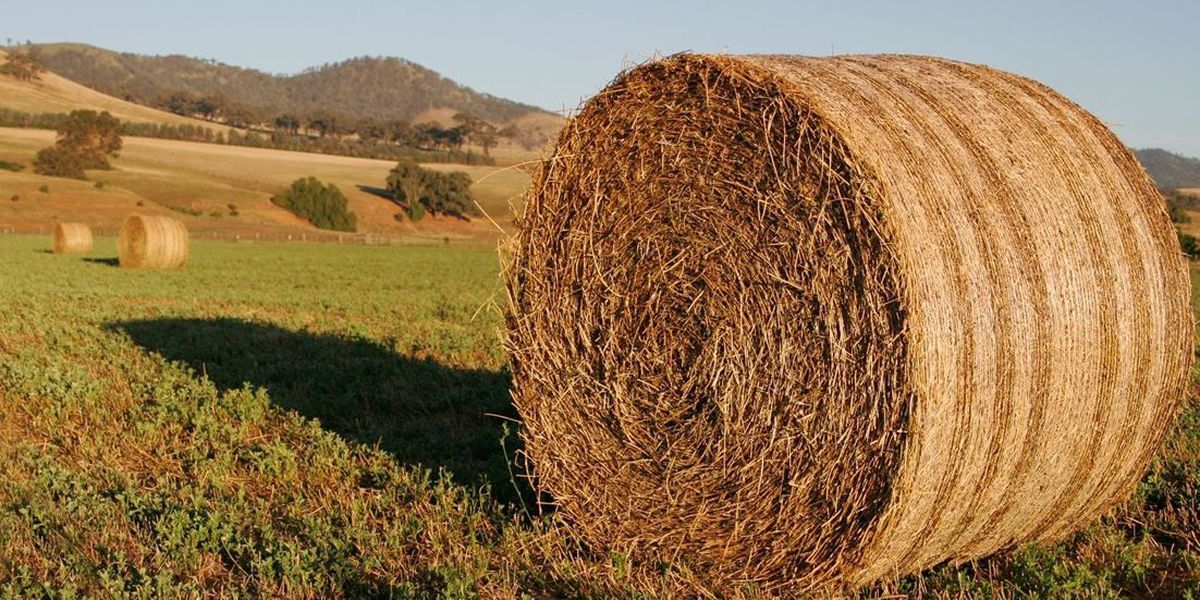
Beware, the better quality the hay, the more you'll save putting it under storage.
Connor Biehler & Steve Niemeyer, University of Nebraska-Lincoln | Oct 13, 2022
Storing big round hay bales by lining them up along the fence row may be easy, but it is not economical. Baled forage probably constitutes the highest percentage of winter feed cost we have wrapped up in a cow. The production of hay uses immense resources, and the ration quality is affected by hay quality. Storing dry hay on the ground without cover causes greater amount of spoilage when compared to other methods of storage. Results found from ranch research done in the Sandhills of Nebraska by the University of Nebraska Extension in 2005-2008 reported no significant nutrient changes in total dry matter pounds, pounds of crude protein or pounds of total digestible nutrients on native hay and alfalfa plots. However, visual damage losses after one year between covered and uncovered with twine or net wrap are reported. More information here.
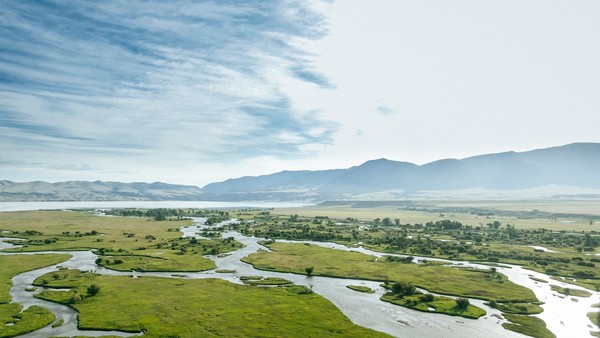 We are happy to announce a new call for the Ranching for Rivers Cost-Share program. This is a voluntary cost-share program to assist landowners in protecting riparian health through improved ranching stewardship practices.
Through the Montana Department of Environmental Quality, and partnering with DNRC, Ranching for Rivers offers 50% cost-share for fencing material, off-site water infrastructure, and developing grazing management plans.
Funding is also available for Conservation Districts and Watershed Groups to provide technical assistance on ranch management projects to local landowners in their area.
Landowners, Conservation Districts, and Watershed Groups who are working within areas with a DEQ-approved Watershed Restoration Plan are encouraged to apply for program funding.
First Call Deadline is January 30th, 2023 For more information and application materials visit MACD website Ranching for Rivers | Montana Association of Conservation Districts (macdnet.org).
 MONITORING...
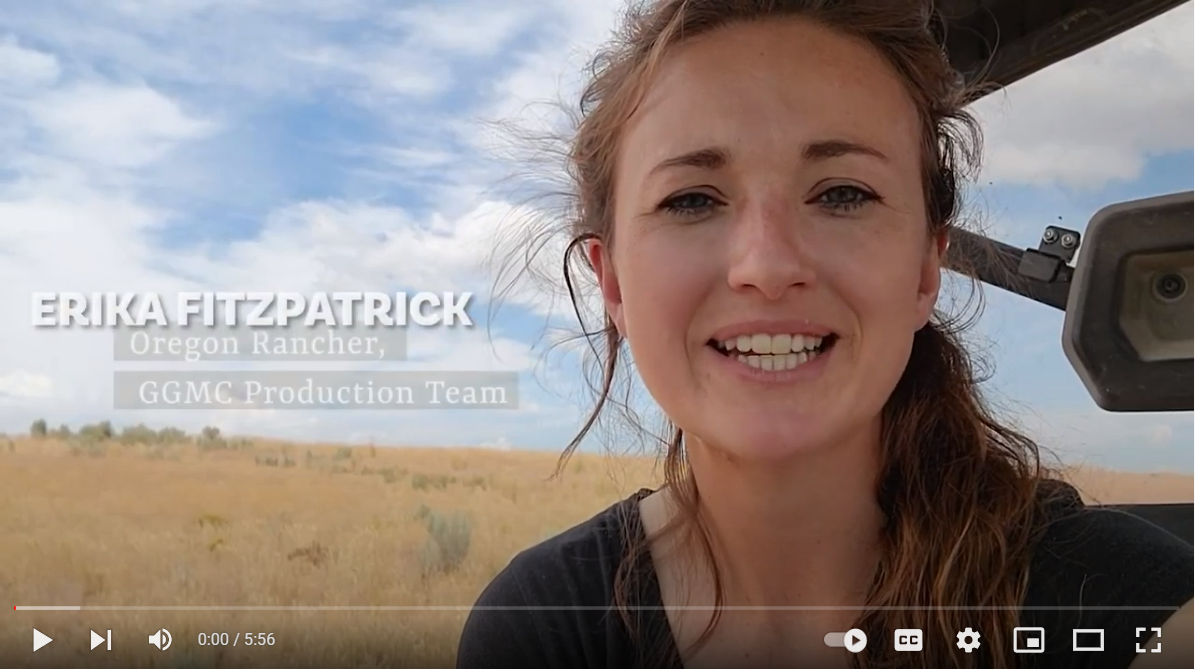
Erika Fitzpatrick gives us a behind the scenes look at her family's photo monitoring program. They use photo monitoring to track changes over time in relationship to their grazing program, climate conditions and impact of invasive annual grasses. Photo monitoring can be a simple, easy to use method to start monitoring on any ranching operation.
"There's a lot of ways you can monitor and that to us was overwhelming. So just picking something simple to start with and then evolving it as we go I think was key for us. It's easy to get bogged down in all the different methods, some require a bit more training than others so we really just wanted to start with something that made sense to us and was doable."
- Erika Fitzpatrick, Oregon Rancher & GGMC Production Team
Why Monitor? Click to read more from Good Grazing Makes Cents!
With lots of demands on time and resources within a ranching operation, adding another task to an already full plate may seem crazy. This is perhaps why many operations currently don’t have a range monitoring program in place. However, by considering what a monitoring practice can do for a given operation and customizing the plan to fit those specific needs, perhaps monitoring will move up in the ranks of the “to-do” list. Range monitoring also doesn't - and shouldn’t be- overly complicated. We collect weights when we’re already running animals through the scale or record Body Condition Scores when we’re already looking at the herd… with the monitoring systems we’re talking about in this edition we’re proposing a system just like that…working it into existing functions/responsibilities you already have on the ranch.
 Estate Planning Road Show Coming to Hi-Line
At Ranchers Stewardship Alliance, we believe in a future where ranching and rural communities in the Northern Great Plains are so successful that ranch families never need to consider selling or transitioning their land out of production agriculture. It can take work.
According to USDA NASS, family-owned farms account for 96% of farms in the U.S. Yet ag census data tells us that only 30% of these farms survive into the second generation. Only 12% are still operating by the third.
Sixty-nine percent of the family farms surveyed expected ownership to continue into the next generation, but only 23% had a plan. Where are you in those statistics?
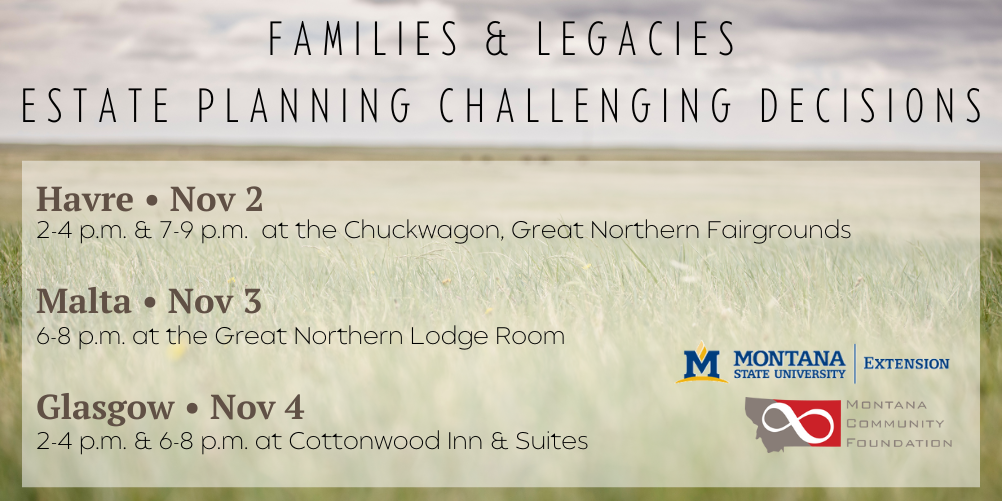
Next week, Montana State University’s Dr. Marsha Goetting will be hitting the Hi-Line for an estate planning road show with stops in Havre, Malta, and Glasgow. If you don't have a plan or yours needs a bit of work, mark these on your calendar!
PLC debuts first "Range Reels" video.
|
|
|
 |
Precision agriculture, youth development among projects that will benefit.
MSU News Service | Oct 25, 2022
Programs promoting precision agriculture, youth development, agriculture scholarships and the state's farm and ranch heritage will all benefit from a newly announced $10 million gift to Montana State University.
The anonymous donation will establish a series of endowments focused on programs based in the MSU College of Agriculture and MSU Extension.
The largest portion of the gift, $5 million, will endow a dedicated faculty chair in precision agriculture who will lead development of new technologies and their data-driven applications for the future of Montana's largest industry.
The new faculty chair position will work to help Montanans improve profitability, agricultural efficiency and sustainability, according to Sreekala Bajwa, vice president of agriculture, dean of the College of Agriculture and director of the Montana Agricultural Experiment Station.
A shrinking workforce and ever-changing global competition means that, more than ever, the future of Montana agriculture will depend on new technologies, she said.

Partnership Announced to Promote Hunter Behavior
It’s up to us. Respect access. Protect the hunt.
In Montana, good relationships between hunters and landowners are integral to our opportunities, lead to proper wildlife management and ensure that our hunting traditions continue.
Landowners play an important role in sustaining healthy wildlife populations, contributing to our economy and communities by creating jobs, and providing valuable habitat and treasured open spaces. But the relationship between hunters and landowners can start to fray when just a few hunters abuse the privilege of hunting on private land.
To promote the importance of hunter ethics and improved hunter behavior, Montana Fish, Wildlife & Parks is partnering with other conservation and agriculture organizations to “protect the hunt.”
The campaign is focused on hunter responsibility and respect for private land and the access landowners provide. The slogan is: It’s up to us. Respect access. Protect the hunt.
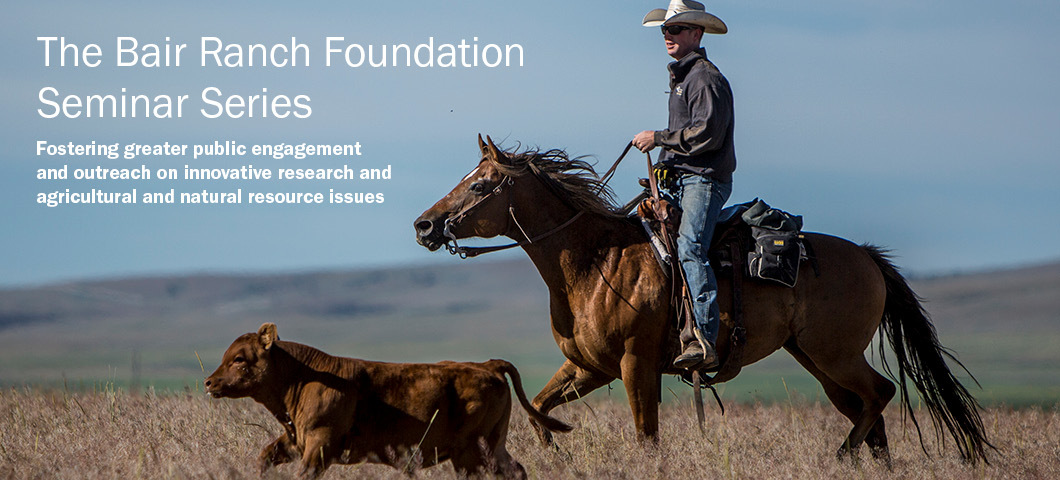
The Fall 2022 Bair Ranch Foundation Seminar Series brings nationally recognized scientists and agricultural professionals to Montana State University for the benefit of students, faculty and the public. The series aims to foster greater public engagement and outreach on innovative research, and highlight agricultural and natural resource issues.
Please feel free to join in person or via WEBEX! Information and schedule can be found here:
http://animalrange.montana.edu/bairranchfoundation.html [animalrange.montana.edu]
The Art of Range
Play Episode Listen Later Feb 17, 2022 55:44
How do we build soil health? What is soil health? Is careful grazing helpful or hurtful? Can anything be done to meaningfully influence soil health? And how would we know? What can be measured that indicates progress? These are the questions Derek Scasta and Jeff Goodwin and their team intend to begin to answer through a recently funded national-scale project called Metrics, Management, and Monitoring: An Investigation of Pasture and Rangeland Soil Health and Its Drivers. This ambitious research and outreach effort, funded through a variety of public and private monies, will combine state-of-the-art experimental research with case studies documenting existing soil health effects on farms and ranches where consistent practices have been in place for years (and unlike investing, prior performance does predict future results). These results will inform policy and trade in carbon markets, enhance agricultural resilience to climate uncertainty, and advise land managers on how to increase profitability, land health, and animal health. This interview introduces the project's history, objectives, and timeline. Stay tuned for those future results.
|
Montana State University:
Animal & Range Science
MSU Extension:
Updated MontGuides
University of Montana:
Rangeland Analysis Platform
Reversing Tree Encroachment Increases Usable Space for Sage-Grouse during the Breeding Season
USDA-Agricultural Research Service
Scientific Discoveries 2022
Rangeland Resources & Systems Research, Fort Collins, CO:
Livestock and Range Research Laboratory, Miles City, MT:
Pest Management Research, Sidney, MT:
USDA- Wildlife Services:
US Forest Service Research & Development:
Research topic: Fire
Research topic: Water, Air, & Soil
November
Nov 1st, Montana State Technical Advisory Committee Meeting
Nov 1st, What's New at the National Wetlands Inventory Program
Nov 2-3rd, Water in the West Symposium
Nov 8-9th, MSU Nutrition Conference
Nov 14th, Forest Service Wildfire Crisis Strategy Roundtables
Nov 14-16th Montana Farm Bureau Federation Annual Conference
Nov 15-16th Strong Her Women in Agriculture
Nov 15-17th, Montana Association of Conservation Districts Convention
Nov 17th, North Central U.S. Climate and Drought Summary and Outlook
Nov 17-18th, Montana Forest Collaborative Network Annual Workshop
December
December 7-9th Montana Stockgrowers Association Annual Convention
Stacey Barta, State Coordinator for Rangelands
(406) 594-8481
SBarta@mt.gov
Rangeland Resources Committee:
Diane Ahlgren, Chair
John Hollenback, Vice Chair
Sigurd Jensen
Jim Anderson
Leah Lewis
Ron Devlin
|