|
Participate in the largest invasive species awareness effort in North America. Follow along on Facebook @invasivespeciesweek, join the conversation, and link your social posts with #NISAW or #invasivespecies.
Squeal on Pigs! Call 406-444-2976
Protect Montana from feral swine.
Feral swine are an invasive, non-native species. Over time, pigs have escaped or were released intentionally, creating free-ranging feral swine populations in the United States and Canada. They are aggressive and pose serious ecological, economic, and health threats. Their spread is blamed for an estimated $1.5 billion annually worth of damage to crops, wildlife, and the environment.
Preparing for a new invasive species in Montana.
Click to Watch Video.
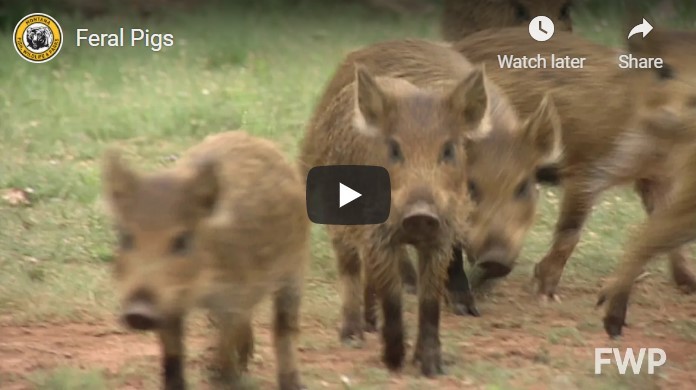 Feral swine are highly destructive and potentially dangerous animals. Their spread is blamed for an estimated $1.5 billion worth of damage to crops, wildlife, and the environment. These swine can carry over 30 diseases and parasites that pose a threat to livestock and humans, including swine brucellosis and pseudorabies. Feral swine tend to forage in areas around rivers and streams, and their trampling and destructive rooting behavior - often compared to rototilling - causes erosion, spread of noxious weeds, loss of crops, and harm to fish habitat. To prevent the introduction of feral swine into Montana, the 2015 Legislature prohibited the transportation, possession, and hunting of feral swine. There are no known established populations in Montana, although there are populations as close as North Dakota and Saskatchewan. Early detection and rapid response are the keys to success. Eradicating small populations and minimizing the impacts of these invasive species are important to protect the economy and natural resources of the region.
 |
|
|
If you see a feral swine, or signs of their damage such as excessive rooting or digging, report it immediately by calling 406-444-2976.
What you can do to stop the spread of invasive species in Montana:
MISC and partners urge all Montanans to share this information widely and take these simple measures to be informed, attentive, and accountable for preventing the spread of terrestrial and aquatic invasive species.
-
WATCH FOR NOXIOUS WEEDS. If you spot some, notify your county weed coordinator https://www.mtweed.org/weeds/weed-districts/ or report to EDDMapS West. eddmaps.org/west/
-
USE CERTIFIED WEED FREE. Make sure to use weed-free forage, hay and mulch. mt.gov/Noxious-Weed-Seed-Free-Forage
-
PLANT ONLY NON-INVASIVE PLANTS. Keep your garden free of known invasive plants. Many invasive species introductions come from the ornamental trade. mtnativeplants.org/
-
CLEAN YOUR GEAR. Always wash and dry your boots, bikes, waders, boats, trailers, and off-road vehicles between uses. playcleango.org/
-
CLEAN.DRAIN.DRY. Aquatic invasive species are often inadvertently spread by boats. Clean. Drain. Dry. every time you use your boat. http://cleandraindry.mt.gov/
-
DON’T LET IT LOOSE. Dispose of unwanted pets, aquarium plants and water, and live bait the proper way, and not into waterways. Be a responsible pet owner. dontletitloose.com/state/montana/
-
DON’T MOVE FIREWOOD. Buy it where you burn it or gather it on-site. Firewood can harbor pests and disease, and Montana depends on its healthy forests. dontmovefirewood.org
-
SQUEAL ON PIGS. If you see a feral swine, or signs of their damage such as excessive rooting or digging, report it immediately by calling 406-444-2976. https://invasivespecies.mt.gov/montana-invasive-species/squeal-on-pigs

Last daily webinar of the week!
Fri | Feb. 26 Show Me the Money! - Moving from Authorization to Appropriations presented by Lee Van Wychen, Executive Director of Science Policy, Weed Science Society of America
|
 |
|
Click to play newly published video about invasive species threats in Montana! |
National Invasive Species Awareness Week Part I, February 22-26th: Virtual
Montana Watershed Coordination Council (MWCC) Meeting, February 26th: Virtual
Montana Invasive Species Council (MISC) Meeting, March 4th: Virtual
Flathead Basin Commission (FBC) Spring Meeting, March 31st: Virtual
Western Regional Panel (WRP) Mid-Year Meeting, April 7th: Virtual
Upper Columbia Conservation Commission (UC3) Spring Meeting, May 12th: Virtual
National Invasive Species Awareness Week Part II, May 15-22nd: Virtual
North American Invasive Species Forum May 18-20th: Virtual
|