|
Nov. 3 is Election Day in Minneapolis. After the City’s Early Vote Center closes at 5 p.m. Nov. 2, any voters who still haven’t voted can only do so at their assigned polling place or by dropping off a completed mail ballot at the City’s election office. All polling places are open Nov. 3 from 7 a.m. until 8 p.m. Anyone in line to vote by 8 p.m. Nov. 3 will still have the opportunity to vote.
Find the right polling place
Voters who plan to vote on Election Day should find out the location of their polling place. They can look for their polling place on the Secretary of State website.
Confirm a mail ballot was received
Voters who completed and mailed back their early ballots should check the online ballot tracking tool the morning of Nov. 3. If the tracking tool indicates that their ballot has not yet been accepted, they should look up their polling place and go vote in person.
Voters can vote in person as long as election officials have not yet received and counted their mail ballots. Elections staff at polling places check to see if they’ve received and counted mail ballots from voters who want to vote in person. Voters are given ballots as long as the City has not received and counted mail ballots from them. Any uncounted mail ballots from people who have voted in person will be cancelled and not counted (even if election officials receive it later).
Any Minneapolis voter who has a completed mail ballot should not mail it in at this point. Instead, mail ballots can be dropped off during voting hours at any Minneapolis Early Voting location. Or, on Election Day Nov. 3, ballots can be dropped off from 8 a.m.-5 p.m. at Minneapolis Elections & Voter Services, 980 E. Hennepin Ave., or the Hennepin County Government Center, 300 Sixth St. S. Mail ballots cannot be accepted at polling places on Election Day.
Voters can bring materials into the polls to help complete their ballots, and the sample ballot is the single best tool for this. Find sample ballots for all Minneapolis precincts on the City website.
Video
Voting in Minneapolis is safe, and there are security measures in place. You can vote at your polling place, or you can still vote early in person through Nov. 2. Watch the video on YouTube.
Find information about registering and voting in Minneapolis on the City website.
How to help
Every election year, Minneapolis sees strong voter turnout and residents who step up. From offering a ride to the polls, to sharing information across languages, you can use our guide for simple, nonpartisan ways to support voters. Download the guide in multiple languages.
Remember, polling places — and within 100 feet — are reserved for voters and people helping them vote.
How to identify an election judge
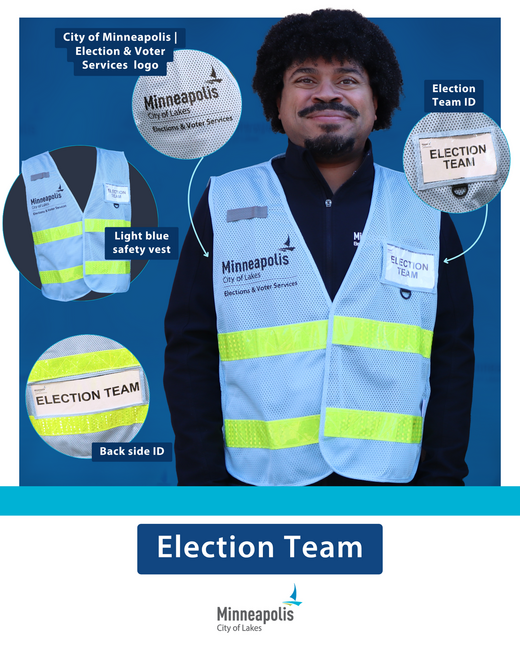
If you need any help while you’re out voting, just ask an election judge. They’ll be inside and outside polling places to make sure voters have access to their ballot. Minneapolis election judges outside of the polling place will be wearing a light blue safety vest with a City of Minneapolis logo. Election judges inside the polling place will have clearly visible identifying lanyards.
We’re fully staffed and ready to help you vote. Let’s work together to help ensure a smooth and accessible election for all.
Graphic about how to identify an election judge.
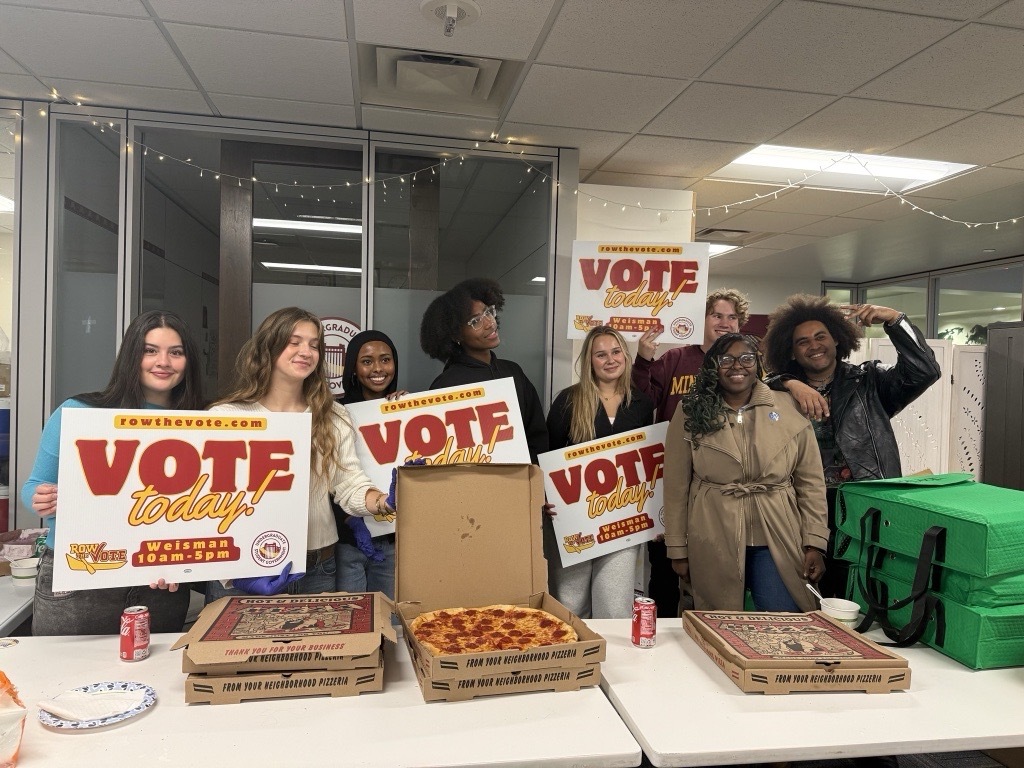
I had a wonderful time with the UMN Undergraduate Student Government doing non-partisan voter turnout on campus this week. The early voting pop-up at the Weisman Art Museum goes a long way to support student voter turnout by bringing the ballot box to campus. I’m proud to report that our efforts helped to secure over 700 votes at the U of M early voting pop-up. Thank you to the Elections and Voter Services team for supporting the pop-up at Weisman and to all the campus leaders who organized to bring more students to the polls!
CM Wonsley with student leaders at Voterpalooza.
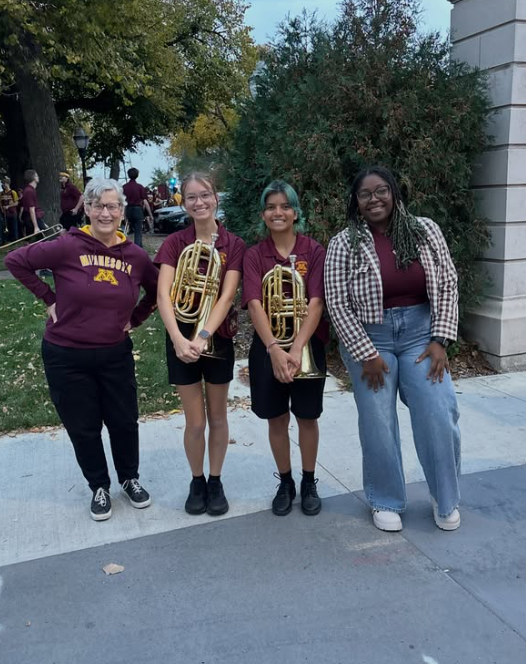
The Gopher spirit was strong this year at UMN Homecoming! I had the best time with students, alumni, and my fellow dignitary Falcon Heights Council Member Paula Mielke.
Council Member Wonsley with Falcon Heights Council Member Mielke and UMN band members at Homecoming 2026.
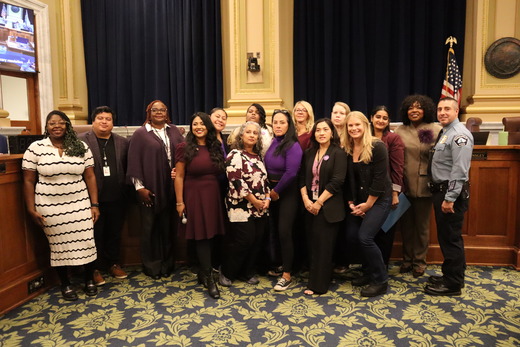
The City Council honored Domestic Violence Awareness Month with a resolution that was presented to survivors, families, and advocates. More than 10 million adults experience domestic and intimate partner violence in the United States every year, disproportionately women—particularly Black, Indigenous, Asian, Latina women, and pregnant and postpartum women. I stand in solidarity with all those impacted by domestic violence and will continue investing in prevention, resources and healing for victims, survivors and their communities.
Council Members with survivors, families and advocates honoring Domestic Violence Awareness Month.
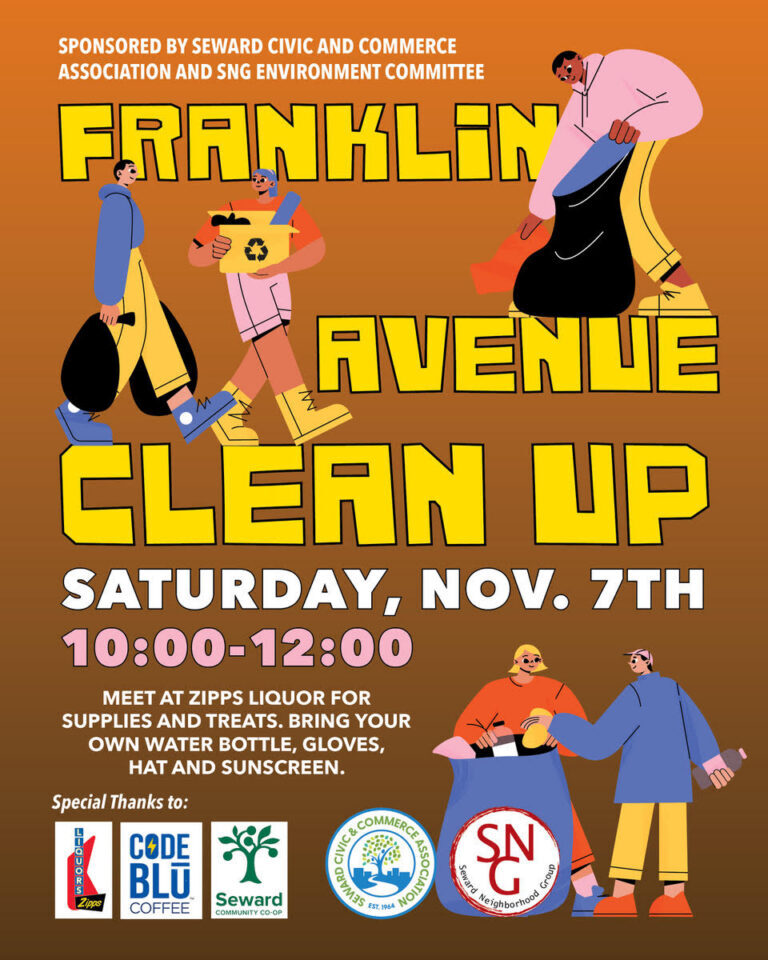
Back by popular demand… Join Seward Neighborhood Group’s Environment Committee and the Seward Civic & Commerce Association for another clean-up along Franklin Avenue! There will be free coffee from Code Blu and treats for kids from Seward Co-op. Bring your family and friends for great fall fun. Sign up here to let us know you’re coming!
Franklin Ave Cleanup
Saturday, November 7th from 10am-noon
Meet at Zipps Liquors for supplies and treats (2618 E Franklin Ave)
Poster for Franklin Ave Cleanup
The annual Prospect Park Fall Market will be on Saturday, November 7 from 9 am - 3 pm at Prospect Park United Methodist Church. It features:
- Artisans selling wares such as pottery, quilts, fabric art, jewelry, cards & more
- Breakfast and lunch for dine in or to-go
- Silent auction of food items & art
- Fresh, homemade baked goods
- Free Kids’ Makers Room for grades Pre-K to middle school.
We hope to see you there for this great neighborhood tradition where you can find unique, locally made items! Bring your appetite and your holiday shopping list!
Prospect Park Fall Market
Saturday, November 7, 9am-3 pm
Prospect Park United Methodist Church (22 Orlin Ave SE)
Prospect Park Fall Market flyer
Summary: The City Council voted to eliminate the Office of Community Safety (OCS), which cost taxpayers $2.1 million directly, but cost taxpayers millions more due to their poor management of city resources. OCS created bureaucratic barriers to advancing public safety beyond policing and reining in MPD. The City Council also consolidated several other departments to help reduce the property tax levy and improve city functions that have been faltering. The City Council unanimously adopted a resolution stating the intention to use the cost savings from the reorganization to support lowering the tax levy and restore critical programs that the mayor has proposed cutting.
Background: Council President Payne and I proposed reorganizing several departments in the City administration. The ordinance restructures and consolidates city government by eliminating the Office of the Community Safety (OCS) and Performance Management and Innovation department, and incorporates the work of the Racial Equity Inclusion and Belonging department into the Neighborhood Community Relations Department.
The Office of Community Safety has become a structural dysfunction within our city government that has created significant barriers to delivering effective, comprehensive public safety services. These failures have come at an enormous financial cost to taxpayers, but more importantly, they have had real consequences for the safety and well-being of residents.
Rather than serving as a vehicle for transforming public safety, OCS has too often become an obstacle to meaningful change and a defender of the status quo. OCS failed to exercise effective oversight of MPD, contributing to millions of dollars in unnecessary costs to taxpayers. At the same time, it has repeatedly proposed cutting critical public safety investments, including embedded social workers, community safety ambassadors, domestic violence navigators, violence prevention programs, and hate crime prevention initiatives—all while advocating for additional funding for MPD. These are not simply disagreements over policy priorities. They reflect a fundamental failure of leadership, accountability, and organizational purpose.
The Minnesota Department of Human Rights has been clear that our city has made far too little progress in addressing the patterns of racist policing that led to the murder of George Floyd. That is unacceptable. OCS was established with the promise of advancing a more comprehensive and accountable public safety system. Yet, in practice, it has functioned more as a public relations shield for failed executive leadership than an institution capable of delivering meaningful reform.
An effective public safety system would be advancing evidence-based strategies that keep residents safe, strengthening alternatives to policing, and ensuring MPD complies with its settlement agreement. Instead, this Council has repeatedly had to intervene to protect critical services and demand greater accountability. We cannot continue propping up an organizational structure that has demonstrably undermined our city’s public safety goals and mismanaged taxpayer resources. With this barrier out of the way, the City Council will continue to advance the comprehensive public safety system Minneapolis has promised to build.
The City Council also unanimously adopted a resolution stating the intention to use the cost savings from the reorganization to lower the tax levy and restore critical programs that the mayor has proposed cutting.
Earlier in the week, Council Member Shaffer proposed a resolution to use all the savings to lower property taxes. Council Members had collaborative conversations about our goals to both pursue levy reductions and to restore cuts to crucial programs that Mayor Frey proposed, such as violence prevention and public health programs. These conversations resulted in a positive compromise that received unanimous support: a resolution stating the intention to use some of the savings for restoring programs, and some for lowering the levy.
This compromise is less about the specific dollar amount and more about demonstrating that this Council can work across differences, find common ground, and deliver for residents during extraordinarily difficult times. It’s clear to me that my co-authors on the resolution are working incredibly hard to address the significant financial shortcomings in the Mayor’s proposed budget. I appreciated not only their willingness to hear my concerns, but also their genuine commitment to finding solutions together.
Our residents deserve a Council that can hold firm to its values, take its fiscal responsibilities seriously, and still find ways to work together to deliver meaningful results. I look forward to the next several weeks of budget deliberations with that same spirit of collaboration, accountability, and shared purpose.
Key votes: The City Council voted 9-4 to reorganize the City government to eliminate the Office of Community Safety and consolidate other departments. Council Members Rainville, Shaffer, Whiting and Palmisano voted in opposition. The City Council unanimously adopted a resolution to use the cost savings from the reorganization to lower the property tax levy and restore programs that Mayor Frey proposed cutting.
Summary: The City Council is protecting BCR, the City’s successful mental health first responder program.
Background: Behavioral Crisis Response (BCR) is the City’s first response program for mental health and behavioral health emergencies. Residents who are experiencing a mental health crisis or see someone who is can call 911 and request BCR response, with or without police depending on the circumstance. The program has been incredibly successful at meeting public safety needs and diverting calls away from MPD. The Minnesota Department of Human Rights and Biden Department of Justice praised this effective program and urged the City to maintain it.
Earlier this fall, the Frey administration proposed fundamentally changing BCR to include a wide variety of other programs that are not consistent with its current success, such as adding needle pickup, giving directions to people who are lost, and homelessness response to their duties. The City Council voted down the Mayor’s proposed contract because of concerns about mission creep. Mayor Frey vetoed this denial, which had no impact– a contract must be approved by the City Council to be effective, and vetoing a denial is not the same as affirmative approval.
The City Council voted to give the Frey administration the flexibility to extend the current BCR contract for 18 months while they City works out a plan to bring the program in-house. There is broad agreement amongst City Council that having BCR be an in-house program would create more stability, be more cost-effective, and reduce the potential for vendor and procurement challenges. The Frey administration vetoed the waiver that would allow them to extend the current contract, which put the entire BCR program in danger of ending on December 31.
This week, the City Council took several steps to continue to support BCR. First, we took up the Mayor’s veto of the contract extension waiver. The City Council voted 8-4-1 to overturn the Mayor’s veto, just short of the nine votes needed. Then, the City Council voted to approve a new waiver, but for 12 months instead of 18 months. This was a compromise in response to the concerns that some Council Members raised about 18 months being too long of an extension. This new waiver passed 8-4-1, and now Mayor Frey has the opportunity to sign or veto it.
There is not a contract in place for BCR starting January 1, so if Mayor Frey chooses to veto the contract extension waiver or not extend the current contract, he is unilaterally choosing to end the BCR program. The City is legally required to maintain a BCR program under our settlement agreement with the MN Department of Human Rights. It is also a crucial public safety program that residents rely on, and diverts thousands of calls from the police every year. I sincerely hope Mayor Frey works collaboratively with the City Council for the good of our entire city to ensure BCR continues in 2027.
Meanwhile, I led the City Council to approve a legislative directive asking for the Frey administration’s plans to transition BCR in-house. Council Member Shaffer made amendments expanding the questions on the legislative directive and the amended version passed unanimously. I and my colleagues are ready and willing to collaborate with the administration and use our legislative and budgetary authority to support bringing BCR in-house by 2028.
Key votes: City Council voted 8-4-1 to overturn the Mayor’s veto of the BCR contract 18-month extension waiver, just shy of the nine votes needed to overturn. The City Council voted 8-4-1 to grant the Mayor a new contract extension waiver for 12 months. The Mayor can now veto or sign this waiver. In both votes, Council Members Rainville, Vetaw, Shaffer and Palmisano voted in opposition and Council Member Warren was absent. The City Council unanimously approved a legislative directive about the Frey administration’s plan to transition BCR in-house.
Summary: The City Council adopted the Safe Outdoor Parking Ordinance, a humane and effective option for some people experiencing homelessness to find safety and connect to resources.
Background: Council Members Chavez, Chughtai, Chowdhury, and Stevenson led the City Council to pass Safe Outdoor Parking, a policy that creates a legal, regulated option for people experiencing homelessness to safely stay in their vehicles overnight in designated, managed, and licensed lots. Modeled after successful programs in Duluth and Denver, this policy allows people to have a safe place to stay, connect to services, receive support, and identify pathways to housing.
This policy will create short-term options for people experiencing homelessness and living in vehicles. Managed by non-profits, religious organizations, or government entities, the safe outdoor parking sites will help create safety, reduce barriers, and connect people to needed resources to connect with housing long-term. You can read more about the policy here.
Thank you to my colleagues and to community advocates for moving this important policy forward!
Key votes: City Council voted 9-4 to adopt the Safe Outdoor Parking Ordinance. Council Members Rainville, Vetaw, Warren and Shaffer voted in opposition. Mayor Frey now has the opportunity to sign, not sign, or veto the ordinance.
Summary: The City Council is putting a fee of $8,158 on slumlords to fund stronger enforcement of the rental licensing code.
Background: High-risk rental licenses are for rental units in Minneapolis that do not meet city standards. These homes and apartments are disproportionately located in North Minneapolis, around the University of Minnesota, near Downtown, and in Phillips/Midtown. In many of these units, residents file complaints, housing inspectors confirm that a violation is occurring, and the landlord fails to correct the violation. For the tenants, this means things like leaks, mold, broken smoke detectors, illegal hazardous wiring, no heat, or other serious and harmful things happening in their home every single day.
When the landlord or slumlord of such a unit requests to renew their rental license, the City has an opportunity to require the landlord to correct the violations and get the unit into compliance before issuing the license renewal. But under the current system, the City lets this opportunity pass by. The Regulatory Services Department renews licenses for all landlords administratively every year, even if the property is in unlivable conditions.
The City Council saw that this was leaving too many renters in dangerous or substandard conditions, and we took action. Last year, Council Vice President Osman, Council Member Chowdhury, former Council Member Cashman and I authored an ordinance places higher scrutiny and accountability on high-risk rental licenses. The Rental License Ordinance, which we call the STOP Slumlords Ordinance, was approved unanimously by the City Council in October 2025 and signed by the Mayor. It establishes that any of the rental licenses in the highest-risk category of the licensing system will no longer be approved administratively, but rather will come to the City Council for a discussion and public vote. This will significantly increase enforcement on slumlords to comply with the housing code.
The implementation date for this ordinance is January 1, 2027, because Regulatory Services requested the entirety of 2026 to get ready for implementation. In advance of January 1, the ordinance co-authors worked with Regulatory Services and the Budget Office to identify the appropriate fee level to set on high-risk rental licenses to comply with fee policy. The fee worked out to $8,158 for one High Risk Rental License. This fee would be applied on top of the regular licensing fees. I look forward to seeing the impacts of STOP Slumlords starting in 2027.
I also want to remind all renters to always report bad conditions to 311. You have a right to live in a safe and comfortable rental, and retaliation for reporting is not allowed. Calling 311 not only helps you get the fixes you need, it also helps hold your landlord accountable.
Key votes: City Council voted unanimously to apply a fee of $8,158 on the rental licenses that are the highest risk to help hold slumlords accountable.
Summary: The City Council is requesting information about Automated License Plate Readers (ALPRs) across the city.Background: Automated License Plate Readers (ALPRs) have become an area of concern across the country. The brand Flock Safety has drawn intense scrutiny for sharing data with the federal government for the purposes of immigration enforcement, and concerns around surveillance, civil liberties, and data security have caused jurisdictions around Minnesota to stop using Flock cameras. Here in Minneapolis, broad community opposition to Flock led the City Council to approve a resolution calling on the Hennepin County Sheriff's Office and University of Minnesota to stop using Flock.
However, Flock is only one brand of ALPR. Minneapolis residents have reached out to Council offices with concerns about ALPR use in Minneapolis beyond Flock. In light of this, Council Members Chavez, Stevenson and I authored a legislative directive requesting information about what kinds of cameras residents may see in public and the function of different cameras, and the data management practices governing each type. The Legislative Directive was approved this week. I look forward to continue to work with my colleagues and the community to protect residents from surveillance.
Key votes: City Council voted unanimously to adopt the Legislative Directive related to ALPRs. The requested return date is February 1, 2027.
Contact Ward 2
Visit: minneapolismn.gov/ward2
Email: robin.wonsley@minneapolismn.gov
Phone: 612-673-2202
City Hall
350 S. Fifth St., Room 370
Minneapolis, MN 55415
For reasonable accommodations or alternative format please contact 311. People who are deaf or hard of hearing can use a relay service to call 311 at 612-673-3000. Para ayuda, llame al 311. Rau kev pab, hu 311. Hadii aad caawimaad u baahantahay, wac 311. |