|
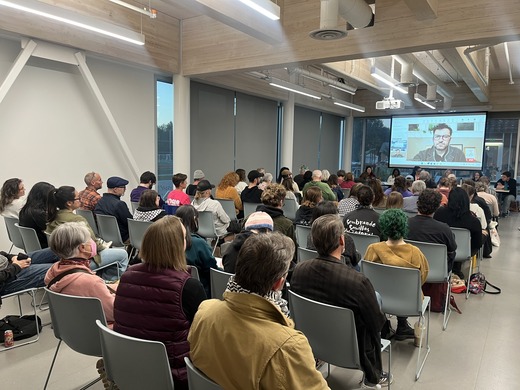
I spoke on a panel about technofascism that was hosted by Saint Paul City Council Member Hwa Jeong Kim. It was a fantastic conversation about surveillance technology, data, big tech, and civil liberties in modern cities. We discussed Flock cameras, drones, and more with a panel of government leaders, academic experts, and community organizers who are fighting for equity and justice in the context of modern technofascism. You can listen to an audio recording of the full panel here. Thank you so much to Council Member Kim for your leadership in convening this important conversation!
Technofascism community panel.
The annual Prospect Park Fall Market will be on Saturday, November 7 from 9 am - 3 pm at Prospect Park United Methodist Church. It features:
- Artisans selling wares such as pottery, quilts, fabric art, jewelry, cards & more
- Breakfast and lunch for dine in or to-go
- Silent auction of food items & art
- Fresh, homemade baked goods
- Free Kids’ Makers Room for grades Pre-K to middle school.
We hope to see you there for this great neighborhood tradition where you can find unique, locally made items! Bring your appetite and your holiday shopping list!
Prospect Park Fall Market
Saturday, November 7, 9am-3 pm
Prospect Park United Methodist Church (22 Orlin Ave SE)
Prospect Park Fall Market flyer
Students at the University of Minnesota are organizing to make UMN-TC a sanctuary campus, where students, faculty and staff are protected from the threat of violence and abduction by federal immigration enforcement. The UMN Young Democratic Socialists of America club invites all students, faculty, staff, alumni, and community members to sign the petition here.
Artist Martha Bird was struggling with her business. A consultant at Springboard for the Arts helped her keep moving towards her goals. She met with that consultant free of charge, thanks to the City of Minneapolis Small Business Team’s Business Technical Assistance Program (BTAP).
Watch a video on YouTube about how Martha got help.
Through BTAP, small businesses in Minneapolis can get up to 50 hours of no-cost help from expert advisors. BTAP consultants can help you in areas such as:
- Developing business, financial and marketing plans
- Meeting business licensing requirements
- Preparing legal documents
- Conducting day-to-day business operations
If you are starting or growing your business, you can get support through BTAP. More than 25 experienced service providers are part of the BTAP network. They speak different languages and have different kinds of expertise.
Visit the City website to find out if BTAP is right for you.
Summary: Mayor Frey vetoed the City Council’s attempt to maintain a dedicated mental health first response program while the program moves in-house. The Public Health, Safety and Equity Committee approved a legislative directive about how to bring the Behavioral Crisis Response (BCR) in-house with the same scope and focus.
Background: Last week, the City Council took action to protect the City’s extremely successful Behavioral Crisis Response (BCR) program. The City Council voted down the Frey administration’s proposal to fundamentally change the scope of the program, preventing mission creep and duplication of services. The administration’s proposal would have also created a gap in mental health response services, which would be unacceptable.
During the discussion, many Council Members also expressed a desire to see the BCR program transition from a contracted program to an in-house program. The City Council voted to enable the Frey administration to extend the current BCR contract to prevent a gap and ensure continuity of service while the transition in-house occurred.
Sadly, Mayor Frey chose to veto both of the City Council actions. The veto of the proposed new contract was purely performative. When the mayor vetoes the Council denying a contract, it does not mean the contract is approved. Approving a contract requires an affirmative vote of the majority of the City Council.
The current BCR contract expires on December 31, and the current policies state that the contract cannot be extended without a waiver. The City Council voted 11-1 to approve this waiver and empower the mayor to extend the current BCR contract because there was near-unanimous agreement that we need to maintain continuity of service in mental health response. Mayor Frey’s veto of this action is a refusal to accept a tool given to him by the City Council to prevent an avoidable operational crisis. Regardless of Council Members’ opinions on the long-term future of BCR, I hope the City Council will override this veto just to ensure that residents have high-quality mental services this winter while longer conversations occur. Mental health response is too important to be put in jeopardy and should not be used as a pawn for political games.
There was robust debate on this contract and the Frey administration provided inconsistent or contradictory answers on why they were proposing changing the scope of BCR. Despite that debate, Mayor Frey chose to make false statements to Kare 11 that the City Council is favoring a “preferred vendor” by denying the contract. This is demonstrably false. The City Council voted down the contract with Community Bridges, Inc., for several substantive and legitimate reasons. Numerous Council Members spoke about not wanting to change this model by moving forward with a contract that would move away from a mental health response to a model that responds to unsheltered homelessness and quality of life crises. Doing so could compromise the model and threaten the success it has had so far in responding to mental health crises. Council Members also cited concerns around an interruption of service that could result if we move forward with an out-of-state company not familiar with our city, in addition to the lack of a clear transition plan that would ensure a continuity of services that Minneapolis residents deserve and expect.
Many City Council Members also spoke extensively about how their opposition to the contract stems from wanting to see the program moved in-house, with no external contract at all. I authored a legislative directive along with Council Members Chavez, Stevenson, and President Payne to help the City Council and the public get a fuller understanding of the actions steps needed to bring the BCR program in house, as well provide an overview of a transition plan to ensure continuing of service for our residents while the City pursues an in-house pathway. The legislative directive was unanimously recommended by the Public Health, Safety, and Equity committee this week.
It’s clear through their words, through the legislation that has been brought forward, and through the votes that were taken that the City Council and its members do not have a preferred vendor and, more accurately, prefer that there is no outside vendor running this program at all.
I hope that Mayor Frey retracts his false statements and works with the City Council to bring BCR in-house. Making these types of false statements opens up the City to massive legal risk by inaccurately stating a contract was rejected for non-legal reasons. Council Members’ offices met multiple times with city attorneys ahead of these actions and have been well within their legal bounds to reject this contract. In fact, Council Members were told that voting down the contract would be the only pathway available for the City Council to have the conversation about a different scope for this contract and bringing the service in-house.
Bringing the program in-house rather than starting over with a new vendor also addresses findings from the recent independent audit, which was released on Monday October 19th. The audit found significant challenges to overseeing a contracted crisis response model for departments structured for direct emergency response. Bringing the program in-house will allow for the program to be a direct emergency response while also addressing the challenges the Frey administration faced managing the contract as outlined in the audit report.
BCR is one of the most successful things happening in the City right now and there is a widespread desire to see the current scope and focus maintained, and to eventually transition from an external vendor to an in-house program. The City Council has championed BCR for years despite repeated threats to its funding and contract. I remain committed to advancing this outcome.
Key votes: Mayor Frey vetoed the City Council’s denial of the contract with a new vendor for a new program that would replace BCR. The Mayor also vetoed the City Council’s action that would have allowed his administration to extend the current contract to prevent a gap in services. These vetoes will be considered at the City Council meeting on October 29th. Nine votes are required to override a veto. The Public Health, Safety and Equity Committee approved the legislative directive about bringing BCR in-house. The full Council will consider the item on October 29th.
Summary: The Public Health, Safety and Equity Committee held a public comment related to the City’s response to domestic violence related calls by Mariah Samuels.
Background: Mariah Samuels was a resident of Minneapolis who experienced domestic violence. She requested protection from MPD repeatedly and followed all the processes that victims of domestic violence are supposed to take for protection. MPD did not protect Mariah, and she was murdered by her former partner.
Mariah’s family and community have worked tirelessly to demand justice for Mariah and accountability for MPD. The City Council has requested an independent after-action review of the City’s handling of this case. This week, the Public Health, Safety and Equity Committee held a public comment period so that Mariah’s community could speak on the record about their continued demands.
I recommend everyone watch the public comments and discussion. Domestic violence claims too many lives and police forces around the country including MPD have failed to protect victims. I stand in solidarity with Mariah’s family and community and everyone impacted by domestic violence.
Key votes: No votes taken.
Summary: The Public Health, Safety and Equity Committee approved a legislative directive I authored about Automated License Plate Readers (ALPRs).
Background: Automated License Plate Readers (ALPRs) have become an area of concern across the country. The brand Flock Safety has drawn intense scrutiny for sharing data with the federal government for the purposes of immigration enforcement, and concerns around surveillance, civil liberties, and data security have caused jurisdictions around Minnesota to stop using Flock cameras. Here in Minneapolis, broad community opposition to Flock led the City Council to approve a resolution calling on the Hennepin County Sheriff's Office and University of Minnesota to stop using Flock.
However, Flock is only one brand of ALPR. Minneapolis residents have reached out to Council offices with concerns about ALPR use in Minneapolis beyond Flock. In light of this, Council Members Chavez, Stevenson and I authored a legislative directive requesting information about what kinds of cameras residents may see in public and the function of different cameras, and the data management practices governing each type. This information can help residents identify what cameras are and are not ALPRs so that there is a shared, accurate understanding of what technologies are in use in our city. The legislative directive also asks for an overview of the ALPRs in the City and how they are permitted and regulated. Lastly it requests updates on the administration's implementation of the recommendations from the independent MPD Biennial Automated License Plate Reader Audit.
I look forward to using the information in this Legislative Directive to help shape responsible policy that protects residents from surveillance. I also want to thank the residents who are subject matter experts in surveillance technology who met with my office and educated us, the questions we should be getting answers on, and what potential actions local government leaders can take.
Key votes: The Public Health, Safety and Equity Committee approved the legislative directive about ALPRs. The response is requested by February 1, 2027.
Summary: The Frey administration presented on Zero Waste to the Climate & Infrastructure Committee. The administration has not taken the initiative to implement Zero Waste outside of actions the City Council has advanced through funding. Due to this lack of political will, Minneapolis is not on track to meet our waste reduction goals, and we are not on track to meet the goal we adopted of closing the HERC by 2028.
Background: In 2024, the City adopted a position that the Hennepin Energy Recovery Center (HERC) should be closed by 2028. The HERC is a serious environmental justice problem that is harming public health in North Minneapolis. Trash produced in Minneapolis is burned in the HERC, and Minneapolis and other municipalities in Hennepin County must significantly reduce our trash in order to close the HERC in a responsible way. The 2017 Zero Waste Plan maps out extensive strategies that would reduce the City’s trash.
The City Council funded Zero Waste initiatives in 2025 and 2026, and adopted a Climate & Infrastructure Work Plan that made Zero Waste a top priority. The City Council has also approved several legislative directives requesting updates from the Frey administration on the progress on the Zero Waste Plan. This week, the Climate & Infrastructure Committee received a presentation on advancing organized commercial collection, one of the best avenues for ongoing funding for Zero Waste.
I was incredibly disappointed to see the Mayor’s administration has made very little progress on Zero Waste. The administration has not hired a Zero Waste Manager to lead implementation of the Zero Waste Plan. There is not an internal City work group on Zero Waste– something the mayor has used to support initiatives he prioritizes like downtown economic development. The mayor has not proposed using Climate Legacy Initiative funding to support expanded investment in Zero Waste.
As a result, Minneapolis is not on track to meet our waste reduction goals and we are not on track to meet the goal we adopted of closing the HERC by 2028. That is an unfortunate reality but we need to be sober about that fact. The administration has not demonstrated strong political will to advance Zero Waste outside of things the City Council specifically makes happen through funding. The City Council is going to have to be on clean-up duty for two years of inaction by the mayor’s administration since the adoption of the HERC resolution.
Zero Waste must be a major priority in the 2027 Budget. This week’s presentation stated that establishing an organized commercial collection fee as a Zero Waste revenue stream would take a minimum of 107 months, which is about 9 years. I believe we can do it a lot faster than that if we see political will from the Frey administration. But even if we cut that in half, it’s too long. If we aren’t going to have dedicated revenue for Zero Waste for several years, then we need to spend City resources to advance the work until we have that dedicated funding source secured.
The City Council must use the budget markup process to fully invest in every single Zero Waste strategy that we possibly can at the most accelerated timeline possible. The 2027 Budget is a crucial opportunity to turn things around and get back on track with waste reduction, and with our goals to close the HERC.
Key votes: No votes taken.
My office has remained involved in conversation with stakeholders about how to restore Evie/HourCar service. State Representative Katie Jones has taken the lead on organizing stakeholders and partners to save Evie/HourCar. This week I attended a meeting with Minneapolis and St Paul elected officials and staff to discuss and brainstorm opportunities. Rep Jones has been pounding the pavement in search of ways to fill the funding and operational gap left with the abrupt end to carshare in the Twin Cities.
Both cities continue working together to further clarify on the specific need (logistics, legal, financial) for renewed operations between now and June 2027 and for the longer-term if the state legislature were to pass a bill that identifies funding and a new carshare operator. We hope to share more substantive updates after we meet again in a couple weeks.
Summary: Council Members Chavez, Stevenson, President Payne and I are urging Mayor Frey to implement off-duty fees.
Background: For years, my colleagues and I have been urging Mayor Frey to use his sole authority over MPD to rein in off-duty work. Off-duty is when MPD officers work private jobs in security and keep the profits, but use vehicles and uniforms that taxpayers pay for. It is widely understood to undermine management, create opportunities for abuse, and not improve public safety.
My colleagues and I have been working for several years to regulate off-duty through charging fees to recover the taxpayer dollars that are used to subsidize MPD officers’ side gigs. Mayor Frey has refused to implement these fees, stating he plans to do so in 2027. This week, statements and documents from MPD revealed that the administration is not planning to implement the fees in 2027.
My colleagues and I wrote a letter to Mayor Frey and MPD leadership urging them to implement the fees. You can read the letter here.
Key votes: No votes taken.
Neighbors near 26th Ave S and 24th St E have been organizing for months to demand traffic calming at this dangerous intersection. These efforts were finally successful, with both the City of Minneapolis and Hennepin County involved in new lines being painted. This intersection will need significant investment in permanent traffic calming to be safe for every user, particularly children crossing to school and people going to Matthews Park. But it’s encouraging to see that persistent resident organizing has made some progress in making the area safer. Thank you to Seward neighbors for your leadership.
On the other side of Seward, Minneapolis Public Works will be installing traffic calming medians on 26th St E at 31st Ave S this fall. This project is part of the Neighborhood Traffic Calming program on City streets that receive Municipal State Aid (MSA). The locations were selected based on a review of unsignalized intersections along City MSA routes and then prioritized based on speed, traffic volume, crash history, pedestrian activity, T.E.P. Score, and engineering judgement.
Traffic calming medians are raised areas located mid-block or at intersections. Median benefits include reducing vehicle speeds and improving crossing safety. The construction of the medians starts on October 21st and is scheduled to be completed by November 6th.
The Minneapolis City Council is adding another way for community members to make their voices heard during the budget process. The City Council will host two informal listening sessions for residents to provide feedback on the Mayor’s 2027 recommended budget.
The dates for the upcoming sessions are:
- Thursday, Oct. 29
- Doors open at 5:30 p.m. Listening session from 6-7:30 p.m.
- University of Minnesota Urban Research and Outreach-Engagement Center (UROC), 2001 Plymouth Ave. N.
- Thursday, Nov. 5
- Doors open at 5:30 p.m. Listening session from 6-7:30 p.m.
- Whittier Elementary School Cafeteria, 315 W. 26th St.
Listening session format
The listening sessions will begin with a brief budget overview. Residents will then have an opportunity to ask questions or give their opinions to City Council Members. Community members wishing to address the City Council are asked to arrive 30 minutes before the session begins to sign up to speak, similar to public hearings held in City Hall. Space will be limited. All City Council members are invited to attend these listening sessions; however, since these are not official City Council meetings, quorum is not required. There will be audio recordings of these sessions for the public record.
Other ways to participate
Residents who can’t make it to one of these listening sessions can participate in other ways, including:
Contact Ward 2
Visit: minneapolismn.gov/ward2
Email: robin.wonsley@minneapolismn.gov
Phone: 612-673-2202
City Hall
350 S. Fifth St., Room 370
Minneapolis, MN 55415
For reasonable accommodations or alternative format please contact 311. People who are deaf or hard of hearing can use a relay service to call 311 at 612-673-3000. Para ayuda, llame al 311. Rau kev pab, hu 311. Hadii aad caawimaad u baahantahay, wac 311. |