|
We expand our community's capacity to grow and share food. |
|
Homegrown Minneapolis is a citywide initiative
expanding our community's ability to grow, process, distribute, eat and compost more healthy, sustainable, locally grown foods. |
|
Homegrown represented at international urban food policy conference
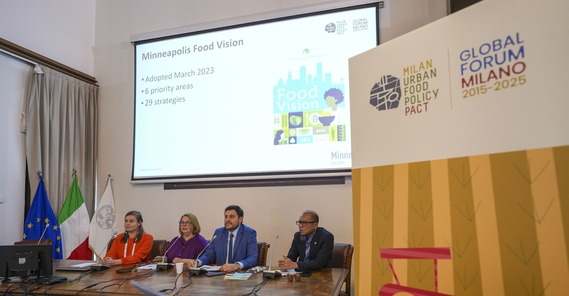
In mid-October Alison Babb, Homegrown Minneapolis manager, joined over 500 delegates from 130 cities at the Milan Urban Food Policy Pact (MUFPP) Global Forum in Milan, Italy.
Launched by the Municipality of Milan in 2015, the Milan Urban Food Policy Pact is an international agreement among cities from all over the world, committed to ‘developing sustainable food systems that are inclusive, resilient, safe, and diverse.’ Minneapolis signed the Pact in 2017, and the Minneapolis Food Vision was developed as part of Minneapolis’ Pact commitment.
“It was incredibly inspiring to learn from talented colleagues working to improve urban food systems all across the world,” says Alison.
Highlights of the Forum included:
-
Presenting on the CLIMATE CHANGE – Food Policies and the Climate Agenda: city experiences and urban/national collaborative policies panel
-
Attending a special session on the new 2025 EAT-Lancet Commission Report
-
Celebrating colleagues from three U.S. cities honored at the Milan Pact Awards
Thanks to the Natural Resources Defense Council (NRDC) Food Matters initiative for the generous sponsorship that made Alison’s attendance possible!
|
|
The Homegrown Minneapolis Food Council works to ensure an environmentally sustainable and socially just food system. These meetings are a great way to meet other community members and learn more about the work happening within our local food system. Every meeting is also accompanied by a food theme and attendees are welcome to bring food to share with others.
When: In-person meeting on Wednesday, Dec. 10 starting at 5:30 p.m.
Where: Powderhorn Park, 3400 15th Ave. S.
Agenda: At this meeting we will wrap up the consensus workshop we started at the November meeting around the question: What does success look like for the food council? We will then use the results of the consensus workshop to begin planning 2026 food council meetings. The meeting will conclude with announcements.
Food theme: Comfort – it's a blustery Saturday evening. You’re inside wrapped in a warm blanket. Your favorite show or movie is on TV. You’re eating one of your favorite foods. Everything feels nice and warm. At this meeting, we invite you to bring any foods that bring you comfort and warmth to share with others.
|
|
Farmers Markets of Minneapolis vendor information session – Jan. 7
Join the Farmers Markets of Minneapolis Collaborative to learn more about getting started at markets in the city. This online informational session will include an overview of each Minneapolis market, insights into their application processes, and a breakdown of City/State permits and licenses, as well as a Q&A at the end. Don't miss out on this opportunity to equip yourself with the knowledge needed for successful market participation!
-
When: Jan. 7, 5:30 – 7 p.m.
-
Where: Virtual
Tier 2 Cottage Foods Training with UMN – Jan. 16
-
When: Jan. 16, 8:30 a.m. to 4 p.m.
-
Where: Urban Research and Outreach Center (UROC), 2001 Plymouth Ave
Winter Farmers Markets – various dates
-
When: First and third Saturdays, 9 a.m. to 1 p.m.
-
Where: 704 S 2nd St
Minneapolis Farmers Market
-
When: Starting in Dec., it's open 9 a.m. to noon
-
Where: 312 East Lyndale Ave N
Neighborhood Roots Market
-
When: Jan. 10, 10 a.m. to 1 p.m.
-
Where: 6010 Lyndale Ave S
-
When: Dec. 7 and Jan. 4, 10 a.m. to 2 p.m.
-
Where: 1325 Quincy Ave
For more information visit City of Minneapolis Things to do
|
|
|
Open Arms: multiple positions
University of Minnesota, St Paul campus: Assistant Professor in Food Systems & Community Nutrition Extension Department of Food Science and Nutrition
The Food Group: Class B Driver
Food Connect Group: Midwest Regional Program Manager
Institute for Agriculture and Trade Policy: MinneAg Policy Intern
The Nature Conservatory: Water and Agriculture Director
|
|
Food Rescue Grant applications are now open – deadline Dec. 16
Funding is available to organizations to collect, redistribute, or process surplus food and redistribute it to people in need. Food security or food recovery organizations working in Hennepin County are eligible to apply. Selected grantees may receive up to $100,000, while organizations collaborating to develop an application based on a shared vision and project may receive up to $150,000.
MN Department of Agriculture - Urban Farm Conservation Mini-Grant – deadline Dec. 18
The MDA’s Urban Farm Conservation Mini-Grant program is now open for applications. This a flexible grant for people who farm or sell in an urban area or on Tribal lands. Urban farmers can apply for up to $5,000 to buy supplies, equipment and services that build out their farm while achieving conservation outcomes. Examples of what urban farmers purchased in the last round of this grant include:
-
Drip irrigation
-
Materials to build on-site composting system
-
Soil testing services
-
Specialty crop tools such as a paper pot transplanter
-
Shade cloth
-
Raised bed materials
Resources from National Healthy Soils Policy Network
The National Healthy Soils Policy Network recently launched a public resources page to share a sampling of the tools and strategies supporting farmer-led soil health campaigns across the country. This new public site now makes select materials accessible to the broader community.
-
A searchable library of toolkits, reports, and key articles related to healthy soils campaigns
-
An overview of healthy soils policy types and their strategic value
-
A directory of enacted state legislation establishing state Healthy Soils Programs as well as a directory of those programs
-
A curated list of “podcasts worth digging into”
-
A curated list of conferences and gatherings where soil health advocates can connect, learn, and strategize!
The W.K. Kellogg Foundation is inviting bold, community-driven ideas
This open, year-round opportunity supports organizations working to create a world where every child and family can thrive.
-
Focus Areas:
-
Early childhood education and family well-being
-
Maternal and child health
-
Food systems and economic equity
-
Racial healing and community leadership
-
Smaller/local grants: typically range from $50,000 to $250,000
-
Regional or systems-level grants: often fall between $300,000 and $1 million
-
Large multi-year initiatives or national collaborations: can exceed $2 million to $5 million
|
|

Homegrown Minneapolis launched its “86” Food Waste series to bring together local chefs, restaurant owners, and food leaders in tackling food waste through prevention and diversion strategies. The first event on October 20 focused on reducing waste at the source with insights from Toast, Laune Bread, and Nightingale. The event on November 17 featured Broder’s, Twin Cities Food Justice and Chowgirls Catering and highlighted food donation, composting and organics recycling, with demos and resources from Chowgirls and other City partners.
For more information on our efforts to help restaurants prevent wasted food:
Attorney General Ellison sues to block unlawful SNAP eligibility guidance
Attorney General Keith Ellison joined 21 other attorneys general in filing a lawsuit to stop the federal government from unlawfully cutting off Supplemental Nutrition Assistance Program (SNAP) benefits for thousands of lawful permanent residents. Attorney General Ellison and the coalition are seeking to block new guidance from the U.S. Department of Agriculture (USDA) that wrongly treats several groups of legal immigrants as ineligible for food assistance, including permanent residents who were granted asylum or admitted as refugees. The attorneys general argue that the guidance contradicts federal law and could impose massive financial penalties on states and are asking the court to declare the guidance unlawful.
State leaders say Minnesota food aid is 'still recovering' from federal shutdown
State leaders are raising awareness about the continued need for food aid, despite the federal shutdown ending earlier this month.
The 43-day shutdown — the longest ever in U.S. history — delayed food assistance and created confusion for millions of Americans who rely on the Supplemental Nutrition Assistance Program, or SNAP.
About 440,000 Minnesotans receive around $73 million in SNAP benefits every month, according to state data.
With the federal government reopened, Minnesota officials said there will not be any disruptions to SNAP benefits in December. People can continue applying for benefits, too.
Still, officials warn the hunger crisis is not over.
|
|
|
Homegrown News
We send information on food systems topics of interest to residents, employees, advocates, and eaters in Minneapolis. If this newsletter was forwarded to you, sign up to receive your own copy!
Subscribe to Homegrown News
Public Health Matters
Stay informed with important public health news and insights from the Minneapolis Health Department.
Subscribe to Public Health Matters
|
|
|
Homegrown Minneapolis brings together key partners from local government, area businesses, community organizations, non-profits, and residents to build a healthy, local food system.
Please contact Homegrown if you would like to suggest an item for the monthly Homegrown Newsletter.
For reasonable accommodations or alternative formats please contact 311 at 612-673-3000. People who are deaf or hard of hearing can use a relay service to call 311 at 612-673-3000. TTY users call 612-263-6850. Para asistencia, llame al 311. Rau kev pab 311. Hadii aad Caawimaad u baahantahay 311.
|
|
|
|
|