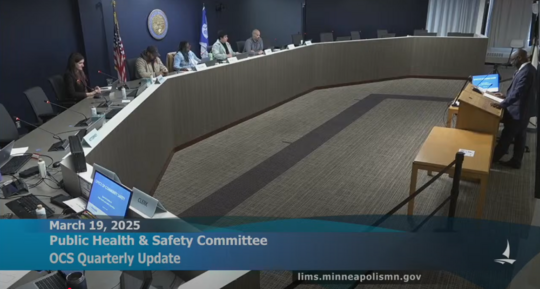
At the Minneapolis City Council’s Public Health and Safety Committee meeting on March 19, Community Safety Commissioner Toddrick Barnette and the Minneapolis Office of Community Safety (OCS) leaders highlighted how their combined mission to deliver a coordinated, comprehensive, and equitable safety services continues to make positive strides toward a safer Minneapolis. These steps taken in the first quarter of 2025 include developing new and innovative programs, recruiting and training staff, and ensuring accountability and transparency so the City can provide the right response at the right time.
“The vision we are working towards is a city where all people feel safe, social disparities are eliminated, and all residents can access opportunities and resources,” said Commissioner Barnette. “The updates today from the OCS departments highlight the important work we are doing, along with our partners within the Enterprise and community, toward that goal and I commend the innovation and collaboration that is helping us move our safety work forward in the right direction.”
Commissioner Barnette said that in the push toward a safer Minneapolis and the coordination of City and community resources, the City remains committed to meeting the requirements of the Settlement Agreement with the Minnesota Department of Human Rights. He reported that the independent evaluator, ELEFA, published its first bi-annual progress report, which highlighted the City's progress towards compliance. Commissioner Barnette added that the work of OCS and the City Enterprise continues to seek true, lasting change for the City when it comes to policing and community safety. Read the full story or watch the OCS quarterly update on the City's YouTube channel.
The U.S. Department of Justice filed a motion on March 19 to continue a pause on the Minneapolis Police Department’s pending federal consent decree. While the city of Minneapolis and Justice Department had reached an agreement before the new administration took office that would hold MPD to federal court-enforceable reforms, it has yet to be approved by a federal judge.
Not long after the change in administration, the new Justice Department filed a motion to put the case on hold. That was set to end Thursday, but the department filed another motion to stay the proceedings. If approved, that could keep the pause going for at least another month.
Read the news coverage
|
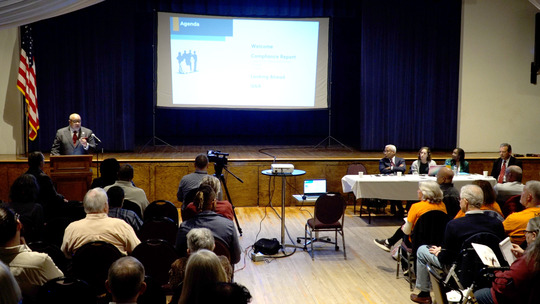 ELEFA, the independent monitor of the City of Minneapolis' settlement agreement, presented its first review period findings to nearly 100 people on March 12.
Effective Law Enforcement for All (ELEFA), the independent monitor group for the Minnesota Department of Human Rights (MDHR) settlement agreement with the City of Minneapolis, shared updates with community members at the Ukranian American Community Center on March 14. Updates were based on the group’s Independent Evaluator Semi-Annual Progress Review Report released on February 3. The report covered the review period from March 18 through September 30, 2024.
President of ELEFA David Douglass told attendees, “Minneapolis is actually further ahead in its first year than any other city we are aware of.” He also gave an overview of current tasks and MPD's progress on those tasks.
Lisa Fink, who serves as team lead for policies, underscored the importance of policy review to ensure they are clear and executable.
“What we found is that a much more collaborative and iterative process has developed to ensure that not only the policies get done, but they get done well,” Fink said. “MPD has really been working closely with both ELEFA and MDHR to discuss ways to improve policy language and to do our best to ensure that these policies reflect best practices, incorporate public feedback and allow for accountability.”
ELEFA will return to Minneapolis in July to update the community on progress of the review period from October 1, 2024 through March 31, 2025.
For more information about ELEFA, visit the ELEFA website.
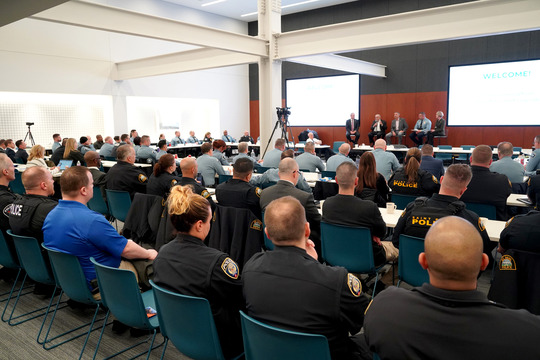 Chief Brian O’Hara welcomes representative of law enforcement partners from throughout the Twin Cities to a special panel discussion on March 5.
The Minneapolis Police Department hosted a unique event for law enforcement professionals across the metropolitan area on March 5. The event, Implementing Reform Measures and Changing Culture in Major City Police Departments, featured wisdom and experience of three former police chiefs who were part of significant change in their respective communities.
The discussion panel featured ‘Law Enforcement Legends’: Charlie Beck, former Chief of the Los Angeles Police Department and former Superintendent of the Chicago Police Department; Michel Moore, former Chief of the Los Angeles Police Department; and Charles Ramsey, former Commissioner of the Philadelphia Police Department and former Chief of the Metropolitan Police Department of Washington D.C.
Each weighed in on the Minneapolis Police Department’s work after the murder of George Floyd and acknowledged the challenges and positives from working under a consent decree.
“People remember the negative a lot longer than they remember the positive,” Ramsey said of community outrage to police-involved incidents. “Building trust is so fragile that it doesn't take much to break it. It takes years to build and, in some cases, one incident to break it.”
The panelists addressed the necessary changes to policing over the past few decades. They also spoke about stressful, worldwide news-grabbing situations they were involved in, including the LA race riots stemming from the beating of Rodney King.
The moderator of the panel was Cornelia Sigworth, Senior Director of Strategic Engagement at Axon and former Associate Deputy Director of the Bureau of Justice Assistance, US Department of Justice.
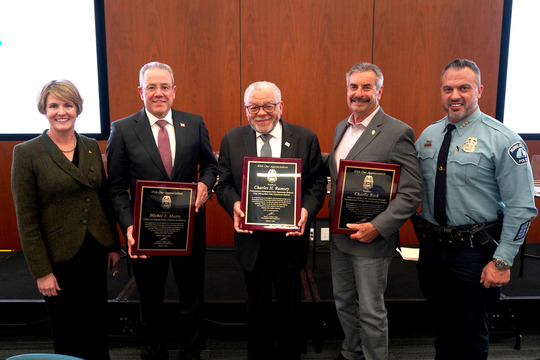 From left to right Cornelia Sigworth, Michel Moore, Charles Ramsey, Charlie Beck and Chief Brian O’Hara.
Reports of thefts, auto thefts, burglaries, assaults and drugs decreased from 2022 to 2024.
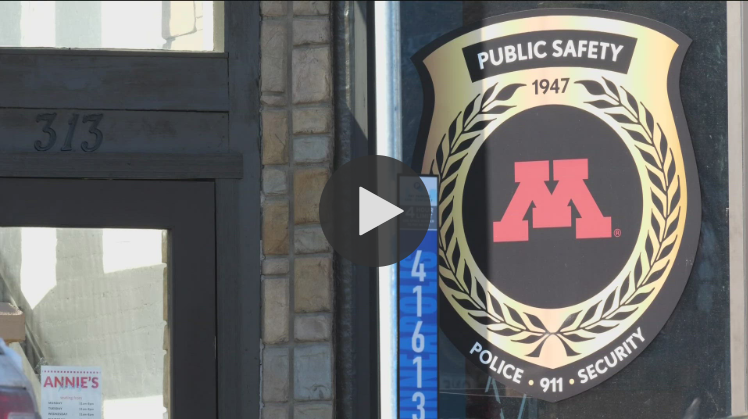 The Minneapolis Police Department (MPD) and University of Minnesota Police Department (UMPD) are extending their mutual aid response agreement another year, allowing UMPD officers to continue responding to emergencies in Dinkytown, including the areas between University Avenue Southeast and 4th Street Southeast, and Oak Street Southwest and I-35W.
According to data from UMPD, reports of thefts, auto thefts, burglaries, assaults and drugs have all decreased from 2022 to 2024. The biggest drop was in reported thefts, decreasing from 75 in 2022 to 30 in 2024, which is roughly a 60% decline.
Data from the Minneapolis Crime Dashboard shows "shots fired" calls in the Marcy-Holmes neighborhood, which includes Dinkytown, more than doubled from 2022 to 2023, jumping from six to 14, then dwindled back down to eight last year.
Six months ago, the university opened its first Off-Campus Safety Center on 14th Avenue Southeast, which provides a space for students to gather, study, ask for help and find safety resources.
Watch the news coverage
 The Community Safety Ambassador Program for south Minneapolis launches this May. (Image credit: Ava Weinreis, Minnesota Daily)
Minneapolis is expanding its use of community safety ambassadors in May to south Minneapolis near the Powderhorn Park neighborhood to improve safety and build community trust.
The Community Safety Ambassador is a pilot program in which ambassadors walk the streets and escort people between places to make them feel safer. They also help local businesses when asked and inform people of available social services. The ambassadors will be dispatched from the Lake Street Safety Center and the South Minneapolis Community Safety Center.
The ambassadors will also use de-escalation techniques, give Narcan during drug overdoses and apply CPR during medical emergencies, said Amanda Harrington, the director of community safety design and implementation.
Council Member Jason Chavez (Ward 9) said he and Minneapolis City Council President Elliott Payne (Ward 1) were inspired by the community safety ambassadors in downtown Minneapolis.
“This program already exists in downtown Minneapolis and we know that it is an effective program that keeps communities safe, it keeps our area clean and it helps people get around,” Chavez said. “We thought that if downtown could have access to these services, the rest of our cultural districts could too.”
Chavez said the program is part of a larger push for a comprehensive approach to safety in the city. He added that increasing safety ambassadors throughout the city will ease the burden placed on local police.
Read the news coverage
OCS In the News
|