|
Summary: The Public Health and Safety Committee is opening a public engagement period around the administration’s Safe and Thriving Communities Plan.
Background: Since the murder of George Floyd in 2020, city leadership and in particular Mayor Frey have pledged to do better, and to provide all of our residents with a public safety ecosystem that includes diverse services and programs to keep everyone safe, like our successful Behavioral Crisis Response program. In 2021, the former City Council took steps to make that promise a reality by commissioning the Leadership for a Networked World at Harvard University to create a blueprint for Minneapolis in how to move from a police-only system to a public safety system that includes a full range of preventative, responsive, and restorative services to meet the public safety needs of residents in an equitable and effective way.
Last summer, Mayor Frey presented the finalized report from Leadership for a Networked World, which is called the Safe and Thriving Communities Report. The detailed report included a ten year action plan broken down into 3 phases which would support the city in expanding and realigning our public safety services, and advancing preventative, responsive and restorative public safety services.
It is critical that the Mayor and his administration, the City Council, and the public are aligned on how to move forward on public safety, and the Safe and Thriving Communities report and plan is that uniting Northstar. This detailed action plan was written specifically to help Minneapolis to address underlying community needs and reduce reliance on police. This comprehensive plan lays out clear steps to advance a public safety system that goes beyond policing.
Since the Safe and Thriving Communities Report and Plan was published last year, there has not been an opportunity for residents to provide input and public comment on the vision it lays out and the actions required to realize that vision. Council is opening a forty-five day comment period for residents to share their thoughts and feedback.
During this time, the Council will also be asking the Mayor’s administration to share updates on what has already been completed, and any changes to the plan that they have made. That process began this week, with a presentation by the Department of Community Safety on their implementation of Safe and Thriving and their plans for the future.
This is an exciting opportunity to ensure that there is a democratic and transparent community engagement process on the City’s plan for public safety. This is something residents were promised in 2020, and have been waiting for serious engagement on ever since. The Public Health and Safety committee is excited to hear how the public responds to these proposed action steps and timelines, and welcomes their feedback. After the forty-five day public comment period and engagement sessions, feedback will be brought to the PHS committee for consideration.
This Council-led process gives the Mayor the opportunity to have Council formally adopt the plan that his administration has said is its blueprint for change. We are hopeful that he will take this opportunity by the fall to ensure we are entering into our budget deliberations with clear guidelines and expectations of what is needed to advance our public safety beyond policing goals in 2025.
I spoke with MPR about the plan and its role in advancing the city’s goals for public safety beyond policing. You can listen to that interview here.
Key votes: The Public Health and Safety Committee received a presentation on the Safe and Thriving Communities Plan. The Committee voted to open a 45-day public comment period on the plan. The Committee voted 4-0 to approve a legislative directive giving the administration the opportunity to update Council and the public on their implementation progress of the plan.
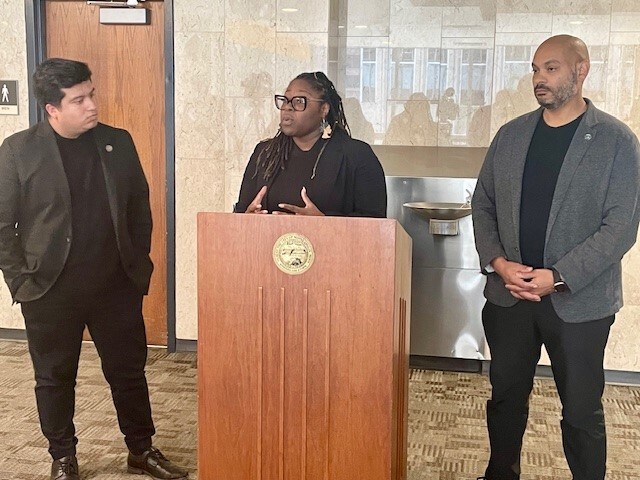
Public Safety Beyond Policing Action Plan press conference
Summary: Council received an update on the Behavioral Crisis Response program, which responds to mental and behavioral health situations, and how we can support the growth of this successful comprehensive public safety program.
Background: The Behavioral Crisis Response Team responds to mental and emotional health crises. They are available via 911. They can be dispatched without police if there is not an immediate danger, or with MPD or Fire if needed to ensure safety for the BCR responders. BCR has been widely celebrated since it was first implemented, winning national recognition and responding to over 10,000 calls in Minneapolis.
BCR presented an update on their services. They asked Council to support them in several ways: funding for the Neighborhood Safety Department (NSD) to purchase and operate a supervisor vehicle, strengthen NSD’s contract management infrastructure, spread community awareness about the program, and conduct a pay equity analysis for BCR responders and traditional first responders. I am strongly supportive of all these requests and look forward to working with my colleagues to make them a reality. I would also like to see the BCR contract changed from a 1-2 year period to a longer term period such as a 10-year contract to ensure that there is stability and security for the program, and more administrative and analysis staff support from the Neighborhood Safety Department.
Key votes: No votes taken.
Summary: The Public Health and Safety Committee asked questions about the MPD staffing study that was presented two weeks ago.
Background: At the last meeting of the Public Health and Safety Committee (PHS) two weeks ago, MPD presented an updated version of a staffing study. The meeting had a packed agenda and there were questions that Committee members did not have time to ask, so the conversation continued this week. You can read about the first presentation and conversation here.
I asked how the implementation of the Behavioral Crisis Response (BCR program) has impacted MPD response times. Chief O’Hara and 911 Director Jodi Hodne extensively praised the BCR program and its impacts on police response times and public safety overall. They both reaffirmed that expansion of the BCR program would be of significant benefit to the public. There was not available data on how frequently BCR and MPD co-responds versus how often BCR responds alone, nor was there data about how BCR has specifically brought down MPD response time. I requested a followup memo to obtain this important data.
The report had stated that up to 20% of calls in recent years could be diverted from police to other responders. I asked if any of that diversion had taken place, and if so which kinds of calls and how successful this had been. Staff shared that diverting traffic control calls to 311 had significantly reduced MPD call volume, although due to differing data systems in 911 and 311 there was not a specific number of reduction that they could pinpoint.
There were some concerning answers during the presentation that I hope will be further resolved through additional data analysis that MPD promised would be happening with the original contractors of the study. These included concerns about MPD not utilizing the staffing tool that was given to leadership, especially since staffing issues have been highlighted as a top concern for the department. The study strongly demonstrates each precinct and the city as a whole would be better served if there was a data-driven approach to how MPD staff’s each precinct and each shift.
I was also disappointed to hear that despite being given a significant amount of recruitment funding for “hard to fill positions” at MPD, the department did not utilize those funds for targeted recruitment for critical positions like the MPD arson investigator, which sat empty for several months.
We also had a fruitful conversation about the positive impacts of embedded social workers. Chief O’Hara shared that social workers have been a huge asset to the public safety system, particularly in reducing repeat calls. Anecdotally, MPD has been consistent that social workers help reduce the number of calls they have to handle, but there is no data available that captures that impact. I emphasized that the updated staffing study should include some metrics regarding the impacts of social workers.
Similarly, Chief O’Hara shared that unarmed violence prevention teams have been an incredibly valuable addition to the public safety system. These professionals have prevented uncounted numbers of conflicts from escalating to the point where they require a police response. However, there is no data available to specifically quantify this impact. This underscores the need for adequate staffing at the Neighborhood Safety Department to ensure that we can quantify the returns on the city’s investment in violence prevention programs.
Key votes: No votes taken.
Background: The Administration and Enterprise Oversight (AEO) Committee received a presentation about what the Mayor’s administration has done to improve hiring practices for public safety employees.
Last year, I authored a legislative directive to learn what the Mayor’s administration is doing to ensure that the city is recruiting high quality candidates for public safety positions. I was motivated to ask these questions after MPD restructured and promoted numerous officers with histories of misconduct, and there was a highly publicized media expose about MPD’s intention to hire an officer who had engaged in gross misconduct and brutality. I wanted to understand why, despite the extreme scrutiny the city is under as well as two consent decrees looming, MPD would so boldly continue questionable hires and promotions.
HR presented that they are attempting to strengthen background checks stating “MPD background investigations include full review of employment history, including prior complaints and discipline.” This does not make me feel confident, as MPD has always looked at these things as part of their background investigation process, yet proceeds with problematic hires nonetheless.
HR presented that “Currently, policy violations are reviewed on case-by-case basis, considering severity, facts, and potential for correction and prevention.” I find this deeply concerning, because the city’s failure to be clear and consistent in disciplinary standards is how problematic officers have been able to circumvent accountability. There have been numerous documented cases in which when MPD finally attempts to discipline an officer, they use the grievance process to claim selective enforcement and evade discipline.
I inquired about the possibility of implementing a zero-tolerance policy to make it clear to the public, potential applicants, and current employees that there are severe consequences to breaking the city’s anti-discrimination, harassment, and retaliation policy. HR shared that zero-tolerance policies have had a chilling effect on reporting violations, because many employees do not want to report a colleague and be responsible for their termination.
While I appreciate this presentation, I have many outstanding concerns about the administration’s hiring practices especially as it pertains to ensuring that all new police officers and other public safety workers have reputable backgrounds, contribute to a positive work environment, and deliver high quality services to residents.
Key votes: No votes taken.
Summary: The Administration and Enterprise Oversight (AEO) Committee received a presentation about what the Mayor’s administration has done to improve workforce culture at the city.
Background: Staffing challenges impact many critical city departments. There have also been incidents where community groups asked Council to take action to improve workforce culture at the city.
The Administration and Enterprise Oversight (AEO) Committee made it a priority to identify the root causes of the city’s recruitment and retention challenges and find ways to use Council authority to help improve the city as a workplace. The AEO Committee 2024-2025 Work Plan includes two priorities that reflect this: “Improving hiring and retention in all departments using a data-driven approach” and “Evaluating enterprise-wide and department-specific attrition and addressing the root causes using data from workplace complaints, exit interviews, recent audits, and reports to improve workplace culture and reduce turnover.”
In line with these priorities, I authored a legislative directive in February asking the administration to share what steps they have taken to improve workforce culture. This information was supposed to be presented to the Council in April. Mayor Frey wrote Council a memo claiming that asking for this basic information was “geared towards sowing discord.” It is confusing and concerning why the Mayor chose to characterize Council efforts to improve the city’s workforce culture this way. Undeterred by the Mayor’s statements, Council Member Koski brought forward a number of very helpful changes to the directive that strengthened and expanded the information being requested of the administration. This amended version of the directive was approved by Council in April and was supposed to be presented to AEO in June. Due to scheduling issues, the AEO Committee received that presentation this week.
The presentation includes several updates on recruitment efforts and added capacity within HR, but it did not include any changes to MPD practices and policies that are geared toward retention. In particular, MPD has a problem with dozens of officers leaving the department with workers’ compensation claims, many for PTSD. This is clearly indicative of a dangerous and negative workplace, yet there were no specific actions that the administration could share they had taken to diminish this workplace hazard and improve workplace culture at MPD, stating “there are a lot of things we have not done as well as we could have” and “we have a lot of information but we don’t often look at it and figure out what it’s telling us.”
HR shared a new one-day class to help MPD leaders use coaching more effectively as one new tool that is being used to improve workforce culture. I asked what is being done to rein in MPD’s improper use of coaching when there needs to be discipline. MPD has not involved HR in any actions to reform their use of coaching.
HR shared that department leaders are required to report complaints promptly to the appropriate department head or to HR, and for department heads to take necessary action when a complaint has been received. I asked if there is a specific required timeline for a department leader to take action after a complaint is seen or they witness inappropriate behavior, and HR shared that there is not. This appears to be a gap that should be addressed so standards and expectations of the city are clear to all department heads and leave few questions about the process.
HR presented about the additional support given to Employee Resource Groups (ERGs). ERGs provide professional and personal support to employees who share a common background or interest. ERGs include Minneapolis American Indian Network (MAIN), Minneapolis Black Employee Network (MBEN), Minneapolis Immigrant and Refugee Alliance (MIRA), Military Employee Recognition, Influence, Culture and Attitude (MERICA), Sexual Orientation & Gender Identity (SOGI), ¡SOMOS!, and Women of Minneapolis Employee Network (WOMEN). These ERGs lead important diversity work at our city, including supporting marginalized employees and planning events for all city employees to participate in. My office has heard consistent concern from staff who participate in ERGs that their feedback on the needs of diverse city employees is not being taken seriously by the administration. There is also an ongoing challenge managers not taking consideration of the workload of those leading in ERGs without compensation. HR did not have any concrete ways that they are supporting ERGs.
HR’s presentation stated that “The number of complaints handled by the HR Investigative Unit has steadily increased over time. In 2022 they were 39% higher than 2021, and in 2023 they were 38% higher than 2022. HRIU is already on track to exceed 2023 complaints by 52%.” It is incredibly concerning that 2024 complaints are on track to exceed the year before by over 50%, especially if these complaints are reflective of the presented trends that employees' top concerns are related to gender and race discrimination, misconduct, and unethical activity. HR shared that they believe the increased number of complaints is a positive sign that employees trust HR and the investigative process enough to report acts of discrimination.
Key votes: No votes taken.
Summary: Council is being asked to approve another $1.4 million in workers compensation to MPD officers.
Background: The Administration and Enterprise Oversight (AEO) Committee was asked to approve another ten workers compensation claims from MPD officers, totaling another $1,400,000 of taxpayer money. As I’ve stated before, I vote against these worker compensation cases because Council and the public do not have assurance that the city is doing its full due diligence in challenging cases to ensure that every single claim that comes before Council is legitimate. Council has been asked to approve numerous workers compensation claims to officers with histories of lying on the record. I do not believe in rubber stamping expenditures of taxpayer money, and these workers compensation claims are a major drain on the city budget, costing over $33 million in the past five years. Until there is more clarity that these cases are being fully and robustly vetted, I will continue to oppose them.
Key votes: The Administration and Enterprise Committee (AEO) votes 5-1 to approve another 10 MPD workers compensation settlements costing taxpayers another $1,400,000.I was the only vote of opposition. Council will vote on the settlements next week.
Summary: Council received a presentation on what the city is doing to support immigrants and displaced populations.
Background: I authored a legislative directive about what the city is doing to support immigrants, refugees, and displaced communities who are coming to Minneapolis. Earlier this summer, city staff coordinated a Policy Roundtable in response to the legislative directive that brought together city, county, state, and nonprofit service providers to discuss the landscape for services and where there are gaps and challenges.
This week at the Administration and Enterprise Oversight (AEO) Committee, staff presented more about how a variety of city departments currently serve immigrants and displaced populations. It included presentations on renter protections, civil rights, and immigrant and refugee affairs. I recommend watching the presentation to hear directly from the city staff themselves. The recording starts at 1:15:00.
I look forward to using the valuable educational opportunity provided by these presentations to work with my colleagues and community members to ensure that our city is supporting displaced populations, and ensuring that working class communities are not pitted against each other for social services and resources.
Key votes: No votes taken
Summary: Renters rights ordinance is one step closer to passing!
Background: I am authoring an ordinance requiring that landlords make basic disclosures to prospective tenants before they sign a lease, as well as to all new tenants who have signed a lease. You can read the full ordinance here and read more about the impacts of the policy here.
The Business Housing and Zoning Committee (BHZ) held a public hearing on the ordinance, and Council has received written public comment on the policy for several weeks. There are several repeated misconceptions that I have heard about the ordinance, particularly concerns from landlords about the impacts of the police. You can read answers to these Frequently Asked Questions about the policy here.
I am working with my colleagues to bring a series of technical amendments and improvements to the policy at the next BHZ meeting. I look forward to the ordinance moving through the legislative process for approval in August.
Key votes: Business, Housing and Zoning Committee will amend the Renters Rights Mandatory Disclosure Ordinance on August 6th. The Council will vote on the ordinance on August 15th. Residents can continue to submit comments in writing to CouncilComment@minneapolismn.gov until the final vote.
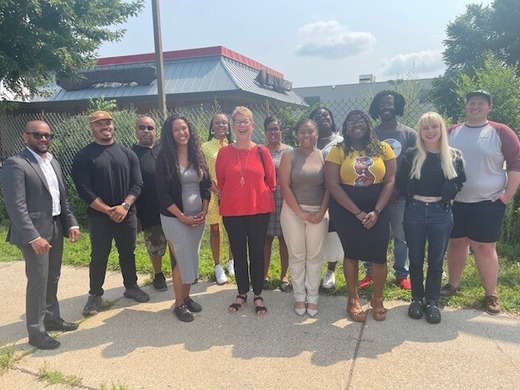
Community leaders gathered to celebrate the passage of an ordinance enforcing higher fines on buildings that have been vacant and hazardous or condemned for multiple years. I authored this ordinance along with Council Member Ellison after hearing from many residents that vacancy and in particular hazardous properties are a huge priority in their neighborhoods.
We gathered outside the abandoned Burger King on West Broadway, a property that is emblematic of the vacancy problem in the city. Residents spoke about how this ordinance will improve racial equity and commercial development, free up more housing units, and overall make our city a more pleasant and equitable place for all. I am so excited to continue working with this coalition to reduce all forms of vacancy across our city.
Community leaders celebrate passage of hazardous building ordinance
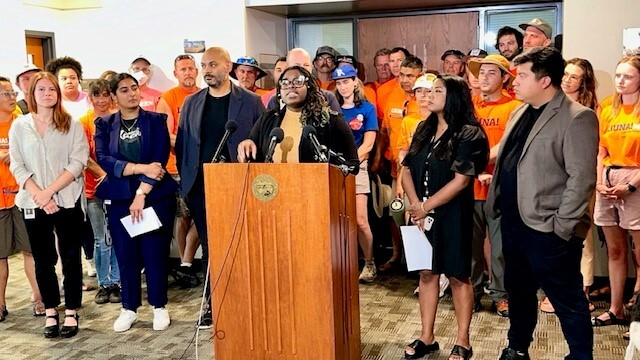
Park workers represented by LiUNA have reached a tentative agreement with the Parks and Recreation Board after being on strike for three weeks. I am so proud to have authored a Council resolution supporting these workers and urging both parties to bargain and reach a fair contract. Solidarity with parks workers!
Parks workers hold press conference prior to Council passing a resolution of support
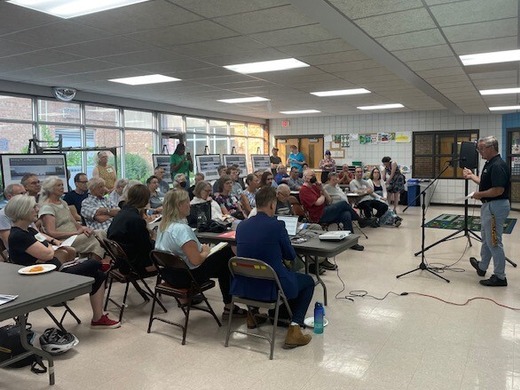
My office attended a community meeting hosted by the Seward Neighborhood Group at Matthews Park to learn more about the Rethinking I-94 project. It was standing room only with over 50 neighbors in attendance. Residents asked great questions to the MNDOT representatives who presented. Thank you to the SNG Environment Committee for creating this productive conversation and to MNDOT for spending time educating neighbors about the process.
Seward Rethinking I-94 meeting
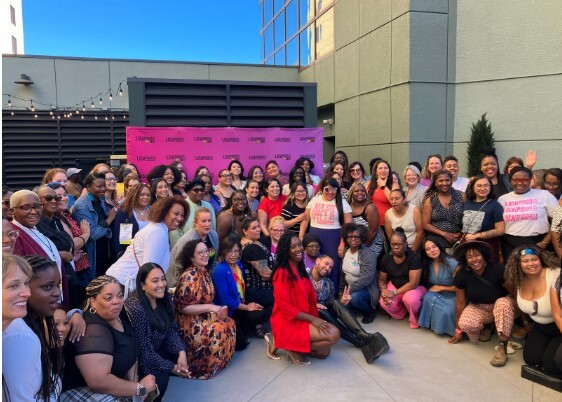
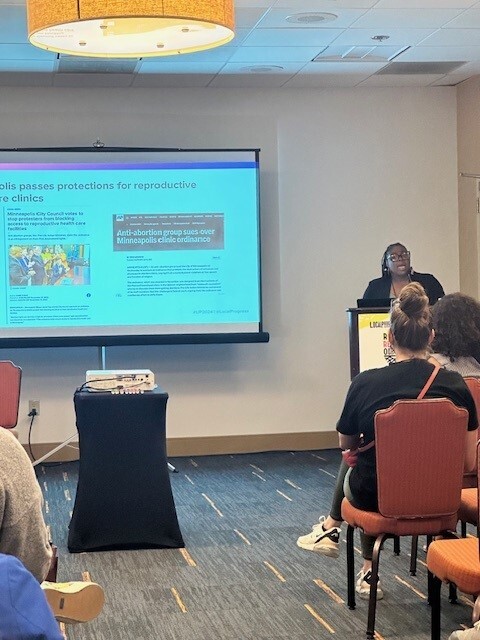
I was honored to speak on a panel hosted by the National Institute for Reproductive Health at the Local Progress Convening about what city and local governments can do to support abortion access and reproductive freedom. Last year, Council Member Chughtai and I worked with Hennepin County to create an abortion access fund. As attacks on abortion and reproductive freedom escalate across the country, cities have the opportunity to defend reproductive freedom.
Abortion for All: Exploring the New Era of Abortion Politics panel
In the upcoming days, crews will need to close a section of Fourth Street to all traffic, as well as a section of 15th Avenue.
Here's what you can expect:
- Beginning Wednesday, July 24, 15th Avenue SE will be closed between Fourth Street and University Avenue. It is scheduled to reopen in late August.
- Beginning Monday, July 29, Fourth Street will be closed for two weeks between Oak Street and 17th Avenue SE. This includes crossings and intersections. When Fourth Street reopens on Friday, August 9, it will be restricted to a single lane between Oak Street and I-35W through fall.
Additionally, these intersections will remain closed through late August:
- The southbound lane of 13th Avenue SE on the north side of Fourth Street will remain closed to traffic. All lanes 13th Avenue SE on the south side of Fourth Street will remain closed to traffic.
- All lanes of 10th Avenue SE on the north side of Fourth Street will remain closed to traffic.
Pedestrian and bike access will be maintained whenever possible, and will be detoured around the work area when necessary.
Expect major delays when traveling in the construction area. Plan an alternative route or allow extra time.
Contact Ward 2
Visit: minneapolismn.gov/ward2
Email: ward2@minneapolismn.gov
Phone: 612-673-2202
We've moved while work is being done in City Hall. Our office is in:
Room 100, Public Service Center
250 South 4th St.
Get directions
For reasonable accommodations or alternative format please contact 311. People who are deaf or hard of hearing can use a relay service to call 311 at 612-673-3000. TTY users call 612-263-6850. Para ayuda, llame al 311. Rau kev pab, hu 311. Hadii aad caawimaad u baahantahay, wac 311. |