 April 8, 2022

Dear Colleagues,
My message to you is one of encouragement and hope. With the right mindset, I believe we will accomplish great things together! This month’s In Focus deals with our Child and Family Services Review, and the work we need to do regarding stability of placements and appropriate permanency goals. I am certain that with vision and determination we can do more than meet these standards - we can become a model for the country. We’ve got great people with a sense of mission who will make this happen. Be encouraged!
As many of you might know, I have been going around the state having “Vision Talks”, and listening to all of you as you put your comments in my “Vision Box”. I am greatly heartened to hear your thoughts. Yes, we have challenges, but we also have a profound sense of purpose that keeps us moving forward. You have also been very receptive of the message I have been sharing with you. I have encouraged you to help people, do no harm, follow the law, listen to people, embrace the probate code, rethink "best-interest", avoid group-think, follow the golden rule, pursue excellence, and fear not/have hope.
I sense a great readiness, even a hunger, to do these things. What will happen when we do? Certainly, we will be able to meet the standards of the Child and Family Services Review, but I believe we will do even more than that. I believe we will establish terrific practice, build a vigorous and helpful culture, and do outstanding work. We will succeed!
I want to thank all of you for the warm welcome I have received since my arrival at Children’s Division. I am expecting great things for the future. I look forward to working with all of you as we fulfill our mission to empower families to live safe, healthy, and productive lives.
Take care,
Darrell
|
JoDene Bogart, CFSR Coordinator
The Child and Family Services Review (CFSR) is a review process that partners federal and state governments to assess conformity with national child welfare requirements. It's an opportunity for us to look in-depth at our casework practice, and see what is happening with the children and families we serve, and to identify strengths and areas for improvement.
Missouri’s Round 3 CFSR concludes on April 30, 2022. Since Missouri’s last CFSR case review in July 2017, we have made many exciting accomplishments, including:
- The Permanency Attorney Initiative (PAI) was developed as a Program Improvement Plan (PIP) strategy and has been a valuable addition for circuits with access.
- The Partnership for Child Safety and Wellbeing provides opportunities for CD team members in the Central Office to communicate with court and juvenile office personnel around permanency for children.
- Expanded involvement of non-resident and non-custodial parents in all cases. Family-Centered Services (FCS) cases were added to policy to ensure safety network support includes all parents, as appropriate.
- A pilot project for pregnant and post-partum mothers with co-occurrence of substance use and mental health challenges was started in partnership with the Department of Mental Health in the southwest area of Missouri, keeping children with their families who might have otherwise entered foster care.
- Initial child welfare practice training was consolidated and made consistent throughout CD and foster care management agencies.
- A new case review process was designed, developed, and implemented to assess casework practice.
- 8 of the 10 CFSR items that are monitored through the case review process have been met.
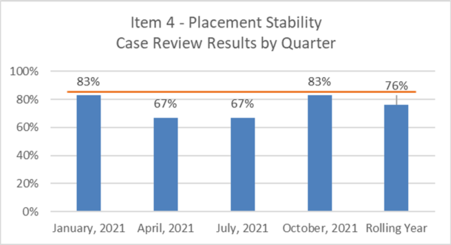
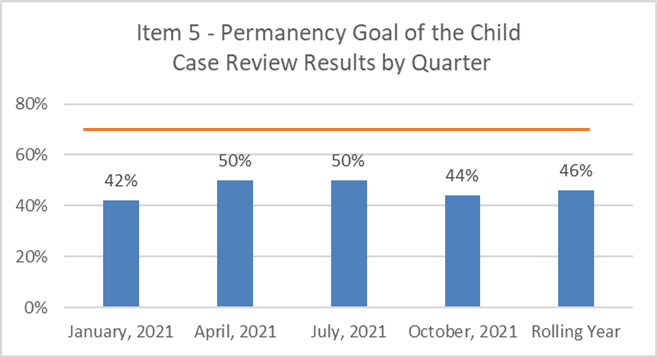
There are a few more steps before CFSR Round 3 is completed. We have one more set of case reviews that are happening right now. This is the final opportunity to reach the measurement benchmarks for Item 4 (Placement Stability) and 5 (Permanency Goal for the Child). The chart outlines our current progress toward those goals. Should the benchmarks not be reached, Missouri will incur fiscal penalties until they are successfully met in CFSR Round 4. The current penalty is more than $700,000, to ensure focus on maintaining and stabilizing placements, making sure permanency goals are appropriate, and staying on top of Adoption and Safe Families Act (ASFA) guidelines for timely Termination of Parental Rights (TPR) filings. They’re also the right things to do for kids!
 |
 |
Because Missouri is one of the states that might be in penalty, we will have our Round 4 CFSR review earlier in the process with the next round. This gives us the opportunity to meet the goals sooner and to suspend the financial impact.
There are not many firm details about Round 4, but we do know it will be held in the late summer or early fall of 2023. We will work with our federal partners in the upcoming months to solidify the date and identify circuits to host the case reviewers. The period of casework practice to be reviewed could begin as early as June 2022. CD policy provides good structure for ensuring the safety, permanency and wellbeing of children and families. Every child deserves our best work!
Vickie Stoneberger, Program Specialist
When meeting with families, it is important to ask questions that focus on the solution to help motivate them in their steps towards reunificaiton:
- Where would you suggest I begin looking for an appropriate placement for your children until you are able to have them back in your home?
- Can you think of a relative or friend that lives close by that I can reach out to for you to ask if they would be a placement for your children?
Adrienne Williams, COA Coordinator
CD is currently in the application process to begin the 4th round of reaccreditation through Council of Accreditation (COA). Once the application process is completed, CD will learn more about the timeline for COA site visits. Site visits are typically held every 4 years; and, therefore, Central Office could participate in a site visit as early as December 2022. Each region would then follow with a separate site visit, typically spread out over 18 months. Prior to each of the site visits, CD will be required to submit Self-Study and On-Site Evidence.
COA reaccreditation requires that CD integrate standards of best practice into our policies and procedures. COA has several 2021 Standards related to CFSR Items 4 (Placement Stability) and 5 (Permanency Goal for the Child). Here are just a few:
Public Agency Child & Family Services (PA-CFS) 12: Child Placement
PA-CFS 12.05: The agency promotes the stability of children’s living environments & prevents the need for placement changes through coordinated placement planning that:
- Ensures children, families, resource families, & residential treatment providers understand the steps involved in the process for a child joining a new living environment, and that they receive support and information throughout
- Provides all legally permissible information about each child’s characteristics, behaviors, histories, physical and behavioral health needs, and permanency goals to prospective resource families or residential treatment providers
- Ensures that resource families and residential treatment providers make an informed decision to accept children into their care
- Arranges opportunities for children and parents to meet prospective resource families or visit residential treatment providers, when possible
- Proactively assessing needs and arranging necessary services, supports, or interventions to preserve the placement when in the best interests of the child
- Permits children transitioning from treatment or foster care to remain in their living environment when possible and appropriate
- Facilitates workers’ ability to spend more time with children, families, and resource families or residential treatment providers after children first come into new living environments or when challenges arise
-
Interpretation: Regarding the 2nd bullet point, information related to children’s behaviors and behavioral health needs should be prepared or delivered by qualified personnel who can provide a clinical and developmental perspective, including information about the child’s previous living environments and trauma history, and their relevance to the child’s current and previous behaviors and functioning. This could also include consulting the child, when appropriate, about the appropriate level of detail to be shared with prospective resource families concerning the child’s traumatic experiences.
PA-CFS 12.07: The appropriateness of children’s placements is reviewed regularly, and changes occur to support children’s best interests and permanency goals, as needed.
-
Interpretation: In treatment foster care, when placements are reviewed in connection to changes to the child’s assessed level of care, placement decisions should be based on the child’s treatment progress and present needs rather than length of stay, and agencies should explore strategies for maintaining placement stability when indicated.
-
Examples: Changes that support children’s best interests and permanency goals might include moving from a foster family to an adoptive family, moving from a foster family to a kinship family, or other changes that bring children closer to family or community.
PA-CFS 13: Child Permanency
PA-CFS 13.04: Permanency plans document permanency goals, why goals are in the best interest of children and their well-being, why other permanency options are not appropriate, and how service plans & identified interventions support permanency and child well-being.
-
Interpretation: State regulations may require obtaining the child’s consent when guardianship or adoption is pursued. However, when the case involves an American Indian or Alaska Native child, such regulations may also be superseded by the Indian Child Welfare Act, wherein consent is not required.
Crystal Epley, Program Development Specialist
- Staff are no longer required to leave a Newborn Crisis Assessment open for 20 days. An update was sent out with the Central Consultation Unit Policy Memo CD22-06 found on the CD Intranet Home Page.
- There is a struggle finding placement for children with aggressive behaviors or, those who are lower functioning. CD has been working with a facility that opened in March. There will be 16 available placements for emergency situations while long term placement is being sought. Staff will need to make a referral through the Residential Care Screening Team (RCST) Coordinator.
- Adult casework experience has been included as qualified experience when applying for positions within CD.
- While Circuit Managers are not able to claim overtime, the compression gap with Circuit Managers has been resolved.
- Comp time is able to be paid out quarterly while the funds are available for the fiscal year. If staff do not want their time paid out, please email Christy Kempker directly at Christy.L.Kempker@dss.mo.gov. Staff need to ensure that their comp time is being entered weekly if they are unable to flex out their time.
- The IT department determines which web browsers are usable within the agency. If there are any forms that are not compatible with a web browser, please email Cynthia Hull at Cynthia.L.Hull@dss.mo.gov with specific information. Additionally, the Permanency Unit is reviewing Alternative Care forms to ensure they are up-to-date and will send out Practice Alerts or Memos as needed.
- Visits with parents need to occur weekly with the assigned worker within the first 30 days of a child entering care. Thereafter, the parents should be seen a minimum of one time per month to complete the Initial Family Assessment, Social Service Plan and attachments if necessary. If parents are located out of state, virtual contact or phone contact with quality conversations are required. This includes discussing services for behavioral changes, child’s wellbeing, and case plan. Data reports are generated to create opportunities to explore case work practice and enhancement opportunities.
|