|
Partners,
I recently had the opportunity to speak at WashU to a group of public health partners and colleagues about building sustainable public health infrastructure in Missouri. As I told the group, Missouri faces significant public health challenges, but I believe we also have an opportunity to reshape and strengthen the systems that support health across the state. While Missouri continues to struggle with poor health outcomes, progress is possible through stronger partnerships, strategic investments and a renewed focus on prevention.
Missouri ranks below the national average on many key health indicators. Approximately 16.6% of adults report fair or poor health, compared with 13.9% nationally. Chronic diseases remain more prevalent in Missouri, and tobacco use continues to be a major contributor. Missouri's adult smoking rate is about 14.7%, significantly higher than the national average of 10.9%, while the state's cigarette tax remains among the lowest in the nation. Reducing tobacco use could improve both health outcomes and long-term healthcare costs.
Despite the challenges, there are signs of progress. Missouri's healthy living ranking has improved from 42nd to 39th nationally since 2023, and life expectancy has rebounded by roughly 2.5 years following declines seen over the previous decade. However, Missourians still live approximately two years fewer than the national average, highlighting the need for continued action.
During my presentation, I talked about how improving health outcomes requires more than simply increasing funding. While additional resources for prevention and health promotion are needed, meaningful improvement will depend on changing how organizations work together, reducing duplication, and focusing on long-term system transformation rather than short-term fixes.
Enter "Project Reimagine," an initiative I’ve talked about here in the Director’s Message several times. Project Reimagine was designed to evaluate our department’s programs, identify core public health functions and modernize the department's structure. The effort emerged as state and federal funding conditions changed rapidly in 2025, prompting us to assess how services can be delivered more effectively. Part of that modernization includes a reorganization centered on two major focus areas: Health Improvement and Health Protection. Health Improvement will bring together programs focused on healthy living, nutrition, access to care and data analysis. Health Protection will combine communicable disease programs, immunization efforts, laboratory services and emergency response functions. We believe this structure will better align resources with the department's mission of improving health and safety for all Missourians.
I also highlighted the important role of Missouri's 115 local public health agencies which provide critical services including communicable disease control, immunizations, food safety inspections, environmental health programs and more. However, capacity varies significantly from one community to another. Some agencies have robust staffing and resources, while others operate with limited personnel and funding. As a result, public health services can vary considerably depending on where Missourians live. According to the state's Foundational Public Health Services assessment, 55% of local public health agencies do not currently meet minimum foundational capabilities, and one-third are unable to provide all foundational program services. Strengthening these core capabilities is essential to ensuring access to public health functions across Missouri.
Funding remains a major challenge. While the department's FY27 budget totals approximately $2.2 billion, much of that funding supports Medicaid home and community-based services. After those obligations are met, only a small portion of general revenue remains available for broader departmental operations, and roughly half of that amount is used to secure federal matching funds. Missouri also ranks near the bottom nationally in public health spending per capita, underscoring the limited resources available for prevention and health promotion efforts. At the same time, governmental public health represents only one part of a much larger public health ecosystem. Health outcomes are influenced by healthcare providers, schools, employers, community organizations, researchers, transportation systems, housing partners and other sectors. The most effective solutions often emerge when these groups work together around shared goals.
As we have discussed among many of you recently, it is time to shift toward mutually delivered public health in Missouri. This is a model built on coordinated action, shared priorities and strategic collaboration. Instead of working in silos, organizations would align efforts, share data and resources, reduce duplication and focus collectively on improving health outcomes. While Missouri's challenges are substantial, we believe the state can build a healthier and more resilient future for all Missourians.
I hope you enjoy learning from different areas from our department below.

Division of Community & Public Health Spotlight: Communications with Local Public Health
Daniel Bogle, DCPH Director
Director Willson is reviving the Director’s Advisory Committee (DAC) for Local Public Health, which provides a formal advisory body to directly integrate LPHA perspectives into our state-level strategic planning and decision-making processes. Consisting of nine peer-elected regional representatives, the committee will co-create actionable policy recommendations, mobilize joint state-local workgroups to tackle systemic infrastructure challenges, and collaborate to improve service delivery statewide. The DAC will be instrumental in building up our mutually-delivered public health system and creating formalized conduits of communication between DHSS and LPHAs. The inaugural meeting for the newly formed advisory body will be held this November.
Additionally, in the month of October the DHSS Center for Local Public Health Services (CLPHS) hosted four of their five scheduled fall regional meetings for local public health administrators. These annual meetings are hosted across Missouri to bring colleagues together, encourage collaboration, share information, and discuss issues and opportunities impacting local public health agencies throughout the state. The regional meetings take place in the northeast, northwest, southwest, and southeast regions, with the central region meeting scheduled for the first week of November. This regional approach provides opportunities to connect with administrators in different areas of the state while creating a space for meaningful conversations and the sharing of ideas, experiences, and best practices. Topics included building a healthier and stronger public health workforce, updates to DHSS oral health programming, information from the Missouri Public Health Institute, and seeking perspectives and feedback from local agencies on vaccine preventable diseases. Many thanks to our partners, Amanda Fahrendorf, Education and Collaboration Manager with the Department of Social Services, and Abigail R. Barker, PhD with Washington University, who joined to discuss the Notification of Pregnancy and Risk Screening Portal, as well as the Collaboration for Clinical Community Integration in Maternal Health.
The success of these gatherings highlights the value of creating opportunities for local public health administrators to come together, share challenges and successes, and build connections that support their work. As we prepare for the central region meeting in November, we look forward to continuing this momentum and further strengthening collaboration among local public health agencies across Missouri. These regional meetings serve as an important opportunity to support communication, promote shared learning, and reinforce the collective efforts of local public health agencies to improve the health and well-being of the communities they serve.
|
Workforce Transformation in Motion
Pat Simmons, Director of Health Care Workforce Transformation
Community Colleges Keep the Health Workforce Moving Forward
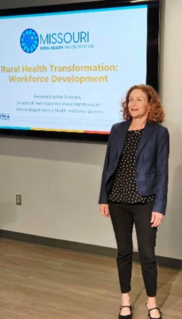
The energy of a new academic year puts Missouri’s health workforce pipeline visibly in motion. Nowhere is that motion more essential or accessible than in Missouri’s 12 community colleges. These independent institutions have a long history of working together to meet both statewide and regional workforce needs, and because each college is deeply embedded in its community, academic and training programs are intentionally aligned with the local economy. The collaborative relationship among these schools was evident on October 2, when the Missouri Community College Association hosted health sciences deans and stakeholders in Joplin for meaningful peer learning and problem solving. I was honored to join the conversation and share information about Missouri’s Rural Health Transformation Program (RHTP) and the resources available to expand health profession training.
Community colleges are often launching points for health career journeys, providing high‑quality, affordable training options that enable learners to build their futures without major debt and often without leaving their communities. Through RHTP, Missouri is expanding high‑need programs including dental assistant, dental hygienist, behavioral health technician, emergency medical services, pharmacy technician, and more through partnerships with community colleges. As Missouri continues to invest in building and strengthening rural workforce pipelines, community colleges remain central to that motion, meeting learners where they are, accelerating training, and connecting talent to the communities that need it most. To explore the programs offered at Missouri’s community colleges, including health care pathways and financial aid options, visit the Missouri Community College Association or your local community college’s website. Together, these institutions are helping more Missourians move toward meaningful, sustainable careers in health care and keeping our statewide workforce transformation firmly in motion.
|
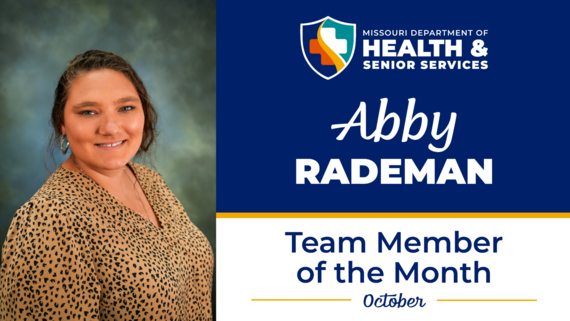 Congratulations to Abby Rademan for being named October's Team Member of the Month!
Abby has been recognized as the DHSS October Team Member of the Month for her exceptional contributions to the Bureau of EMS and the Time Critical Diagnosis Unit. In less than a year with the organization, she has become a trusted and indispensable team member known for her professionalism, adaptability, reliability, and commitment to excellence.
Nominators praised Abby for consistently going above and beyond her assigned responsibilities. She proactively supports two programs during periods of increased workload, quickly mastering complex systems, specialized terminology, and administrative processes with minimal guidance. Her initiative and attention to detail have enabled her to effectively support advisory councils, committees, and a variety of operational activities.
Abby takes ownership of critical projects and administrative functions, including coordinating virtual and in-person meetings, managing travel arrangements, organizing schedules, handling logistics, and assisting with hiring efforts. By taking on these responsibilities, she helps teammates focus on their core duties, improving workflow, efficiency, and operational continuity across both programs.
Her knowledge, professionalism, and dedication reflect the expertise of a long-tenured employee, despite her relatively short time with the organization. Abby's positive attitude, collaborative spirit, and outstanding service make her highly deserving of this recognition.

A Focus on Our Wellness
Halloween is quickly approaching, which means Halloween parties will soon commence. Here are two healthy recipes to incorporate!
Mindful Reset
Box Breathing is a simple 4-step mindfulness and breathwork technique that uses equal counts of inhaling, holding, exhaling and holding to calm the nervous system. Repeat for 3 to 5 rounds, or until you feel centered.
-
Inhale: Breathe in slowly through your nose for a count of 4 seconds (visualize moving up one side of an imaginary box).
-
Hold: Keep your lungs full and hold your breath for a count of 4 seconds (visualize moving across the top of the box).
-
Exhale: Release the air slowly through your mouth or nose for a count of 4 seconds (visualize moving down the other side of the box).
-
Hold: Keep your lungs empty and hold for a count of 4 seconds (visualize moving across the bottom of the box)
-
Nervous System Regulation - Activates the parasympathetic nervous system to help pull your body out of a "fight-or-flight" stress response.
-
Stress & Anxiety Reduction - Lowers cortisol levels, blood pressure, and heart rate.
-
Improved Focus – Shifting full attention to the rhythmic count anchors your mind in the present moment and stops racing thoughts.
|
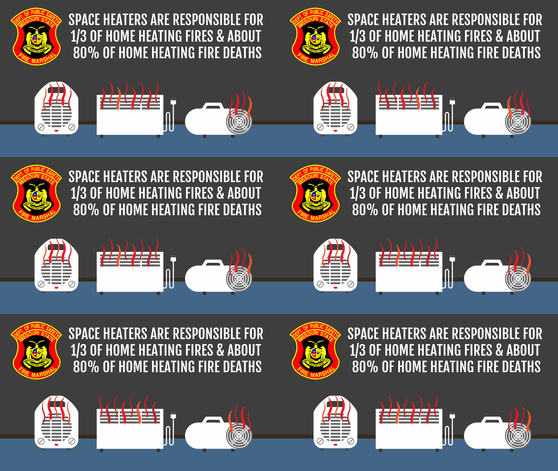
Fire Safety Month
Eric Hueste, Office of Emergency Coordination
October is Fire Safety Month, making it a great time to take a few minutes to think about fire prevention and what we would do if a fire happened at work or at home.
Fire can spread much faster than most people realize. A small fire can become a major emergency in just a few minutes, which means knowing what to do before an emergency happens can make all the difference.
According to the National Fire Protection Association, U.S. fire departments respond to tens of thousands of fires in commercial and industrial properties each year.
Some important facts about fires in non-residential buildings:
-
Electrical distribution and lighting equipment are among the significant causes of commercial building fires.
-
Heating equipment can also be a major ignition source, especially during colder months.
-
Fires in commercial buildings can result in billions of dollars in property damage each year.
-
Smoke and fire can spread through corridors, stairwells, ceilings, and ventilation systems, making a familiar building surprisingly difficult to navigate during an emergency.
-
Fire safety isn’t just about preventing fires, it is also about early detection, rapid notification, clear evacuation routes, and knowing where to assemble after evacuating.
A Few Fire Safety Facts
-
You may have only 1–2 minutes to escape after a smoke alarm sounds, depending on how quickly a fire develops.
-
Smoke can be more dangerous than flames. It can quickly make it difficult to see, breathe, or find an exit.
-
Modern furnishings can cause fires to spread faster than fires involving older materials.
-
Cooking is one of the leading causes of home fires. Never leave cooking unattended, especially when using a stovetop.
-
Smoke alarms save lives. Working smoke alarms provide an early warning that can give people valuable time to escape.
-
Fire extinguishers are for small, contained fires. If a fire is growing, producing heavy smoke, or blocking your escape route, get out and call 911 rather than trying to fight it.
Take a moment to identify the two closest exits from your work area. Know where the fire extinguishers are located and familiarize yourself with your building’s evacuation procedures.
Never go back into a burning building for people, phones or personal belongings. Leave the firefighting and rescue operations to trained emergency responders. A few minutes of preparation today could make a life-saving difference tomorrow.
|
The Admin Insight
Chad Ridder, Director of the Division of Administration
October 1 was a big day for budget teams across the state. It was the constitutional deadline for each executive agency’s department budget request for the upcoming state fiscal year to be sent to the Governor’s Office for review. The completed request was due October 1, but the work always starts well before that deadline. Division teams begin work on requests starting as early as the previous May. They work with the Bureau of Budget Services and Analysis to review current budgets and future planned spending to identify where additional funds are needed and where excess can be reduced. The creation of our DHSS budget is truly a department-wide team effort.
While the budget has been submitted for review, the work is not finished. As the Governor’s Office begins to make its recommendations and Missouri’s General Assembly reviews our requests, DHSS begins its work educating essential stakeholders about the vital work we do for the citizens of Missouri and ensuring we continue to receive funding for core public health.
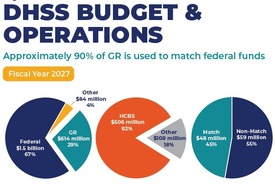
The total DHSS Fiscal Year 2028 Department Request budget is slightly over $2.13 billion with 1,944.75 FTE (Full-Time Equivalent). It comprises 29% general revenue funds, 67% federal funds, and 4% other funds. Within our request, you will find nearly $60 million in reductions of excess authority and various realignments to ensure our appropriations reflect how we intend to spend funds in the next fiscal year. In addition, DHSS has requested four New Decision Items (NDI). NDIs are requests for new funding in the next fiscal year.
Three requests seek additional appropriation authority of federal or other funds to allow the department to accept additional federal funding and increase access to funds already received through fees and donations. The other NDI relates to increased funding for our Home and Community-Based Services (HCBS) program to continue operations in the coming fiscal year due to rising costs.
If you would like to review our department’s budget book and learn more about the statewide process, please visit the Office of Administration’s webpage.
|

Cybersecurity Tip: Staying Safe on Public Wi-Fi While On the Go
Ryan Marsch, Director of Information Technology and Data Strategy
Many of us work on the move, whether we are visiting local health clinics, meeting with community partners, or catching up on emails during travel. While public Wi-Fi at coffee shops, airports, or hotels is incredibly convenient, it is also a prime target for cybercriminals looking to steal sensitive state and citizen data. By practicing a few simple remote security habits, we can make sure our business systems and private health data remain fully protected no matter where we are working.
Public Wi-Fi networks are open to everyone, including bad actors. Whenever you connect to public Wi-Fi without taking precautions, you are potentially broadcasting your passwords, emails, and files to anyone nearby.
The Risks: What Happens on Public Wi-Fi?
When you connect to an unsecured network, you open your mobile devices up to three major tricks used by cybercriminals:
-
Snooping and Data Stealing: Anyone connected to the same public Wi-Fi network can easily monitor unencrypted data packets traveling through the air. This allows them to capture passwords you type, read your personal messages, or view files you open.
-
Fake Hotspots: Bad actors often set up their own Wi-Fi networks with convincing names like "Free Airport Wi-Fi" or "Cafe Guest" to trick you into connecting. Once you connect to their fake hotspot, they can see everything you do online.
-
Man-in-the-Middle Attacks: Attackers can intercept the communication between your device and the internet. For example, they can quietly reroute you to a fake website that looks exactly like your bank or a state portal to trick you into typing in your login credentials.
Simple Rules for Secure Remote Work
Protecting your department's data on the go is easy if you follow these best security practices:
-
Turn on Your VPN: If you have one, always activate your Virtual Private Network (VPN) before doing any work. The VPN acts like a secure, encrypted tunnel, scrambling your data so that anyone snooping on the network cannot read it.
-
Keep Sensitive Business Private: Avoid accessing private databases, performing financial transactions, or logging into highly sensitive systems while connected to public Wi-Fi. If you must type in passwords or financial details, wait until you are on a secure network.
-
Disable Auto-Connect: Turn off the feature on your phone, tablet, and laptop that automatically connects to nearby Wi-Fi networks. This prevents your device from quietly connecting to an unsecured or fake hotspot without your knowledge.
-
Turn Off File Sharing: Disable sharing features like AirDrop, nearby sharing, and printer sharing when working in public. This blocks other users on the same Wi-Fi network from seeing your device or trying to send you malicious files.
-
Look for the Padlock (HTTPS): Always make sure the websites you visit start with https:// (and display a little padlock icon in the browser bar). This ensures the connection between your browser and that specific website is encrypted.
|

Show-Me Your Age
DHSS is partnering with the Missouri Office of Administration's Information Technology Services Division, the Department of Public Safety and the Department of Revenue to support safer communities through the launch of the new Show Me Your Age application.
This innovative age-verification tool helps retailers, venues and regulatory partners quickly and accurately confirm a customer's age when purchasing age-restricted products such as alcohol, tobacco and cannabis. By standardizing verification processes across Missouri, the application strengthens efforts to prevent underage sales and promotes compliance with state laws.
The digital tool allows users to verify age by scanning a valid driver's license or manually entering a date of birth. It also flags potentially invalid or fraudulent identification, helping businesses make informed decisions and enhancing public health and safety protections. Built-in reporting capabilities provide valuable data on verification trends and enforcement activities across the state.
Learn more about the Show Me Your Age application.
|
Thank you for your continued partnership!
|