May 1, 2026
2026 World Cup in Missouri
Summary
The 2026 FIFA World Cup™ (World Cup) is coming to Kansas City with FIFA Fan Festival™ (Fan Fest) events and matches scheduled from June 11 through July 11, 2026. The event could bring over 650,000 visitors from the United States (U.S.) and several other countries to the Kansas City metropolitan area during this month-long event. The large increase in visitors to Missouri for the World Cup matches and associated festivities may result in an increase in individuals seeking medical care for a variety of reasons, including communicable diseases of public health concern. The Missouri Department of Health and Senior Services (DHSS) is working in collaboration with local, state, and federal public health agencies and healthcare partners in the bi-state area to enhance surveillance and response activities during the World Cup.
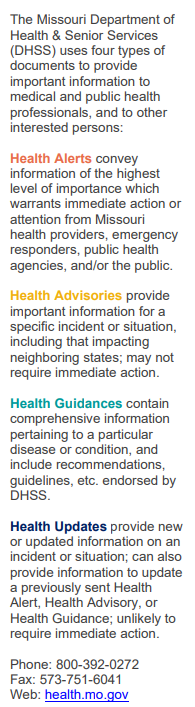
DHSS is issuing this Health Advisory to raise awareness of the World Cup events and support ongoing planning and preparedness efforts. The recommendations and resources included support the prompt diagnosis, enhanced surveillance, and prevention measures for communicable diseases and other reportable conditions. Missouri healthcare providers, please contact your local public health agency or the DHSS’ Bureau of Communicable Disease Control and Prevention at 573-751-6113 or 800-392-0272 (24/7) with questions regarding this health advisory, or during the World Cup to report suspected high priority disease cases or clusters of disease; or to request testing of high-priority conditions from Missouri State Public Health Laboratory (MSPHL).
Background
The World Cup tournament matches will take place in the U.S., Mexico, and Canada between June 11 and July 19. The Kansas City stadium (GEHA Field at Arrowhead Stadium) will host six matches between June 16 and July 11, including four Group Stage matches (June 16, 20, 25, and 27), a Round of 32 match (July 3), and a quarter-final match (July 11). Large gatherings of fans will occur at matches as well as at watch parties, impromptu parades, celebration parties, and official Fan Fest events. Visitor projections are reported to be up to 650,000 or more visitors in the Kansas City area. Over 50% of visitors are expected to be international travelers, staying an average of 9-10 days.
Currently, four teams have selected Kansas City area venues for base camps: Algeria, Argentina, England, and Netherlands. Several of the teams with base camps in the Kansas City area have historically strong traveling fan support. Fans may seek lodging and activities near their team base camps and may remain in the region for several days.
Additional information can be found at kansascityfwc26.com.
Information for Healthcare Professionals
Public Health Surveillance
The large increase in visitors to Missouri for the World Cup matches and associated festivities may result in an increase in individuals seeking medical care. The increases may include, but are not limited to communicable diseases, sexually transmitted infections, drug and alcohol related illnesses and overdoses, injuries, and heat-related illnesses. During the World Cup matches and festivities, Missouri healthcare professionals should expect and plan for an increase of visitors with limited knowledge of the U.S. healthcare system, possible lack of medical insurance coverage, and with limited proficiency in communicating in English. The most prominent languages among expected attendees may include Spanish, Arabic, French, Dutch, German, or Portuguese.
DHSS is working in collaboration with local, state, and federal public health agencies and healthcare partners to enhance surveillance and response activities during the World Cup. Surveillance and response activities during large events such as the World Cup are important to ensure prompt detection and response to any emerging disease threats. The surveillance efforts include case-based reporting according to the Missouri’s Reportable Conditions Rule, syndromic surveillance, hospitalizations surveillance, and wastewater surveillance. These public health surveillance resources can provide valuable insights for both clinical and public health intervention, and healthcare providers play a critical role.
Disease Diagnosis and Reporting
Prompt diagnosis and timely reporting of accurate identifying information for communicable and other reportable diseases and conditions is integral to disease surveillance and public health response activities in Missouri. Healthcare providers should review plans and capabilities to prepare for increased patient volume as well as unfamiliar and high consequence diseases. Public health must be notified of suspected communicable disease concerns, possible disease clusters or outbreaks. The Missouri State Public Health Laboratory (MSPHL) is available to provide support in diagnostic testing for certain high priority communicable diseases. The services offered and disease specific guidance is available at health.mo.gov/lab/atoz. Testing for high-priority communicable diseases conducted by the MSPHL must be pre-approved by the DHSS Bureau of Communicable Disease Control and Prevention (BCDCP) by calling 573-751-6113 during regular business hours or through the ERC (800) 392-0272 (24/7).
The MSPHL is providing additional courier support during the World Cup, including Friday pick-up at hospitals and local public health agencies from May 15 through July 31. More information is available on the courier services webpage. The MSPHL is available for consultation on specific tests and specimen collection, packaging, and shipping by calling (573) 751-3334 during regular business hours or through the ERC at (800) 392-0272 (24/7).
Healthcare professionals, healthcare facilities, and clinical laboratories in Missouri must continue to routinely notify DHSS or local public health agencies about reportable diseases and conditions in accordance with established reporting rules. Clusters of unusual, novel, or emerging diseases are also immediately reportable to the state or local public health agency. Additional information regarding reportable diseases and conditions, and reporting rules is available on the communicable disease surveillance webpage. Healthcare professionals, healthcare facilities, and clinical laboratories in Missouri should consider the following to help ensure prompt diagnosis and timely reporting to public health during the World Cup matches and festivities.
- Plan for an increase in patients with limited English proficiency. Familiarize yourself with organizational policies and resources for interpretive services.
- In addition to the thorough collection of medical and epidemiological information, incorporate questions and documentation in the medical record about domestic and international travel, animal exposures, and participation in World Cup events at patient intake and as part of a complete health history and physical examination.
- Ensure healthcare providers have access to information available to support the prompt testing and diagnosis of conditions that are not routinely seen in the U.S. Resources such as the CDC Travelers’ Health, CDC Yellow Book, and KDHE Global Infectious Disease Events Dashboard are available in the Resources section of this Health Advisory.
- Consider triage of patients suspected of having communicable disease to minimize opportunities for disease transmission in healthcare settings, including triage outside of facilities, and update plans as needed.
- Obtain pertinent immunization histories whether vaccine preventable disease is suspected, or not.
- For visitors to Missouri, in addition to standard demographic information, obtain and document thorough travel history, accurate phone number, and location name and address where the individual is staying while visiting for the World Cup.
- Report all individuals suspected of having a reportable disease or condition to DHSS or local public health agencies following the routine process for reporting to public health. Reports should be provided to the Bureau of Communicable Disease Control and Prevention routinely through electronic laboratory reporting (ELR), telephone to 573-751-6113, fax to 573-751-6417, or by other rapid communication.
- For immediate notification of suspected high-priority communicable disease concerns, possible disease clusters or outbreaks, or to request laboratory testing for communicable diseases from the MSPHL, contact your local public health agency or DHSS’ Bureau of Communicable Disease Control and Prevention at 573-751-6113 or 800-392-0272 (24/7).
Respiratory Illnesses
Respiratory virus illnesses like Influenza, respiratory syncytial virus (RSV), COVID-19, and others can spread even in summer months. Southern Hemisphere respiratory illness season typically peaks between April and September. With significantly increased numbers of international travelers, common respiratory (and other) pathogens may be present at higher rates than typical for the region at this time of year and require careful medical and epidemiological evaluation.
Individuals with symptoms requiring isolation need to be advised to stay home or at their lodging away from others until they are feeling better and fever-free for 24 hours. Those individuals determined to need isolation should be informed about the likely follow-up call from public health professionals.
Measles
The U.S. and many other countries continue to experience outbreaks of measles. As of April 23, 2026, a total of 1,792 confirmed cases of measles has been reported from 37 states in the U.S., including Missouri. Measles is highly contagious and can spread through the air when an infected person coughs or sneezes. Persons are contagious from 4 days before to 4 days after the rash appears. One person with measles can easily pass it on to 9 out of 10 people around them who are unvaccinated or do not have natural immunity.
Healthcare providers should consider measles as a diagnosis in anyone with fever (≥101°F or 38.3°C) and a generalized maculopapular rash with cough, coryza, conjunctivitis presenting on a timeline of symptoms consistent with measles. Risk factors for measles include recent international travel, domestic travel to an area with a known measles outbreak, or other known or suspected exposure to measles. Suspect measles cases should be isolated immediately and notification made to the local or state health department. Consider offering measles screening or testing outside of facilities to avoid possible transmission in healthcare settings. Individuals with symptoms requiring isolation need to be advised to stay home or at their lodging away from all others and avoid all public spaces until five days after rash onset. Healthcare facilities should not release individuals until proper isolation precautions can be assured in cooperation with public health officials.
Heat and Patient Health
Heat index temperatures over 100°F (37°C) are not uncommon in Missouri during June and July. Travelers may be unaccustomed to heat and humidity and may spend more time outdoors than usual or not have access to air-conditioned areas. Healthcare providers should be prepared to treat individuals with heat-related illnesses.
Responding to Overdoses
Large events that involve travel, celebrations, and crowds can also increase the risk of substance use and accidental overdoses. Synthetic opioids fentanyl and nitazenes, and sedative medetomidine are three highly potent and dangerous substances recently noted for increased detection, and usually mixed with other illicit drugs. Important information regarding clinical signs and treatment in the case of opioid co-involvement with medetomidine can be found at CDC HAN-00527 Medetomidine in the U.S. Illegal Fentanyl Supply Increasing Risk for Overdose and Severe Withdrawal Syndrome.
Healthcare providers should know how to recognize and respond to an overdose with the lifesaving use of naloxone. Naloxone is effective and safe to use. Note that for some very potent opioids, such as fentanyl or nitazenes, multiple doses of naloxone may be needed. If there is no response or minimal response after 2-3 minutes, a repeat dose of naloxone may be needed to reverse an overdose. It is very important to stay with the individual until EMS arrives in case more than one dose of naloxone is required. Missouri's Good Samaritan laws protect individuals from prosecution when responding to overdoses for drug or alcohol-related issues.
Information on these and other illicit or unregulated substances is found in the World Cup resources section below.
Emergency Medical Services (EMS) Agencies
EMS transport agency preparedness is an important component of overall public health protection in preventing community transmission and protecting healthcare workers. EMS agencies should be reviewing their plans in coordination with hospitals, their local healthcare coalition, and other appropriate stakeholders. Considerations include, but are not limited to, interfacility transport planning, plans for increased traffic and consideration for aeromedical transport, mass casualty incident preparedness and infectious disease protocols including PPE. Any additional information regarding specific public health events, for example for high consequence threats, will be provided through a separate health alert notification. An EMS Infectious Disease Playbook planning resource is available.
Syndromic Surveillance (ESSENCE)
The DHSS Electronic Surveillance System for the Early Notification of Community-based Epidemics (ESSENCE) collects electronic emergency department (ED) data from hospitals meeting established criteria for the purpose of syndromic surveillance to detect public health events as an earlier warning signal compared to other surveillance methods. ESSENCE utilizes electronic chief complaint and discharge diagnosis data to promptly detect an increase in trends at a specific hospital or in a geographic area. ESSENCE can also be used for situational awareness during known health events by querying all ED visits for a particular syndrome or health concern. Missouri ESSENCE data is only accessible by users authorized by the DHSS. The authorized staff from individual hospitals or hospital groups that submit electronic ED data to ESSENCE can view their data as well. DHSS is working in collaboration with the Kansas Department of Health and Environment (KDHE) Syndromic Surveillance Program to ensure regional syndromic surveillance data will be consistent during the World Cup.
Hospitals enrolled in ESSENCE can assist public health officials at the local, regional, and state level by taking the following reporting/coding actions:
- Update chief complaint and nursing notes to add important visit context for all relevant patients regardless of chief complaint or diagnosis. For example, consider helping to flag visits of interest using the phrase 'FIFA26; or other event related identifiers in these fields.
- Ensure appropriate and complete discharge diagnosis information and consider including the ICD-10 CM code Y93.82 for identifying ED visits related to the World Cup. ICD-10 CM code Y93.82 is the diagnosis code for 'Activity- Spectator at an Event'.
- Record travel and event attendance by documenting responses to the following recommended screening questions:
- "In the past month, have you traveled outside of Missouri or Kansas?"
- "In the past month, have you attended a World Cup event such as a match, fan zone, or other large gathering?"
- Consider inputting de-identified triage notes regarding traveler lodging location and dates of stay, as well as primary language spoken.
- For questions regarding syndromic surveillance, contact ESSENCE.ESSENCE@health.mo.gov.
Wastewater Surveillance
When people have an illness, they can shed the virus or bacteria into wastewater. Shedding can happen even when a person has no symptoms or before they begin showing symptoms. Genetic material from viruses or bacteria can be detected in wastewater, providing public health insights even when individuals do not access the healthcare system. Because of this, wastewater testing can provide valuable information about community health. Wastewater testing can show early signs of when illness is present and spreading in a community.
For this type of surveillance, wastewater is sampled each week at many wastewater treatment plants (WWTPs) across the state and tested for multiple pathogens including COVID-19 virus, influenza viruses and respiratory syncytial virus (RSV) in the wastewater. The wastewater surveillance sampling and testing frequency will be increased around the time of the World Cup in partnership with eight WWTPs covering the Kansas City area to provide better detail regarding community and traveler health.
Temporal changes in pathogen loads in wastewater are monitored for each WWTP. In addition to providing facility-level insights, the data are also aggregated into Missouri regions, including the Kansas City metro area, to provide a multi-tiered approach to community monitoring data.
Samples with high and sufficient genetic material are also tested for variant mutations and subtypes, to show the dominant strain or indicate the presence of sub-lineages at the time of sampling.
The testing results including regional data are included in the wastewater dashboard.
Missouri’s wastewater surveillance data are also displayed on CDC’s National Wastewater Surveillance System website where Missouri and Kansas data can both be found. Note that CDC and DHSS use different viral activity level calculations. CDC’s calculation uses non-normalized virus concentrations to be consistent across states, while DHSS adjusts for wastewater flow rates from facilities to help make comparisons over time. Because of these differences in viral activity level calculation methods, there may occasionally appear to be minor discrepancies between Missouri’s and CDC’s maps.
Additional information for healthcare professionals
Mass Casualty Events
Healthcare providers and facilities should be prepared for medical surge and ensure plans and staff are updated to consider potential mass-casualty risks including biological, chemical, radiological/nuclear, kinetic, cyber or natural disaster events. Information on these threats is available in the resources section below.
SAFEvT
The DHSS Office on Women’s Health offers the Sexual Assault Forensic Exams via Telehealth Network (SAFEvT) to provide telehealth support to hospitals that do not have forensic nurses available 24/7. It is organized in a hub-and-spoke model with multiple contracted hub sites providing around-the-clock support to their assigned satellite hospitals. An online map shows where survivors can get a forensic exam near them. The map and more information about the SAFEvT Network can be found at health.mo.gov/SAFEvT.
Human Trafficking
Human trafficking is an increasingly alarming issue in Missouri, and major events can attract traffickers and heighten risks. State and local officials are prioritizing human trafficking prevention efforts. Healthcare providers should be aware of how to recognize and respond to signs of human trafficking.
World Cup Resources
Public health surveillance data during major public events such as the World Cup provides real-time monitoring of health trends to help public health officials detect public health threats like novel infectious diseases or outbreaks, identify risk groups, evaluate and target interventions, utilize resources wisely, and make data-driven decisions to protect attendees and the broader public.
Patient Screening Resources
CDC Travelers’ Health resources for clinicians: https://wwwnc.cdc.gov/travel/destinations/list.
CDC Yellow Book – travel medicine topics for healthcare professionals: https://www.cdc.gov/yellow-book/index.html.
KDHE Global Infectious Disease Events Dashboard: http://datainsights.kdhe.ks.gov/GIDE/.
CDC Heat and Medications, Guidance for Clinicians: https://www.cdc.gov/heat-health/hcp/clinical-guidance/heat-and-medications-guidance-for-clinicians.html.
Public Health Surveillance Resources
Missouri Weekly Influenza Surveillance Report: https://health.mo.gov/living/healthcondiseases/communicable/influenza/dashboard.php.
Missouri Wastewater Surveillance Dashboard: https://health.mo.gov/living/environment/wastewater-surveillance/public-wastewater.html.
KDHE travel page: https://www.kdhe.ks.gov/1508/Travel-Health.
Emergency Medical Services Planning Resources
Administration for Strategic Preparedness and Response (ASPR): https://asprtracie.hhs.gov/technical-resources/resource/4442/ems-infectious-disease-playbook.
Disaster and Emergency Planning Resources
Disaster and emergency planning resources: https://health.mo.gov/emergencies/.
Cybersecurity and Infrastructure Security Agency: https://www.cisa.gov/protecting-networks-cyberattacks.
Illicit or Unregulated Substance Resources
Fentanyl information and resources: https://www.cdc.gov/stop-overdose/caring/fentanyl-facts.html.
Nitazenes information and resources: https://content.govdelivery.com/accounts/MODHSS/bulletins/40fa4a1.
Medetomidine information and resources: https://content.govdelivery.com/accounts/MODHSS/bulletins/4113df7.
7-OH information and resources: https://health.mo.gov/safety/foodsafety/kratom/.
Missouri Poison Center: https://missouripoisoncenter.org/ or 1-800-222-1222.
Time2Act – Time2Act-Stop Opioid Misuse in Missouri: https://time2actmissouri.com/
Order FREE Naloxone: https://getmissourinaloxone.com/
Missouri Drug Overdose Dashboard: https://health.mo.gov/data/opioids/.
|