March 24, 2026
Health Risks Associated with Nitazenes - Summary
- Nitazenes are highly potent synthetic opioids increasingly found in counterfeit pills, powders, and vapes—often without users knowing.
- Nitazenes are so powerful that even a tiny amount can cause someone to stop breathing – overdoses can happen quickly and are often fatal.
- Missouri’s school wastewater testing has detected nitazenes in many participating schools, prompting coordinated safety and communication efforts.
- Overdose resembles other opioid overdoses, but multiple doses of naloxone may be needed due to nitazenes’ strength. Naloxone is effective and safe to use.
- People should be aware that any illicit substance or vape may contain nitazenes.
Background Information on Nitazenes
Nitazenes (pronounced “NYE-tuh-zeens”) are an emerging category of synthetic opioids. They represent a class of chemicals, known as 2-benzylbenzimidazoles, that act on opioid receptors (called “mu” receptors) to produce opioid-like effects. They were originally developed in the 1950s but were never approved for medical use in the United States (U.S.) due to safety concerns. Since 2019, nitazenes have been increasingly present in the illicit drug supply in North America, Australia, and Europe. The chemical structure of nitazenes is distinct from that of traditional opioids such as morphine or heroin, so they are not detected on traditional standard drug screenings.
Since 2019, more than 20 different nitazene compounds have been identified. Although there have been attempts to ban individual compounds, such as through the United Nations Commission on Narcotic Drugs and the United States’ Drug Enforcement Administration, new nitazene compounds are continuously synthesized, presenting a challenge for regulation.
Of particular concern is the fact that some nitazene analogues are over 5 to 10 times more potent than fentanyl and hundreds of times more potent than morphine. This means that a very small quantity can have a large clinical effect, and they carry a high risk of overdose and may be fatal.
In the United States, nitazene overdose information is limited, but its use has been implicated in more than 90 fatal overdoses in Tennessee between 2019 and 2023. This number is likely an underestimation, as nitazenes cannot be detected with traditional toxicology testing and are often not noted in overdose death reporting. The Missouri Department of Health and Senior Services (DHSS) State Unintentional Drug Overdose Reporting System (MO SUDORS) has captured data on nitazene presence in 14 overdose deaths in 2024, over three times the combined number from 2019-2023.
Where are Nitazenes found?
Nitazenes have been found as contaminants, or “laced” in numerous products, including:
- Illicitly manufactured tablets (or in powder form).
- Some of these illicitly manufactured products mimic legitimate pharmaceuticals, such as benzodiazepines (e.g. Xanax), oxycodone (a.k.a. Percocet), and hydrocodone (a.k.a. Vicodin).
- Other controlled substances such as fentanyl, heroin, methamphetamines, and cocaine.
- Unregulated cannabis products.
- Other non-controlled substances such as xylazine (which is a veterinary sedative not approved for human use) and bromazolam (which is an unlicensed designer benzodiazepine).
- Now emerging is also the threat of nitazene-laced vapes and contaminated, unregulated products such as synthetic cannabis.
Individuals using any of these substances are most likely unaware that they are being exposed to nitazenes.
Nitazenes in Missouri Wastewater – Detection and Response
In 2025, Missouri launched a pilot program to test wastewater from public schools that volunteer to participate for several illicit drugs of concern. These schools support their communities and the state by helping to identify potential drug trends affecting students and the surrounding community, while ensuring the protection of individual health information. This program, led by the Missouri Department of Public Safety (DPS), currently involves 37 schools across the state.
Since January of this year, laboratory analysis from this program has detected nitazenes in 26 of the 37 schools’ wastewater. This corresponds with increasing detections of nitazenes in law enforcement drug surveillance, medical journal articles identifying a rising nitazene concern in overdose cases and emergency department visits, and Missouri SUDORS data.
These detections in Missouri wastewater have resulted in several actions by DPS, DHSS, and other partners including the Missouri Department of Elementary and Secondary Education (DESE), to assure the school administration, teachers and nursing staff, as well as the community and public health agencies around these schools, have the information and resources needed to protect their children and families.
Clinical Effects of Nitazenes
Symptoms of nitazenes may include, but are not limited to:
- Dependence and addiction
- Withdrawal symptoms such as diarrhea, irritability, cold sweats, and body aches
- Slowed or shallow breathing
- Constricted pupils
- Vomiting, Nausea, Constipation
- Sweating
- Itchiness
- Drowsiness
- Pain relief
- Euphoric sensations
- Overdose (see below)
Overdose
Nitazenes work on the “mu” opioid receptors, so overdose presents similarly to overdoses with other opioids. Symptoms of a nitazene overdose may include:
- Pinpoint pupils
- Pale or cyanotic (bluish) lips or complexion
- Loss of consciousness
- Very shallow or absent breathing
- Gurgling noises
- Clammy skin
- Blue fingernails
- Vomiting
- Limp body
- Unresponsiveness
- Slow heartbeat or abnormal heart rhythms
- Cardiac arrest (heart stopping)
- Death
Combining nitazenes with other substances such as benzodiazepines, alcohol, ketamine, or cocaine increases the risk of overdose.
Because of the increased potency of nitazenes, multiple doses of naloxone may be required. Administer one dose and repeat after 2-3 minutes as needed if no or minimal response.
Treatment
Acute Overdose
In the event of a suspected nitazene overdose:
- Call 9-1-1.
- Administer Basic Life Support (BLS) if you have been trained to do so.
- If the person is vomiting, lay the person on their side.
- Administer naloxone (a.k.a. Narcan) if available.
- Overdose from opioids, such as nitazenes, can be reversed with naloxone, which restores normal breathing.
- Naloxone can be administered as an intranasal spray in the nostril or as an intramuscular injection. Both of these methods are equally effective at saving lives.
- If there is no improvement in breathing OR if the person stops breathing or becomes unresponsive again, administer an additional dose of naloxone after 2-3 minutes.
- Nitazene can be many times more potent than fentanyl, so if there is no response or minimal response after 2-3 minutes a repeat dose of naloxone may be needed to reverse an overdose. It is very important to stay with the individual until EMS arrives in case more than one dose of naloxone is required.
- Missouri's Good Samaritan laws protect individuals responding to overdoses from prosecution for drug or alcohol related issues.
- It is also necessary for a patient whose overdose was reversed with naloxone to be medically monitored, ideally in an emergency department, in case respiratory suppression recurs.
- Remember: if you are unsure if someone has opioids (such as nitazenes) in their system and they appear to be overdosing, you should always give naloxone. Naloxone will not hurt someone, even if they do not have opioids in their system.
Chronic Use
Individuals who experience dependence or addiction to nitazenes, other opioids, or other illicit substances should talk to their health provider to seek recovery support.
Recommendations
- The most effective way to avoid exposure to nitazenes is to only use medications obtained directly from a licensed pharmacist with a valid prescription.
- Avoid using illicit substances (including but not limited to opioids).
- Be aware that illicit and unregulated substances carry a risk of being laced/contaminated with nitazenes or other chemical compounds, even if they are labeled otherwise.
- Be aware that vapes carry a risk of being contaminated with nitazenes.
- Talk to children and teens about risks associated with nitazene use and how to respond to an emergency.
- Stay informed about overdose risks.
- Be aware that Fentanyl test strips cannot detect nitazenes.
- Keep multiple doses of naloxone available and be ready to administer it in case of an emergency.
- Remember that someone can overdose on nitazenes without knowing they took them.
- Use naloxone in any emergency that looks like an opioid overdose, regardless of the substance you believe the person took.
- Be aware that nitazene overdoses may require more than one dose of naloxone to be reversed.
Resources and References
Resources
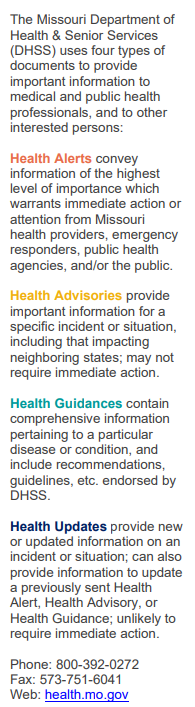
Please contact the DHSS's Bureau of Community Health and Wellness at 573-522-2820 with questions regarding this Health Advisory.
List of References:
- Schwarz, E. S., Dicker, F., Lothet, E., Spungen, H., & Levine, M. (2025). Nitazenes: An Old Drug Class Causing New Problems. Missouri medicine, 122(4), 329–333. https://pmc.ncbi.nlm.nih.gov/articles/PMC12331301/
- UN: https://www.unodc.org/LSS/Announcement/Details/16bcac76-5c96-49f6-9d8a-56d1aa76cd7a
- DEA: https://www.federalregister.gov/documents/2024/07/29/2024-16391/schedules-of-controlled-substances-temporary-placement-of-n-desethyl-isotonitazene-and-n-piperidinyl
- Roberts, D. M., Tisdell, B., Sajeev, M. F., Jiranantakan, T., Harvey, C., & Brown, J. A. (2025). Clinical Experiences With the Nitazene Class of Synthetic Opioids: A Cohort Study. Annals of emergency medicine, 86(5), 475–483. https://doi.org/10.1016/j.annemergmed.2025.06.619
- Pereira, J. R. P., Quintas, A., & Neng, N. R. (2025). Nitazenes: The Emergence of a Potent Synthetic Opioid Threat. Molecules, 30(19), 3890. https://doi.org/10.3390/molecules30193890
- Holland, A., Copeland, C. S., Shorter, G. W., Connolly, D. J., Wiseman, A., Mooney, J., Fenton, K., & Harris, M. (2024). Nitazenes-heralding a second wave for the UK drug-related death crisis?. The Lancet. Public health, 9(2), e71–e72. https://doi.org/10.1016/S2468-2667(24)00001-X
- Vanderbilt University: https://news.vumc.org/2025/09/16/forgotten-opioid-has-resurfaced-as-lethal-street-drug/
- CDC: https://www.cdc.gov/mmwr/volumes/71/wr/mm7137a5.htm
- CDC: https://www.cdc.gov/overdose-prevention/reversing-overdose/about-naloxone.html
- Australian Alcohol and Drug Foundation: https://adf.org.au/drug-facts/nitazenes/
- Vandeputte MM, Stove CP. Navigating nitazenes: A pharmacologic al and toxicological overview of new synthetic opioids with a 2-benzylbenzimidazole core. Neuropharmacology. 2025 Sep 1;275:110470. doi: 10.1016/j.neuropharm.2025.110470. Epub 2025 Apr 17.PMID: 40252758.
|