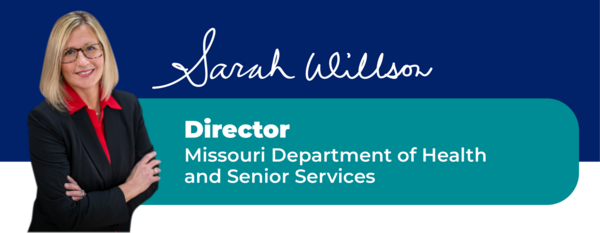
|
Director's Message | Jan. 27, 2026
|
|
|
Partners,
I hope everyone is staying safe and warm following this winter storm, and I want to take a moment to thank each of you for your continued partnership. Today’s message will highlight key updates, upcoming priorities and opportunities for collaboration as we move forward together.


New Dietary Guidelines
The White House recently released new “real food” dietary guidelines representing the largest change to dietary guidelines in recent history. In response to the new recommendations, the department has assembled subject matter experts to come to a consensus on the impact of the change. This analysis will include making recommendations to and implementing changes in existing department programs. The change also represents an opportunity for development of new programs.
In addition, the department held the first of its kind whole food nutrition meeting in December 2025. The meeting brought together multidisciplinary state agencies, community, industry and academic partners to discuss whole food nutrition. The group, including members of the Governor’s Office, recognizes the importance of the collaboration and continued work. The department is particularly interested in the ability to positively impact nutrient-sensitive chronic disease.
|
FY2027 Proposed Executive Budget
Governor Kehoe delivered his State of the State address on January 13, 2026, one year after he was sworn in as the 58th governor. Titled “A Foundation for Growth,” the speech focused on fiscal discipline, smaller government, economic competitiveness, and growth in the key priority areas of public safety, economic development, agriculture and education.
The governor’s speech highlighted other priorities like modernizing government including the use of artificial intelligence and efficiency through the Missouri GREAT initiative. The address ties directly to his Fiscal Year 2027 budget recommendation, which reduces more than $600 million from the general revenue core operating budget to address imbalances focusing on core government functions amid strong but challenged revenues.
Core Enhancements: DHSS is recommended to have new funding actions (Supplementals + New Decision Items): $278.7Million (M) Total — $52M General Revenue (GR), $219M Federal, $7.7M Other. These actions are dominated by Medicaid HCBS costs to continue and federal authority adjustments.
Core Reductions and Reallocations: There were also reductions proposed by the department. The single largest reduction is the removal of $153.9M in COVID federal authority previously carried in core. The following is a summary:
-
DHSS reduced $180,853,921 across all funds in FY27 Department Request
- This includes $175,000 GR, $174,249,321 Federal, and $6,429,600 Other
-
FY27 Governor’s Recommended Budget reduced DHSS by an additional $82,234,170 across all funds
- This includes $52,130,932 GR, $254,734 Federal, and $29,848,504 Other
-
DHSS’ total core reduction from FY26 TAFP - $263,088,091
DHSS budget recommendations largely rebalance authority (especially federal) and targets GR of a few high visibility priorities while advancing fund swaps to relieve GR pressures. As previously noted, service expansions center on HCBS continuity, while multiple program trims or eliminations are contemplated in maternal health, environmental health, public health laboratory, local public health, and regulatory programs. The executive budget reductions largely reflect recommendations put forth by the department based on the analysis of programs and services over the past six months.
Missouri ranks lowest among states for GR spend for core public health services at just $7 per Missourian. That amount could be doubled, and Missouri would still rank dead last. The budget, being 67% federally funded, has been significantly impacted by federal funding cuts. Continued federal budget uncertainties and anticipated reductions could significantly impact department programs and services due to the availability of and voluntary participation in federal programs. The department will continue to evaluate programs and services including how they are delivered to make changes necessary to improve efficiency and service to stakeholders and Missourians overall.
Additional budget documents and explanations can be found at oa.mo.gov.
|

Reimaging the Future
As previously discussed in newsletters and stakeholder meetings, the divisions of DHSS embarked on a journey to “reimagine” the programs and services offered by the department. This includes asking the important question, “Why do we do what we do?” -- the goal being to look at each program and service to evaluate the value of the program or service to the mission of the department. Leaders were also tasked with assessing if the work should be performed differently to increase efficiency. At times we must be prepared to do less in order to do more.
The first phase of the exercise was to list every program and service using a tool developed internally in Smartsheet. Then, information was collected about each one including statutory or regulatory requirement, funding source, relation to core public health, if others could/should perform, among other points. We learned a few things going through the process and have made some adjustments. The next phase includes aligning program levels more consistently among divisions to more easily assess alignment and opportunities for blending. We will also apply another prioritization factor to decrease subjectivity.
We recognize our colleagues and stakeholders are interested in how department leaders will make decisions during these changing and fiscally constrained times. We also recognize there are multiple approaches that can be employed. We have combined a number of approaches including MoSCoW prioritization, impact vs. effort, RICE and others to complete phase one prioritization. While we did not know for sure that state or federal changes would necessitate the quick application of our combined learning and efforts, it proved beneficial in discussions when learning there would be core reductions in the state FY27 budget.
Many people have been involved in the various steps of the project to date including the director, deputy directors, division and deputy division directors, operational excellence team members, policy director, chief medical officer, front line leaders, and colleagues who have attended special discussions or completed surveys. Most colleagues have been involved in some way given this project didn’t begin in July 2025. It began several years ago when colleagues and stakeholders were surveyed and involved in setting the most recent strategic plan. The strategic priorities implemented a couple of years ago help to guide today’s discussions.
The saying a “goal without a plan is just a dream” comes to mind with Project Reimagine. While phase one discussions helped us identify possible core reductions, we have a lot of work to do. The world around us is changing. The department must eliminate redundancies, prioritize programs that have the biggest impact, reduce red tape and ensure our partners are committed to quality and similar goals. Senior leaders are tasked with constantly evaluating what we do and how we do it. All staff are encouraged to submit suggestions for improvement through the staff suggestion box.
The reality is we must adapt and change. That change may result in fewer initiatives, a smaller department, contracting differently, reorganization, increased use of AI and more. The first reaction to change is usually resistance. When you find yourself resisting, go the opposite direction and ask more questions, make more suggestions, consider more possibilities…lean in. We will figure it out together and make it work for the good of the people we serve.
|

Implementing the Discipline Without Punishment System: A Positive Approach to Accountability
DHSS is moving away from traditional punitive disciplinary methods and embracing approaches that foster accountability, respect and collaboration. Specifically, we will implement Discipline Without Punishment (DWP)—a system designed to correct performance and behavior issues without relying on fear or penalties—by the end of 2026.
Developed by Dick Grote, DWP is a progressive disciplinary system that focuses first on recognizing performance and coaching; and second on problem-solving rather than punishment. Instead of issuing warnings or suspensions, the process encourages employees to take ownership of their actions and make informed choices about their future with the organization. It encourages leaders to treat colleagues like adults and colleagues to act and perform like adults. A system of mutual respect.
Traditional discipline often creates adversarial relationships, lowers morale, and fails to address the root cause of issues. DWP offers a more constructive alternative by:
-
Preserving dignity: Employees are treated as responsible adults, not as offenders.
-
Building trust: Open dialogue fosters mutual respect between employees and management.
-
Improving performance: Employees are empowered to correct issues without fear of retaliation.
By implementing DWP, we aim to:
-
Strengthen our culture of accountability and respect.
-
Enhance employee engagement and productivity.
Director Willson led senior leaders through the program during a series of sessions occurring October-December. The next step is establishing an implementation team. During 2026, managers will receive training on the DWP process and policies will be updated and communicated. Employees can expect clear communication about expectations and support resources to help them succeed.
|

Missouri’s Master Plan on Aging
The department recently released Missouri’s Master Plan on Aging. The Division of Senior and Disability Services worked with multiple agencies and community stakeholders to develop the 10-year, action-oriented roadmap that brings together public agencies, local organizations, and communities to prepare for this future. The plan outlines a bold and coordinated vision to support the well-being of all Missourians across their lifespan and the action steps to get there.
We are all aging. Missourians who are transitioning into the next phase of their lives, Missourians of all ages with disabilities, and younger Missourians who will become older adults one day, as well as their support network of family, friends, caregivers, and neighbors, are all part of this reality. Our older adult population is rapidly growing, faster than any other age group. In 2023, Missourians over 60 comprised almost 25% of the state’s population. In addition, more than 30% of adults in the state, age 18 and older, report living with a disability—a rate that is notably higher than the national average. As Missouri’s population ages, many individuals will experience increased support needs, due to aging, disability, or both.
By 2034, for the first time, there will be more older adults than individuals younger than 18. And by 2060, older adults will significantly outnumber children in Missouri. This demographic shift will affect every sector of life in Missouri, from health care and housing to transportation, employment, and community design. As the population ages, the decisions made today will shape the future for all Missourians.
The next step will be establishing subcommittees to begin the work of implementation of the plan. Contact Mindy Ulstad, mindy.ulstad@health.mo.gov, with any questions.
|

The Buzz About Vaccination Changes
The CDC has recently modified vaccination recommendations. They have gone from one list of recommended childhood vaccines to three distinct categories: routinely recommended for all, recommended for high-risk individuals, and recommended with shared clinical decision-making. While all vaccines previously recommended for all are still listed, some are now in the high-risk and shared clinical decision-making (SCDM) buckets.
For Missouri, this change could impact the department’s mandated vaccination requirements for childcare and school attendance. Language in statute authorizes the department to set vaccination requirements for childcare facilities in section 210.003/Regulation 19CSR 20-28.040 which specifies the department set a schedule “in accordance with recommendations of the CDC’s advisory committee on immunization practices (ACIP).” The CDC’s adoption of new guidance occurred without the formal recommendation of their ACIP. However, the committee meets in February where it is anticipated they will formally recommend the guidance adopted by the CDC.
For school requirements, section 167.181/regulation 19 CSR 20-28.010 states the “immunizations required, and the manner and frequency of their administration shall conform to recognized standards of medical practice.” The CDC/ACIP is not considered in this section of statute. Noteworthy, 19 CSR 20-28.060 states all immunizations within the latest recommended schedule of ACIP shall be required. This regulation identifies immunizations which individual and group health plans shall cover.
While all childhood vaccinations are still recommended, they aren’t blanketly recommended. The new CDC guidelines conflict with current Missouri mandates, specifically, Hepatitis B and Meningococcal. These vaccines are now listed under “recommended with SCDM,” and Hep B is not recommended as a birth dose, except for high-risk kids, which is still recommended as three doses starting with birth.
While SCDM is not a new concept, those opposed to the new recommendations are voicing concern that SCDM will increase clinician workload and undermines the overall importance of scientifically proven effective and safe vaccines. From a department standpoint, we must balance a message that supports vaccination, is based upon medical standards, and doesn’t undermine or jeopardize our position as the state health authority. Subject matter experts at the department are working with the Governor’s Office, state departments and community stakeholders to assess Missouri’s current regulatory requirements, communicate any suggested modifications, and educate the public on the overall effectiveness of vaccination. For example, since requiring Hep B in 1991, we have seen a 99% decrease in Hep B in kids.
|

Other Federal Updates
- On January 9, the Administration for Strategic Preparedness and Response (ASPR) released a new Strategic Plan for 2026-2029. The Strategic Plan outlines goals to strengthen state and local readiness, secure America’s medical supply chain, address emerging health security threats, advance gold standard science, and execute rapid and efficient federal response. The agency has been troubled with a changing organizational structure and concerns about long-term survival. This may signify a renewed emphasis on the importance of preparedness.
- Missouri Pregnancy Risk Assessment Monitoring System Funded: The Missouri Pregnancy Risk Assessment Monitoring System (PRAMS) is a population-based surveillance system that supports maternal and child health. It is a primary data source for Title V, which is the block grant that supports MCH programs across the state. Most of the CDC’s PRAMS staff were dismissed in early 2025, which temporarily halted data collection and raised concerns about its future. Despite rumors that the program was cancelled, Missouri PRAMS remains fully operational. On Jan. 13, the CDC announced a one-year continuation of PRAMS funding. The program typically operates on a 5-year grant cycle, but this 1-year continuation allows normal operations to continue while DHSS develops a plan for longer-term sustainability if CDC funding does not continue beyond April 30, 2027.
|

Safety is our Mission
The health and safety of Missourians is the essence of DHSS’s mission. The Office of Special Investigations, which is charged with the investigating crimes of abuse, neglect and financial exploitation of the elderly and disabled, was pivotal in the investigation that ultimately lead to a federal conviction of a Dent County man for neglecting his uncle, a U.S. Army veteran with quadriplegia, for years and concealing his corpse to fraudulently obtain $1.8 million in his uncle’s VA disability benefits. In 2025, the Office of Special Investigations handled 2,106 investigation referrals to protect Missouri’s elderly and disabled population.
|
|
|
|
|
|