|
Partners,
Today is National Public Health Thank You Day!
As Thanksgiving approaches, I want to take this moment to express my deepest gratitude to our dedicated state public health team and all of our public health partners. Their commitment to protecting the health and well-being of our communities is the foundation of a stronger, safer Missouri. Through every challenge, their expertise, resilience and compassion shine through. This season, we are especially thankful for their service.


2026 DHSS Legislative Priorities
The department recognizes throughout each year and as a part of long-range planning the need to request changes to appropriations and programming. While all suggested changes may not be feasible in a single year, the items put forward for consideration are an important part of an overall strategic plan. The department's authorized priorities for the 2026 legislative session include:
- Multidisciplinary Teams – Division of Senior and Disability Services has proposed language that will make it easier for multidisciplinary teams (such as social workers, law enforcement and advocates) to work together to protect seniors.
- Employee Disqualification List (EDL) – Division of Regulation and Licensure has proposed language to fill in gaps that exist within the EDL, which is the list that disqualifies individuals from being employed in nursing homes, hospitals and adult daycares.
- Vital Records Data Protection – Division of Community and Public Health (DCPH) has proposed language to remove the requirement that DPCH release lists of birth dates and death dates upon request.
- Office of Special Investigations (OSI) Peace Officer Standards and Training Certification – The OSI investigates the criminal element of adult abuse and neglect cases. To make their processes more efficient, DHSS will be seeking to make them POST certified to act as official peace officers. This will allow them to issue warrants and procure records for their investigations, allowing them more expediently service Missouri’s aging population.
- DCPH has also proposed some language to remove outdated language, update existing language, and remove defunct committees dealing with:
- Arthritis
- Asbestos
- Healthcare Associated Infections
While there were other valuable initiatives that were considered, it is also important the department is available to monitor language filed by other entities that may impact health and safety. Program experts are always available to provide education and resources to help others pursue sound health policy.
|
Policy Updates
The Department of Social Services published a summary of Missouri’s application for the Rural Health Transformation Program. Missouri has applied to participate in the Rural Health Transformation Program—a historic $50 billion federal initiative to reshape rural healthcare across the country.
Through this program, Missouri is proposing ToRCH Care—the Transformation of Rural Community Health Care.
This is not just a project. It’s a movement. The vision is to ensure every rural Missourian has access to high-quality care through a delivery system that is well-aligned, community-anchored, and built to last. Among many things, ToRCH Care will:
- Create 30 local community hubs and 7 regional coordinating networks.
- Expand access to primary, behavioral, and maternal health care.
- Integrate clinical and non-clinical services—from telehealth to transportation.
- Support alternative payment models that reward outcomes, not just volume.
- Build a digital backbone to connect providers and improve care coordination.
- Invest in workforce development, including EMS, midwifery, and medical training.
- Fund strategic renovations to modernize rural health facilities.
This is systemic change. It’s about sustainability, equity, and innovation. What makes ToRCH Care powerful is its local focus.
Each hub will be empowered to design programs that meet the unique needs of their community—whether that’s school-based health, perinatal home visiting, or nutrition support. At the same time, we’ll ensure consistency and shared infrastructure across the state. This is how we build a rural health system that is both locally responsive and statewide strong.
|
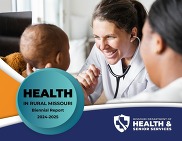
2024-2025 Bi-Annual Rural Health Report
The DHSS State Office of Rural Health recently published the 2024-2025 Bi-Annual Rural Health Report. The report communicates the status of rural health based upon data collected and analyzed by the department. One in three Missourians—over 2 million people—live in rural communities. These are our farmers, teachers, veterans and families. They are the backbone of our state.
The 2024–2025 Biennial Report reveals opportunity for improvement. The following are a few highlights:
-
47 rural counties—more than a third of Missouri—have no hospital.
-
6% of rural residents are uninsured, compared to 9.1% in urban areas.
-
19 of the 20 counties with the highest poverty rates are rural.
- Rural Missourians have higher death rates in 9 of the top 10 causes of death, including heart disease, cancer, stroke, and suicide.
-
Black/African American residents in rural counties have a preterm birth rate of 14.8%, compared to 10.5% for white residents.
-
Infant mortality in some rural counties exceeds 18 deaths per 1,000 live births, more than triple the Healthy People 2030 target.
These are not just numbers. They are lives. They are missed opportunities. The department encourages Missourians to view the report and consider how local, state and federal partnerships can improve the health of our rural neighbors.
A special thanks to our Bureau of Health Care Analysis and Data Dissemination, including Andrew Hunter and Chelsea Fife, for their leadership in producing the 2024–2025 Biennial Report.
|

Board of Health
The Board of Health and Senior Services met on Nov. 17, with the DHSS senior leadership team in attendance. Topics included in the agenda were the DHSS budget and future budget considerations, recent operational changes, the Rural Health Transformation Project application, and efforts to bolster the Missouri physician and healthcare workforce. The gubernatorially-appointed board is a source of valuable external perspectives on department operations, projects and priorities – offering incisive advice on critical and timely topics. DHSS is thankful for the recent appointment of Dr. Casey Burton (shown), who was in attendance.
|
Federal Alerts:
Infant Formula Recall Due to Botulism
The Centers for Disease Control and Prevention, the U.S. Food and Drug Administration, and at least ten states are investigating an outbreak of botulism linked to powdered infant formula produced by ByHeart.
HHS Announcement on Women's Health
On November 10, HHS announced action to remove broad "black box" warnings from hormone replacement products for menopause. A fact sheet outlines additional details and information on the plan.

Old McDonald Had a Farm
The department recently had an inquiry from a school about being able to have chickens and use the eggs in their nutritional program. The Division of Community and Public Health commented for the school to use the eggs they would need to contact the Missouri Department of Agriculture (MDA) and obtain a Missouri egg license for the school farm. DHSS regulations require that a food establishment obtain food products from an approved source. The license would make the school farm an approved source. After that the eggs must be properly cleaned and stored. That’s it!
|

Department Happenings
-
Spirit Web Application: On Nov. 17, Missouri WIC implemented a phased launch to transition 116 local agencies from MOWINS, an installed participant management information system (MIS) application, to the web-based SPIRIT Web application. Approximately 250 local agency staff spent the last month working in the SPIRIT Web test environment and are now utilizing the SPIRIT Web production environment. Over the next four months, all 800 staff from all local agencies will complete the transition to SPIRIT Web, with a deadline of February 28, 2026. The new MIS will improve system efficiency and modernize WIC’s MIS technology. Our hats off to the hard work of the WIC team.
-
New Smoke-Free Housing Directory Now Available in Missouri: DHSS, in partnership with the American Lung Association in Missouri, recently launched the Missouri Smoke-Free Housing Directory. The new online resource makes it easier for residents to find smoke-free housing options and celebrates property owners who provide healthy living environments. Tobacco use remains the leading cause of preventable death in Missouri. Missouri has one of the highest smoking rates in the nation, and over half of Missourians who smoke try to quit each year. Smoke-free housing protects residents from secondhand smoke and vape aerosol, reduces fire risk, and supports people in their efforts to quit. Property owners and managers are invited to list their smoke-free properties in the directory at no charge. DHSS also offers support for those interested in adopting or enhancing their smoke-free policies. Available resources include guidance on policy implementation, smoking cessation tools for residents, and free smoke-free signage to help promote healthier living spaces.
|
 |
Thanks for your continued partnership, and have a safe and healthy Thanksgiving!
|